Back in the late 1990s, a fire marshal in Florida named Bill Whitstine was training arson dogs. Dogs that could walk into the charred remains of a building and tell you exactly where a fire started, and whether someone had used gasoline to set it. He was good at it. He was the first person to ever attend the Maine State Police Canine Academy for accelerant detection, back in 1989.
Then the insurance companies came calling.
This was the era when “water losses” were quietly bankrupting insurers. State Farm and Allstate were getting hammered by claims, and somewhere in a conference room, Bill said the thing that started an entire industry: “Well, we could use a dog for that.”
A couple of scientists in the room told him flatly that it wouldn’t work.
So he went and proved them wrong.
That was over 30 years ago. Today, Bill runs Mold Dog, a subsidiary of his Florida Canine Academy, and he has trained mold-detection dogs working in 16 countries.
I find this stuff fascinating, so let’s talk about mold dogs.
What a mold dog actually does.
Here’s the problem mold dogs solve. Standard mold testing can tell you that you have mold. An ERMI dust test or an air sample comes back elevated, and now you know there’s a problem somewhere in the house. But where? Behind which wall? Under which floor? In the ducts?
That “where” is the expensive part of finding mold. Without it, you’re tearing open drywall on a hunch.
A dog walks in and points to the spot.
Dogs have up to 300 million scent receptors. Humans have about 5 million. That gap is so large it’s hard even to picture. They can detect odors at parts-per-trillion concentrations, which is roughly the equivalent of one drop in an Olympic-sized pool.
Here’s the part most people get wrong: the dog is not smelling mold spores or mycotoxins. It’s smelling MVOCs, microbial volatile organic compounds. These are the gases mold releases as it grows and metabolizes. Think of it as mold off-gassing. That musty, earthy, “something’s not right” basement smell? Those are MVOCs.
MVOCs travel. They move through wall cavities, ceiling spaces, vents, and materials. So even when the mold itself is sealed behind a finished wall, the dog can follow the invisible scent trail back toward the source.
And critically, a mold dog detects both viable and nonviable mold. Wet or dry, alive or dormant. That matters more than it sounds. If a house had a roof leak ten years ago, got a new roof, and dried out completely, the mold is still there and still a problem for sensitive people. A moisture meter won’t find it (nothing’s wet). Infrared won’t find it. But the dog still alerts.
What an inspection actually looks like.
It starts with a conversation, not a dog. The handler gets the history: symptoms, smells, past leaks, roof issues, plumbing problems, flooding, and any prior remediation.
Then comes a visual walk-through, partly to spot obvious problems and partly for safety. The handler is looking for things that could hurt the dog, like glue, mouse traps, or glass, before the dog ever comes in.
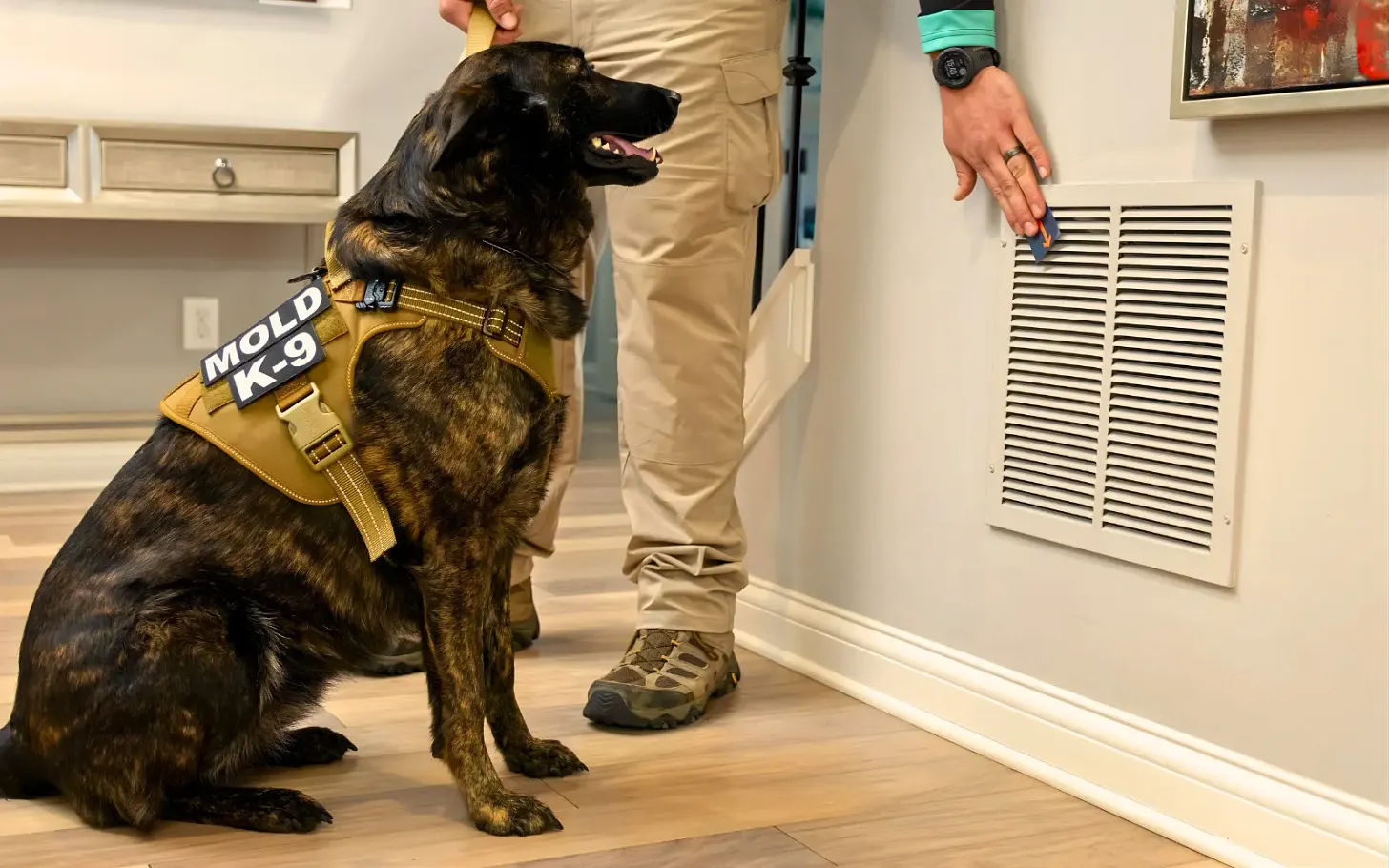
Then, handlers run a systematic search, on-leash, moving clockwise through each room the same way arson dogs are run. When the dog hits an MVOC source, it alerts by sitting, then pointing with its nose. Up at the ceiling, at the wall, at the floor, sometimes all three. Handlers will then put tape or some type of source indication where the dog alerted.
Once the dog is done (which is normally <30 min), an inspector will come in with moisture meters, thermal imaging, sometimes a borescope, and sometimes air or surface samples to send to a lab.
Mold dogs can be a crucial part of a holistic mold test. The dog finds the where. Then a certified inspector figures out what type and how to remediate it.
Where these dogs come from, and how they’re trained.
So what makes a good mold dog? This is the most interesting part.
Bill, the OG mold dog trainer, says he looks for the troublemakers. The dogs at the shelter that people surrendered because they’re “too much,” tearing things up, running away, and jumping on the walls with energy. Those are often the smartest dogs. They’re not bad. They’re bored. They need a job. Bill takes that orneriness and points it at something useful.
The only hard nos are the smoosh-nosed breeds (pugs, bulldogs) because the short snouts don’t work as well, and any dog that’s skittish or fearful. The test Bill uses: the dog has to be able to walk into a Home Depot and not flinch when the automatic doors whoosh open. Confident and curious, not afraid.
The training itself is no joke. Many of the articles I read say it takes anywhere from 800 to 1,000 hours for the dog to become an expert. The dog spends two to three months getting imprinted on the 16 genera of mold it needs to know, learning to recognize that category of MVOC odor and ignore everything else: food, people, pets, perfume, and cleaning products.
Then comes a piece people skip right past: the handler matters as much as the dog. After the dog is trained, the handler does a 40-hour course, and they’re trained as a team. You can’t just hand a trained dog to a new person. The handler has to understand airflow, humidity, building materials, and how to read that specific dog’s body language. A dog “milking” an alert for an extra treat looks different from a dog hitting a serious source, and only a handler who knows that dog can tell the difference.
And it doesn’t end at graduation. Most training programs require quarterly check-ins plus annual recertification. That ongoing calibration is one of the biggest things separating a legitimate mold dog from a gimmick.
So how many of these dogs even exist? What does a test cost?
Fewer than you’d think.
There’s no official national registry, and no clean number I can point you to. But the language across the industry points to less than ~500 in the United States. This is a small and very specialized niche.
If you want a mold dog inspection, you may have to wait and/or pay for travel. A typical inspection runs about $1,000 to $2,000, plus travel if the team isn’t local.
How accurate are they, really?
The honest answer is: very good, not perfect.
Certified mold dogs generally test in the 90 to 97 percent accuracy range. Bill keeps performance data on his own dogs and puts them in the 90s. The Nose Patrol, a Bay Area team, holds its dogs to a minimum of 90% accuracy, with real performance often higher.
A few honest caveats that Bill mentioned in a recent podcast:
- Misses are usually the handler’s fault, not the dog’s. Pulling the dog away from an area too fast, skipping a wall because the family dog’s bed is there. That’s human error, and it’s the main reason for the quarterly retraining.
- The treat problem is real but manageable. Research on food-reward vs. play-reward dogs found that play-reward dogs would “lie” slightly more for a toy, but within the margin of error. Good training catches the dog that fakes an alert for a snack.
- No tool is the whole answer. The dog narrows the search. ERMI, air samples, a good inspector, and a remediator do the rest.
A question on my mind, and probably yours too. But isn’t this bad for the dog?
Short version: the dogs are sniffing tiny amounts for tiny windows of time, and they’re monitored more closely than most of us monitor ourselves.
The longer version is reassuring. When a dog sniffs, it’s not the same as a human breathing it in. The dog pulls scent in and blows it back out. And the exposure is genuinely minimal: the dog is typically in a house for only 20 to 30 minutes, sniffing parts-per-trillion amounts. If a home is visibly covered in black, green, or blue mold, most inspectors won’t even bring the dog inside. Some inspectors point out that a dog tracking a rabbit through the woods is inhaling far more environmental mold from wet leaves and soil than it ever encounters on a job.
In addition, many of these dogs get blood work and chest X-rays twice a year, more often than most humans! When Bill was asked this question, he mentioned that across 30 years and many dogs (mold, arson, termite, bed bug), he reports no elevated health problems and normal lifespans. One of his dogs, a Jack Russell named Ozzie, lived to 17. A Lab-Rottweiler mix named Mindy made it to 14. Both right in line with normal life expectancy for their size.
The real animal harm issue in mold isn’t the working dog that visits for 20 minutes. It’s the family pet living 24/7 in a sick house nobody’s tested yet.
The mold dog industry is fascinating and can be incredibly valuable as part of a mold inspection.
Have you heard of mold dogs before today? Let me know your thoughts. I reply to every message.
Hunter
We built a bunch of FREE resources for you!
- Take our home health quiz (~5 min)
- View a recent home assessment report
- Try out our indication guide to lead pipes
- See your radon risk with our Minnesota radon map
- Calculate what the best air purifier is for your home from our database
- Schedule a free 15 minute chat with our founder about any questions you have