In 2001, Melinda Ballard started noticing something was off in her family’s historic ranch in Dripping Springs, Texas. Small things at first. Her husband, Ron, developed memory problems and balance issues so severe that he had to stop driving. Her young son began having nosebleeds and severe respiratory issues. Melinda herself developed what she described as cognitive fog so thick she struggled to function.
They went to the doctors. Got diagnoses. Nothing explained the full picture.
What eventually turned up was a slow roof leak that had gone unaddressed for too long. Behind their walls, Stachybotrys chartarum (what most people call “black mold”) had taken over. The remediation cost more than $600,000. The lawsuit that followed became one of the most high-profile toxic mold cases in U.S. history.
Now, most mold stories don’t end in federal lawsuits. But a lot of them do end with people feeling health impacts and costly home remediations.
Mold sits in a weird category. Everyone vaguely knows it’s bad. Almost nobody knows if they actually have it, what it does to the body, or the best way to test.
What is mold, exactly?
Mold is a fungus. There are over 100,000 known species, though only about 1,000 are commonly found in the U.S. Outdoors. Mold plays a totally useful role: it breaks down dead trees, fallen leaves, and organic matter. It’s part of the decomposition machine that makes the planet function.
Indoors, that same appetite for organic matter becomes a problem. Mold will eat through wood, paper, drywall, carpet, insulation, and ceiling tiles. It doesn’t just sit there; it actively digests whatever it’s growing on.
So how does it start? It needs a few different things.
Moisture. Humidity above 50%, a slow leak, and condensation on a cold wall. Any sustained moisture source works.
Food. Mold eats organic material. Wood, drywall, paper, carpet, insulation. Essentially, anything carbon-based in your home qualifies.
Temperature. Mold grows comfortably in the same temperature range humans prefer (roughly 40–90°F).
Oxygen. Mold finds it even in tiny enclosed spaces. A sealed wall cavity isn’t safe from it.
Darkness. Mold prefers dark conditions, which is why basements, wall cavities, and the space behind cabinets are prime real estate.
Spores. Already present everywhere, indoors and out. You can’t eliminate them. You can only control whether the other conditions exist for them to grow.
The key thing to understand: mold needs moisture to survive. Without it, spores might float around indefinitely, but can’t colonize. Every mold problem is, at its core, a moisture problem.
Mold in homes.
24 to 48 hours is all it takes for mold to begin growing after a water intrusion
50% of buildings in the U.S. have some degree of water damage
85% of office buildings have experienced past water damage
50% prevalence of mold and dampness found across 12,842 homes in one large study
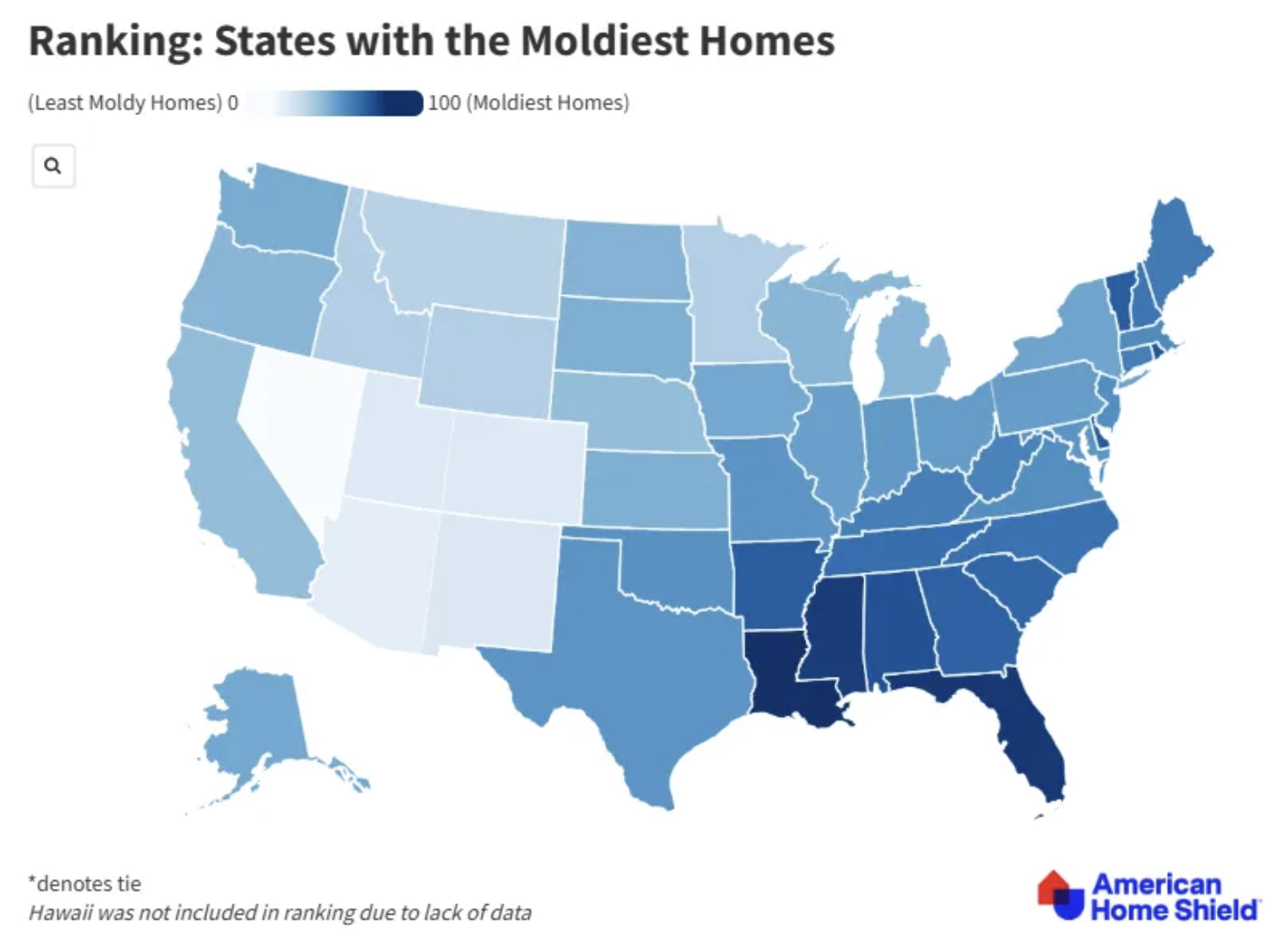
The truth is that mold is very prevalent in homes across our country.
For those of us in Minnesota, add in freeze-thaw cycles, ice dams, condensation from cold walls meeting warm indoor air, and the humidity dynamics of sealed homes in winter. The conditions here are genuinely favorable for mold growth.
The health picture.
This is where it gets complicated, and I want to be precise with you about what the science actually says versus what’s established versus what’s still emerging.
The clearest and most settled science centers on allergenic and respiratory effects. Mold produces allergens, irritants, and in some cases, mycotoxins (more on those below). The WHO has linked indoor dampness and mold to roughly 21% of U.S. asthma cases. The Mayo Clinic published research suggesting that 96% of chronic sinus infections may be attributable to mold overexposure.
Common symptoms from mold exposure include:
- Sneezing, runny nose, red eyes
- Skin rashes
- Asthma attacks or worsening asthma
- Coughing and shortness of breath
- Headaches and dizziness
Beyond the respiratory picture, there’s a more controversial (but increasingly researched) body of literature around mold’s neurological and systemic effects. Dr. Ritchie Shoemaker’s work on Chronic Inflammatory Response Syndrome (CIRS) has suggested that roughly 24% of the population has a genetic susceptibility (HLA-DR gene variants) that makes them unable to effectively clear mycotoxins from the body. For these people, even relatively low-level mold exposure can trigger a cascade of symptoms: fatigue, brain fog, joint pain, temperature dysregulation, and more.
The mycotoxin distinction matters.
Mold and mycotoxins are not the same thing. Mold is the organism. Mycotoxins are chemical compounds that some molds produce under certain conditions (usually stress, competition with other organisms, or specific humidity ranges). Not all molds produce mycotoxins. And a home can have low visible mold but meaningful dust-borne mycotoxin exposure. This distinction matters because a home can have mold growth without significant mycotoxin concern, but it can also have low visible mold while still carrying meaningful exposure through accumulated dust.
For the nerds. Types of mold worth knowing.
There are dozens of species you might encounter in a home assessment. Here are the ones that come up most often and matter most for health:
Stachybotrys chartarum. The infamous “black mold.” Thrives on constantly wet materials like drywall and wood. Produces mycotoxins (trichothecenes) associated with flu-like symptoms, severe respiratory damage, and neurological effects. Requires sustained moisture to grow.
Chaetomium. Commonly found in water-damaged homes, particularly in drywall, wallpaper, baseboards, and carpets. Often found alongside Stachybotrys in serious water damage situations.
Aspergillus. A large family (almost 200 species). At least 16 cause illness in humans, including lung infections and asthma exacerbation. One of the more ubiquitous molds encountered in assessments.
Penicillium. Some species are genuinely useful (antibiotics, cheese). Others are allergenic and grow aggressively in water-damaged homes.
Cladosporium. Very common, grows in both warm and cold conditions. Often found on window sills, bathroom surfaces, and HVAC systems. Associated with respiratory and inflammatory reactions.
How mold spreads.
This is important to understand because it shapes both how mold hides and how testing works.
Mold spreads by releasing spores, microscopic reproductive cells that travel through the air. Spores range from 2 to 10 micrometers in size. They’re invisible to the naked eye and naturally present in both indoor and outdoor air at all times.
Some molds release spores easily, and those spores settle and resettle with every disturbance (moving through a room, running the HVAC, opening a door). Other molds have stickier spores that cling to surfaces and only dislodge through direct contact.
Here’s the part that matters practically: spores can remain viable for years after they’re produced. And the allergens associated with spores can remain allergenic even after the spore itself is dead. This is why mold remediation isn’t just about killing the mold. It requires physically removing the material it colonized.
Where mold most commonly grows out of sight:
- Inside wall cavities (especially around plumbing, windows, and exterior walls)
- Under the flooring and behind the cabinets
- Attics (ice dam leaks, poor ventilation)
- Crawl spaces
- Inside HVAC ductwork
By the time mold becomes visible, the underlying issue is typically well established. Visible growth is the last indicator, not the first.
How to actually test for mold.
This is where I want to slow down, because most people get this wrong. Either by over-trusting a test that gives them a false negative, or by getting a positive result, panicking, and not knowing what to do next.
To be clear, even after lots of research, I am still learning about the optimal testing protocol as there is a TON of confusion and misinformation in the industry.
The key thing to understand upfront: different tests answer different questions. There is no single test that tells you everything. Here are the main options and what each one actually does.
Air sampling.
A pump pulls a measured volume of air through a cassette and captures what’s actively aerosolized at that moment. It’s the most common method inspectors use, and it has real applications. Room-by-room sampling can help triangulate where concentrations are highest. It’s also the standard for post-remediation clearance testing (after work is done, you want to confirm airborne counts have returned to background levels before reoccupying the space).
The structural flaw: mold aerosolization is heavily driven by disturbance. Foot traffic, HVAC cycling, humidity swings, and even opening a door can change the result dramatically. Two samples taken in the same room an hour apart can look completely different. A positive result is meaningful. A negative result is not a clean bill of health. There’s also a species identification problem. Spore trap results are examiner-dependent and cannot distinguish between closely related species under a microscope. Aspergillus and Penicillium are often reported together as “A/P” because they’re visually indistinguishable at the spore level. That matters because some Aspergillus species are potent mycotoxin producers and others are relatively benign, and a generic “A/P count” tells you nothing about which you’re dealing with.
Surface (swab) testing.
Useful when you have visible growth and want to know specifically what species you’re looking at. Doesn’t tell you how widespread the issue is or whether spores are circulating through the home. Good for a targeted question; not useful as a screening tool.
ERMI / MSQPCR dust testing.
This is the method I find most credible for initial whole-home screening. ERMI (Environmental Relative Moldiness Index), designed by EPA scientists, is a built on MSQPCR technology, a DNA-based testing method that analyzes settled dust for mold. Because settled dust accumulates over weeks and months, you’re getting a historical record of what mold has been present and amplifying in the space, not just a snapshot of one moment.
The species-level precision is a meaningful advantage over air sampling. MSQPCR identifies mold to species by DNA. That clinical specificity matters when you’re trying to understand health risk, not just whether mold exists.
The ecological ratio, the ERMI score is built on, is also genuinely useful in theory: a high ratio of water-damage species (Group 1) to common indoor species (Group 2) suggests the mold community in the home has shifted toward a water-damage profile. But the composite score itself has a known flaw, it subtracts Group 2 from Group 1, which means a home with high levels of everyday molds can receive an artificially low score even if concerning species are present. My view: ignore the summary score and look at the raw species data.
The limitations worth knowing: old DNA from a previously remediated problem can persist in settled dust and inflate results. ERMI works best in carpeted homes or spaces with upholstered furniture where dust accumulates. Hard surface floors with frequent cleaning produce less representative samples. And a high ERMI result tells you there’s a problem, it doesn’t tell you where it is.
Manual inspection.
If you already know or strongly suspect a problem (visible growth, musty odor, known water event), a manual inspection is the gold standard. A proper one means physically crawling through the home, checking hidden areas, and combining a thorough visual survey with tools like moisture meters, thermal cameras, and borescopes to identify moisture sources and hidden growth that none of the tests above will locate on their own.
The most defensible protocol combines methods: ERMI for the whole-home historical picture, targeted air sampling in areas flagged by moisture readings or thermal imaging, and cavity sampling (drilling a small hole into a suspect wall cavity and pulling an air sample directly from it) when concealed water damage is suspected. Each tool fills in what the others miss.
It is also INCREDIBLY important to also run an outdoor baseline sample, this lets you distinguish internal mold amplification from ambient outdoor spores that enter any home naturally.
Moisture control: the only real solution.
Everything else is downstream of this. You can test, remediate, and filter all you want. But if the moisture source isn’t fixed, the mold comes back. Always.
The key moisture sources to address:
Plumbing leaks. Even slow drips inside walls create ideal conditions
Bathroom and kitchen ventilation. Exhaust fans should vent to the exterior, not into the attic space
Indoor humidity. Keep it below 50% year-round; below 45% is better. In a Minnesota winter, the challenge is actually keeping it high enough to prevent static while preventing condensation on cold surfaces
Basement and crawlspace intrusion. Water infiltration through foundation walls or floor is a major source in older homes
HVAC maintenance. The air handler and ductwork are mold-friendly environments when damp. Coils, drain pans, and ductwork need regular attention
The bottom line.
Mold is one of the most prevalent and most underdiagnosed indoor environmental problems. It hides. It grows where you aren’t looking. And a meaningful percentage of people (those with the relevant HLA-DR susceptibility) react to it severely, even at levels that wouldn’t bother most people in the same space.
The only way to know is to test.
Wishing you a mold-free home,
Hunter
We built a bunch of FREE resources for you!
- Take our home health quiz (~5 min)
- View a recent home assessment report
- Try out our indication guide to lead pipes
- See your radon risk with our Minnesota radon map
- Calculate what the best air purifier is for your home from our database
- Schedule a free 15 minute chat with our founder about any questions you have