In 1902, a 25-year-old engineer named Willis Carrier was hired to solve a printing problem in Brooklyn. The Sackett-Wilhelms lithography plant couldn’t keep ink registered on paper. The pages kept swelling and shrinking depending on the day, ruining color print runs.
The problem wasn’t the heat. It was the humidity.
Carrier’s fix (a system of chilled coils that pulled moisture out of the air) became the prototype for what we now call air conditioning. The cooling was a side effect. Humidity control was the original feature.
Not only is humidity control important for printing, but I think it is one of the most under-measured variables in home health. Let’s talk about it.
What is humidity, anyway?
Water shows up in three forms: liquid, solid, and gas. The gas form is called water vapor, and humidity is just the measure of how much water vapor is hanging out in the air around you.
There are two ways to put a number on it.
Absolute humidity is the actual amount of water vapor in a given volume of air (grams per cubic meter). It doesn’t care about temperature. It just counts molecules.
Relative humidity (RH) is the percentage of moisture in the air compared to the maximum that air can hold at its current temperature. This is the number you see on weather apps. It’s what we’ll talk about for the rest of this post.
The “relative” part matters a lot. Warm air can hold way more water than cold air. So when 32°F outdoor air at 70% RH leaks into your 70°F living room and warms up, that same amount of water reads as roughly 15% RH inside. This is why northern winter homes are deserts.
There’s one more concept that ties everything together: dew point. The dew point is the temperature the air would have to cool to before water vapor starts condensing into liquid (rain outside, water on a window inside). Higher dew point means more actual moisture in the air. Unlike RH, dew point is an absolute measure: it doesn’t change when you heat or cool the air, only when you add or remove water.
These concepts matter a lot when trying to understand mold growth (more on this in a bit).
Why should I care?
Indoor humidity has a sweet spot. Between 30% and 50%.
This isn’t only a comfort thing. Humidity touches your health and home structurally.
When the air is too dry, it can cause skin irritation, chapped lips, and dry eyes. It can also dry out the mucous membranes in the nose and throat, which may make people more susceptible to colds, respiratory infections, and allergies. Low humidity can also worsen asthma and bronchitis symptoms by increasing airway irritation. This lack of moisture impacts the home environment by causing wooden furniture, floors, and musical instruments to crack or warp. Low humidity can also lead to paint chipping and static electricity buildup.
When it’s too humid, you can’t cool down. Sweating doesn’t cool you down on its own, as the air is already saturated with water, so sweat just sits there. High humidity also encourages the growth of mold, mildew, and dust mites, which can trigger allergies, asthma, and respiratory issues. Prolonged high humidity can cause wooden furniture, flooring, and doors to rot. It also damages paint, wallpaper, and insulation.
For the nerds.
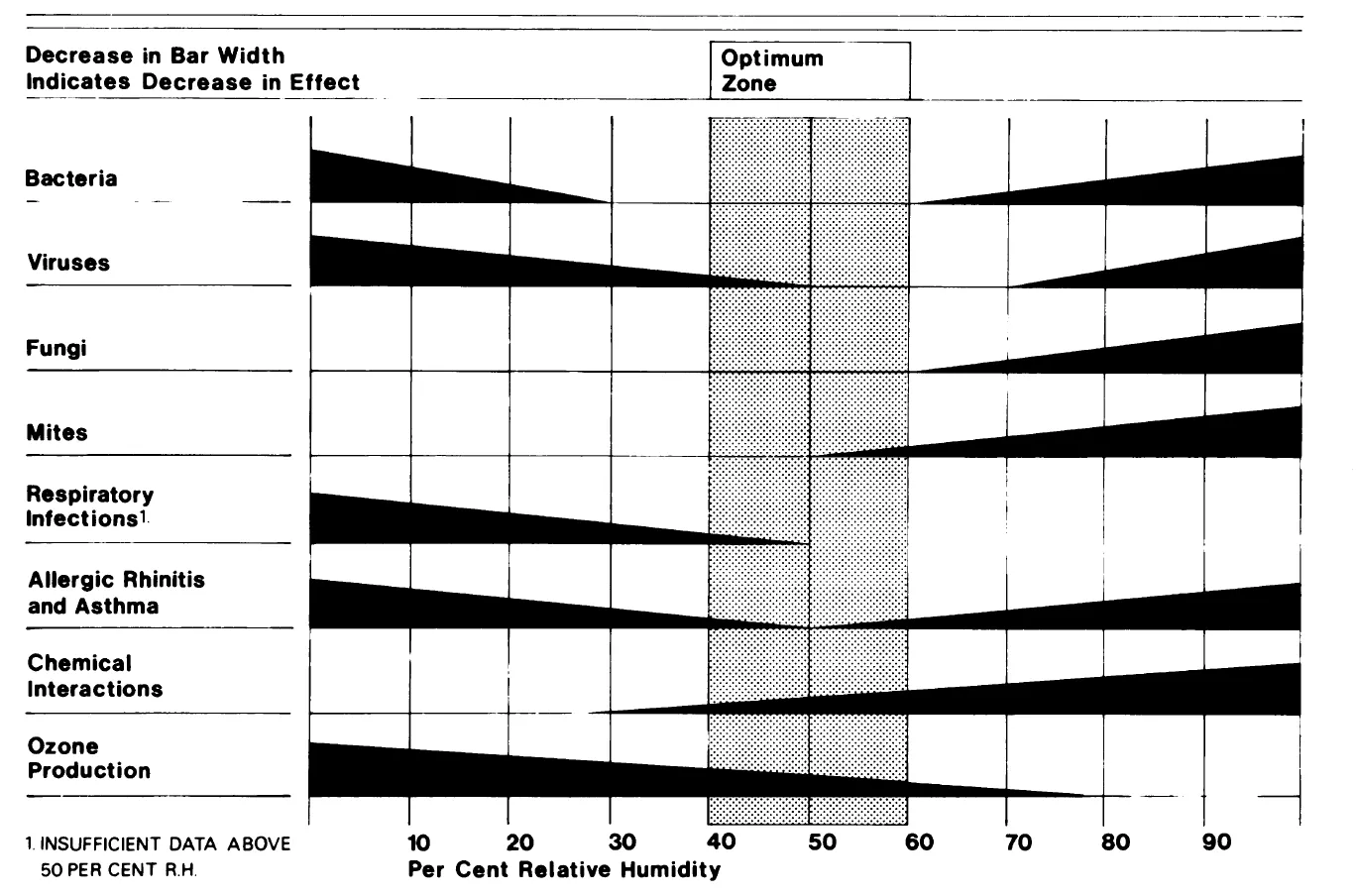
The Scofield-Sterling humidity chart (1985) is the foundational diagram in this field. It overlays the operating ranges of bacteria, viruses, fungi, dust mites, respiratory infections, allergic rhinitis, asthma, and chemical interactions. When you stack all of them, the clear intersection (where every line stays minimal) is roughly 40% to 60% RH. Closer to 40% is better for mold risk while still protecting your airway.
What’s happening in most homes.
In winter, heated indoor air gets very dry. Cold outside air holds very little moisture, and when that air comes inside and warms up, the relative humidity drops even more significantly. For example, a Minnesota house in February can easily run 15% to 25% RH without supplemental humidification.
In summer, the problem flips. Humid outside air plus AC systems that don’t dehumidify aggressively enough push indoor RH above 55% or 60% in bathrooms, basements, and poorly ventilated bedrooms. That’s mold and mite territory.
Shoulder seasons (spring and fall) are actually closest to ideal in most climates. One heuristic: if you like how your home feels in April and October, that is probably because the humidity is where it should be.
The mold problem.
I think mold might be the single biggest reason humidity matters. Above 60% RH (and especially above 70%), things start growing. But “things start growing” undersells what’s actually happening, so let’s get into it.
Mold needs three things to grow: spores, food, and water. Spores are everywhere. They drift in through every door and window, ride in on clothing, settle in dust. You will never eliminate them. Naturally, food is also everywhere in a home: drywall paper, wood, fabric, and even the thin film of dust that coats every surface in a house. Mold eats all of it.
That leaves water as the only ingredient you actually control. Cut off the water, and the spores stay dormant.
Water activity, not room humidity.
You’ll remember dew point from earlier. If not, quick refresher: dew point is the temperature at which air becomes saturated and water vapor starts condensing into liquid. It’s an absolute measure of moisture, so it doesn’t move when you heat or cool the air. Only when you add or remove water to the air (showering, humidifier, etc.)
Indoor dew point determines what surfaces will get wet. If the air in your house has a dew point of 50°F, every surface cooler than 50°F will sweat. The single-pane window on a 5°F night. The cold water pipe behind the sink. The interior face of an exterior wall in February. This is the water activity that breeds mold.
The dew point calculator at dpcalc.org is the easiest way to see this in action. It was built by the Image Permanence Institute for libraries and archives. You plug in temperature and RH, and it returns the dew point, plus a mold risk rating.
A few values for a 70°F room:
- 30% RH → 37°F dew point
- 40% RH → 44°F dew point
- 50% RH → 51°F dew point
- 60% RH → 56°F dew point
Time is the other variable.
Germination isn’t instant. Most indoor molds need around 24 to 48 hours of elevated surface moisture to break dormancy. This is why a hot shower doesn’t grow mold on the wall (the surface dries fast), but bathroom corners do (they stay damp for days). A one-night humidity spike is rarely a problem. A basement that hovers at 65% for three weeks absolutely is.
A cool mold-risk chart is worth owning.
Adam Stetten, a building science consultant in Raleigh, took the DPCalc data and turned it into a single-page Temp x RH chart that maps mold risk zones.
The core insight: mold risk isn’t a single number. It’s a gradient that shifts with both temperature and humidity at once. Per Stetten’s analysis, the risk zone begins at 65% RH when it’s 80°F, but doesn’t kick in until 72% RH at 60°F. Warm + wet grows mold fast. Cool + wet buys you time, but not forever.
Other things that thrive in humid air.
- Dust mites reproduce aggressively above 50% RH. They don’t drink water. They absorb moisture directly through their cuticle, so humid air is what keeps them alive.
- Off-gassing chemicals (formaldehyde from particleboard, certain VOCs from paints) release faster at higher humidity and temperature, which is one reason kitchens and bathrooms tend to be the worst rooms in the house for VOC peaks.
- Building materials (wood, drywall, paint) can warp or trap moisture, which then becomes a substrate for everything above.
So how do I measure and control it?
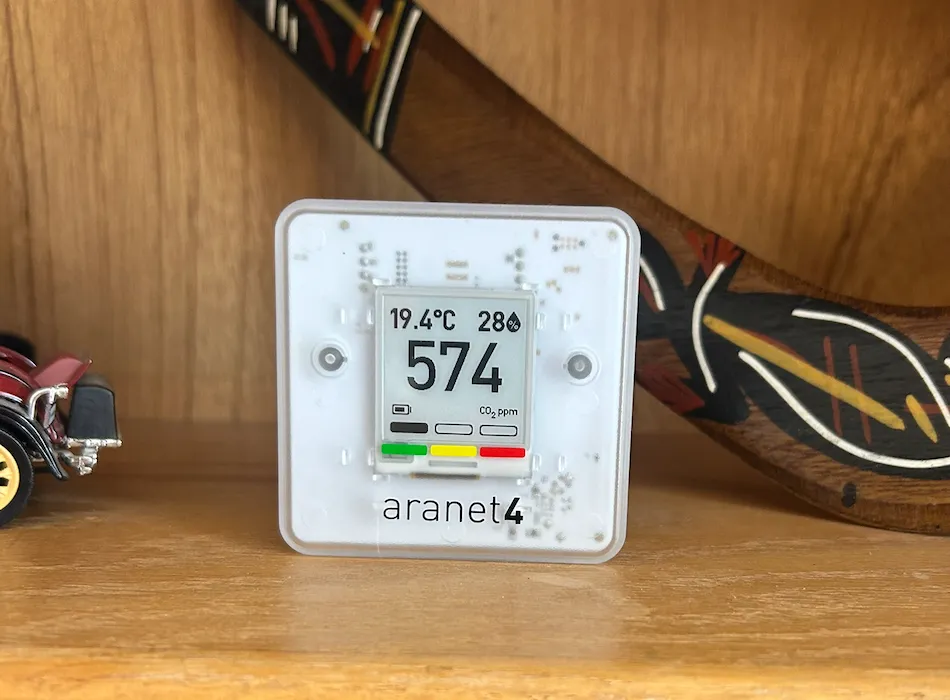
You can measure humidity with a hygrometer. A decent digital hygrometer costs around $15. Many smart thermostats have them integrated! It is worth having one to keep an eye on the change throughout the seasons. I’d even place a few throughout the home (bedroom, main living area, and in the basement). This will help you get a sense for how each room handles humidity and can see the full day-night cycle.
Humidifiers and dehumidifiers.
Once you start tracking RH, you’ll find one of two problems. Either your house is too dry (almost always winter, heating-driven) or too wet (almost always summer, basement-driven). The good news is that there is equipment to fix either side.
Humidifiers. I am cautious.
The best option here is a single quality portable humidifier in the bedroom. You spend a third of your life there, dry air actually wakes you up, and a portable lets you target one room without raising RH for the whole house. Make sure you measure the humidity changes in that room, consistently clean the humidifier, and use RO or distilled water in it. Please, no essential oils or fragrances added.
I would stay away from a whole-home humidifier on the furnace. I think they cause more problems than the benefits they provide. They can raise RH in the wrong places and can become biological reservoirs for mold growth in the ducts.
Dehumidifiers. Simpler, harder to mess up.
Dehumidifiers are great. They pull water out of the air and dump it. The risk profile is lower than humidifiers because you’re removing moisture, not adding it. The problem is that if you don’t have a way to drain the dehumidifier, then you are emptying a bucket consistently.
Sometimes the answer is just better air movement.
Bathroom and kitchen exhaust fans, run long enough, fix most short-term humidity spikes. An HRV or ERV can balance moisture for the whole house in either direction, depending on the season. Ventilation gets skipped in the humidifier-vs-dehumidifier debate, but it’s often the cleanest fix for spike-driven humidity problems.
This has been fun to dive into, learning more and more!
Wishing you a happy 40%…
Hunter
We built a bunch of FREE resources for you!
- Take our home health quiz (~5 min)
- View a recent home assessment report
- Try out our indication guide to lead pipes
- See your radon risk with our Minnesota radon map
- Calculate what the best air purifier is for your home from our database
- Schedule a free 15 minute chat with our founder about any questions you have