
Two light factors are location-dependent that most people never think about: natural light access and light pollution at night.
Natural light during the day is critical for circadian rhythm, mood, energy, and sleep quality. I’ve written a lot about this. But whether your home actually gets good daylight depends heavily on which direction it faces, how far neighboring structures are, and how much tree canopy is overhead. A north-facing home surrounded by tall buildings or dense trees is going to get dramatically less natural light than a south-facing home on an open lot.
A tool I love for this: Suncalc.org. You can plug in any address and see the sun’s trajectory throughout the day and across seasons. It’ll quickly show you whether a property gets good morning sun in the main living spaces (ideal) or sits in shadow most of the day.
Light pollution at night is the flip side. Streetlights, commercial signs, and headlights from nearby roads can disrupt melatonin production and sleep quality if they’re bleeding into your bedroom. Lightpollutionmap.info lets you check the sky brightness for any area. Darker skies at night = better sleep conditions.
*****
Noise.
*****
The ground your house sits on matters, and not just structurally.
Superfund sites. The EPA has a map of active and historical superfund sites (contaminated land designated for cleanup). You do not want to be within a half mile of one of these. Contaminated soil can leach into groundwater, and remediation often takes decades. EPA.gov/superfund will show you what’s in your area. This applies to old industrial properties and brownfields too, not just EPA-designated sites.Flood zones.
Flood zones are underappreciated health risks. The obvious concern is structural damage. But flooding also means mold, which is one of the most serious indoor air quality threats there is. FEMA’s flood map (msc.fema.gov) is worth checking before any purchase near water.
Radon zones. The geology under your home is a driver of radon risk. The EPA’s radon zone map gives you a rough idea by county, but it’s only a starting point. Zone 1 (high potential) covers most of Minnesota and Wisconsin. However, if you’re buying anywhere, you need to test. It is very house-specific. More here.
*****
EMFs.
There’s a phrase every real estate agent lives by: “location, location, location.”
And they’re right. Location is probably the single biggest factor in a home purchase. But when they say it, they mean school districts, proximity to work, and whether the neighborhood holds its value.
Those things matter. But I’ve been thinking about location very differently lately.
When I hear it, I think of cell towers. Natural light. Noise decibels. Green space. Superfund sites.
The location where we decide to live has enormous consequences on our long-term health and wellness. Most people never frame it that way. Let’s explore it.
*****
Why your location matters more than you think.
Think of it this way…you’re a fish, and your home is your fishbowl. Most fish don’t think about the quality of the water they’re swimming in. But the water determines everything. You can eat well, sleep well, exercise, do all the right things, and still be slowly affected by the environment you’re suspended in 24 hours a day. The difference is that you can actually do something about your water.
One interesting thread from Blue Zone research (the regions of the world where people routinely live past 100) is that these communities tend to be less densely populated and more isolated from major pollution sources. Places like Ikaria, Greece and Nicoya, Costa Rica. People attribute longevity there to diet and community. That’s probably true. But fewer cars, less industrial pollution, quieter nights, and more access to nature almost certainly play a role too. We just don’t talk about it as much.Location is a foundational health decision. Most people never frame it that way.
*****
Air.
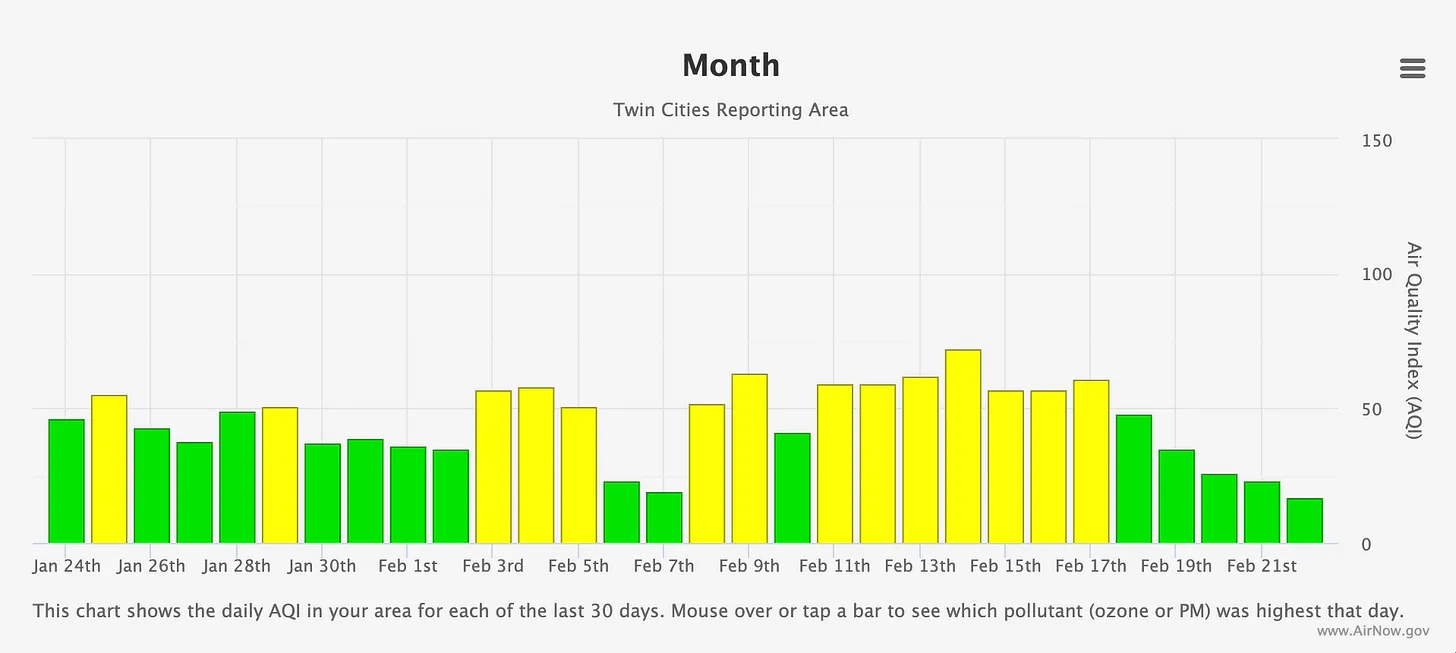
Outdoor air quality is the most direct way your location affects what you breathe inside. And the sources of bad outdoor air are more varied than most people realize.
The big ones to know:
- Airports and major highways. Living within a mile or two of a busy airport or highway means consistent exposure to ultrafine particulate matter, nitrogen dioxide, and jet-fuel exhaust. Studies have linked proximity to airports with higher rates of cardiovascular disease and respiratory illness. The EPA’s AQI doesn’t always capture hyperlocal conditions around these sources, so proximity alone matters.
- Industrial facilities and agricultural land. Factories, refineries, and non-organic farms can push pesticides, herbicides, VOCs, and particulates into surrounding neighborhoods. Worth knowing what’s upwind of you. (And I mean literally upwind. Prevailing winds matter.)
- Wildfire smoke. This one is increasingly relevant for the whole country, not just the West Coast. Minneapolis has had some rough air quality days in recent years due to Canadian wildfires. PM2.5 from wildfire smoke is particularly nasty because the particles are fine enough to penetrate deep into lung tissue.
- Elevation. This one surprised me. Higher elevation generally means cleaner air since pollutants and smog settle in valleys and lower areas. Cities at elevation that see a lot of traffic, though, can have their own problems since combustion engines run less efficiently at altitude and emit more hydrocarbon pollution.
- Your neighbors. This one gets overlooked. A neighbor who smokes on their porch, burns brush regularly, or runs a fireplace every winter night is a real and immediate air quality factor. Wood smoke contains fine particulates and carcinogenic compounds.The tool I’d start with: Airnow.gov. You can check historical air quality data for any zip code and get a sense of how many unhealthy AQI days an area sees per year.
*****
Water.

Whether you’re on municipal water or a private well, your location has a massive impact on what comes out of your tap.
Municipal water quality varies a lot by city. It starts with the source. Municipal water comes from either surface water (lakes, rivers, reservoirs) or groundwater (aquifers). Where your city pulls its water from matters because different sources carry different contaminants. Surface water tends to pick up agricultural runoff, industrial discharge, and increasingly, PFAS “forever chemicals” from surrounding land use. Groundwater can have naturally occurring arsenic, nitrates, and radon, depending on the geology of the region.
Then comes treatment. Utilities use chlorine and chloramine to disinfect, which kills pathogens. But those disinfectants react with organic matter to form disinfection byproducts (DBPs), a class of compounds with growing links to cancer and other health issues with long-term exposure.
Then it travels to your house. Older cities (Minneapolis included) still have lead service lines running to homes that can corrode and leach into the water supply.
Well water is its own world. If you’re buying rural property, you’re responsible for testing your own water. Agricultural runoff (nitrates, pesticides) is a real concern in farming regions. So is naturally occurring arsenic, which shows up in certain geological formations across Minnesota and Wisconsin more than people realize.
Two resources I keep coming back to: EWG.org/tapwater lets you see your utility’s water quality report in a digestible format and flags what’s above health guidelines (not just legal limits, which is an important distinction).
*****
Soil & Ground.

*****
The ground your house sits on matters, and not just structurally.
Superfund sites. The EPA has a map of active and historical superfund sites (contaminated land designated for cleanup). You do not want to be within a half mile of one of these. Contaminated soil can leach into groundwater, and remediation often takes decades. EPA.gov/superfund will show you what’s in your area. This applies to old industrial properties and brownfields too, not just EPA-designated sites.Flood zones.
Flood zones are underappreciated health risks. The obvious concern is structural damage. But flooding also means mold, which is one of the most serious indoor air quality threats there is. FEMA’s flood map (msc.fema.gov) is worth checking before any purchase near water.
Radon zones. The geology under your home is a driver of radon risk. The EPA’s radon zone map gives you a rough idea by county, but it’s only a starting point. Zone 1 (high potential) covers most of Minnesota and Wisconsin. However, if you’re buying anywhere, you need to test. It is very house-specific. More here.
*****
EMFs.
Your body is 45-75% water, and water conducts electricity. Your nervous system works by sending electrical signals from your brain to the rest of your body. External electromagnetic fields can interfere with your body’s own electrical systems.
EMFs aren’t one thing. There are magnetic fields (from power lines and wiring), electric fields (also from wiring), and radiofrequency radiation (RF, from cell towers, Wi-Fi, Bluetooth, 5G). The location-relevant ones are primarily RF from cell towers and antennas, and magnetic fields from high-voltage power lines.
*When wireless technology started proliferating, no long-term safety studies were conducted on what it meant to live and work near concentrated sources of it. We’re kind of in the middle of that experiment right now. I’d rather not be a prime subject.
One concept worth knowing: EMF saturation. In densely built urban environments, so many devices, cell towers, antennas, routers, and office buildings are pumping out fields that the ground itself can become saturated with electricity. The ground normally helps dissipate these fields, but there’s a point where it can’t keep up. Dense urban cores, high-rise districts, and areas with heavy antenna clusters are more susceptible to this.
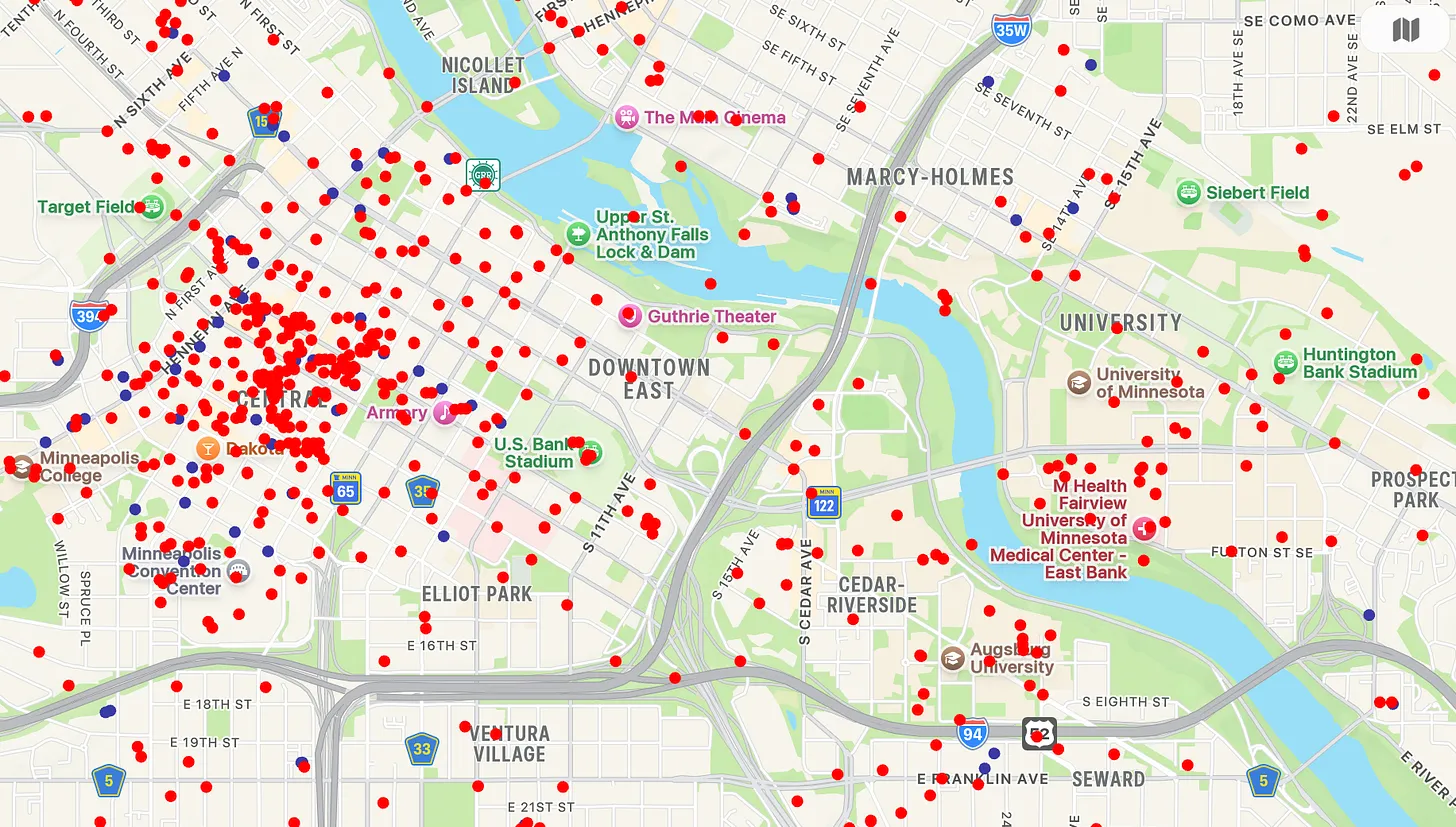
Practically, the tool I’d use before buying anywhere is AntennaSearch.com. Plug in any address, and it’ll show you the number, proximity, and type of cell towers and antennas registered nearby. More than 500 feet from major tower clusters is a reasonable preference. So don’t need to be that far for signals to drop off significantly. Fewer antennas in close proximity = better.
You don’t have to move to the woods. Just be aware of what is around.
*****
Light.
Two light factors are location-dependent that most people never think about: natural light access and light pollution at night.
Natural light during the day is critical for circadian rhythm, mood, energy, and sleep quality. I’ve written a lot about this. But whether your home actually gets good daylight depends heavily on which direction it faces, how far neighboring structures are, and how much tree canopy is overhead. A north-facing home surrounded by tall buildings or dense trees is going to get dramatically less natural light than a south-facing home on an open lot.
A tool I love for this: Suncalc.org. You can plug in any address and see the sun’s trajectory throughout the day and across seasons. It’ll quickly show you whether a property gets good morning sun in the main living spaces (ideal) or sits in shadow most of the day.
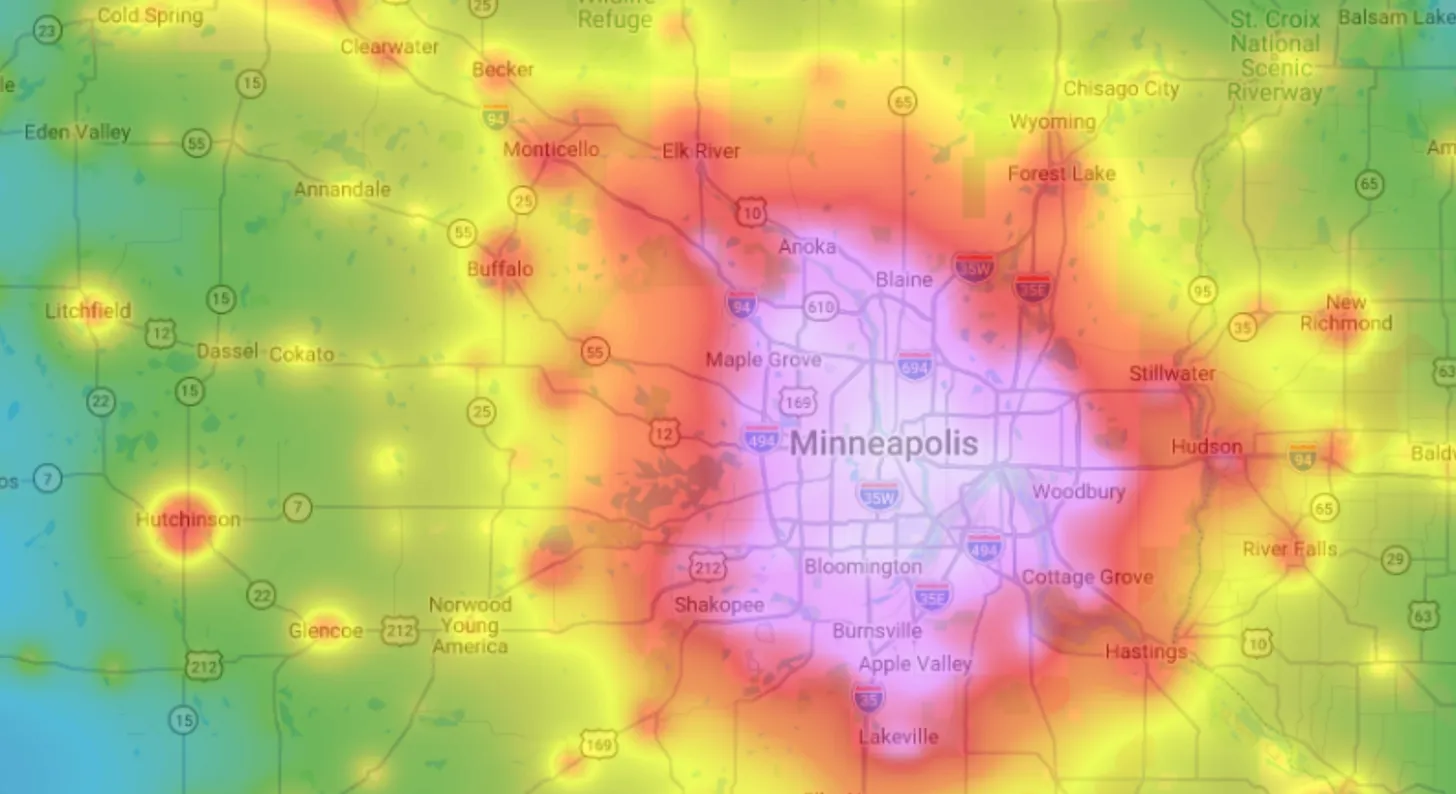
Light pollution at night is the flip side. Streetlights, commercial signs, and headlights from nearby roads can disrupt melatonin production and sleep quality if they’re bleeding into your bedroom. Lightpollutionmap.info lets you check the sky brightness for any area. Darker skies at night = better sleep conditions.
*****
Noise.
Noise is a form of pollution. Chronic noise exposure, even at levels that feel tolerable, keeps your body in a low-grade stress state. Your nervous system doesn’t fully power down. You get shallower sleep, elevated cortisol, and higher blood pressure over time.
The main sources to be aware of:
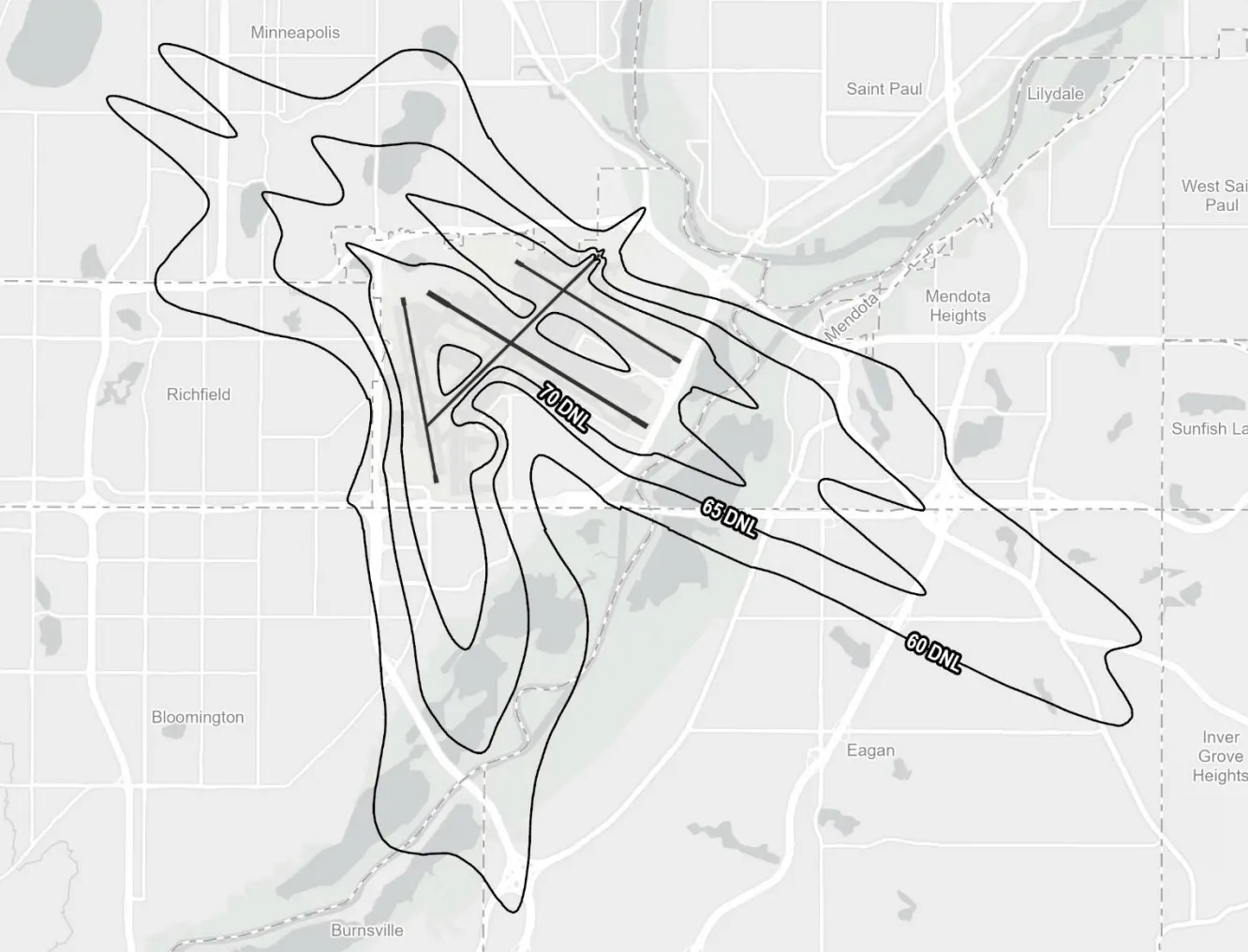
- Airports. Being in a flight path is different from being near a highway. Jet noise is intermittent and loud, which may actually be worse for sleep disruption than constant noise. Above is the map of the MSP airport. Ideal to be outside the 60 DNL range.
- Highways. Constant road noise keeps background stress elevated. Even habituated sleepers show elevated cortisol responses to traffic noise in studies.
- Trains. Don’t underestimate this one. Train schedules and horn requirements vary widely by municipality.
- Industrial/commercial neighbors. Worth knowing your zoning and what’s permitted around you. Truck deliveries, HVAC units, and industrial equipment can be surprisingly loud.
The target: outdoor daytime noise below 55 dB(A) and nighttime below 40 dB(A) (WHO recommendations). Noise-map.com lets you check traffic, airport, and train noise levels for most US cities.
Take an evening visit to any property you’re serious about. Walk the block. Sit outside for 20 minutes. You’ll learn a lot.
*****
Nature.
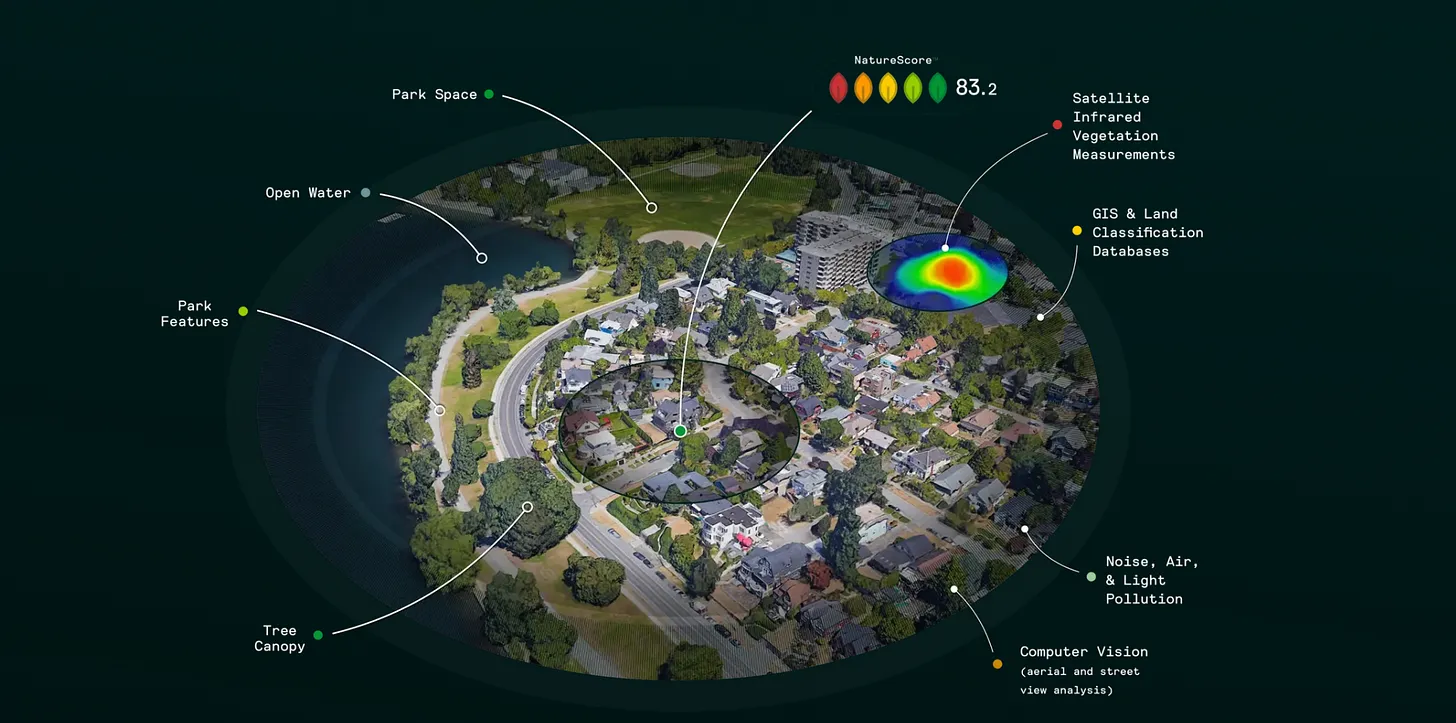
This might be the most underrated one on the list. Access to nature, green space, trails, and water has been linked to meaningfully better physical and mental health outcomes. The research here is solid and growing.
Studies consistently show that people with access to parks and green spaces have lower rates of depression, anxiety, and stress-related illness. There’s even research suggesting that proximity to forests and blue space (lakes, rivers) specifically boosts immune function.
Practically, I look at:
- Walkscore.com for overall walkability and daily errands on foot
- Naturequant.com/naturescore for quantified access to parks, trails, and nature
- Whether you can easily get to a lake, river, or large park on foot or by bike
*****
Social & Community.
Social connection is one of the strongest predictors of longevity. Isolation is genuinely bad for your health at a physiological level. So proximity to community matters.
Beyond that, practical access to things like a quality grocery store (whole foods options, fresh produce) means you’re more likely to actually eat well. Walkable access to restaurants, coffee shops, and social spaces creates the conditions for an active social life without having to plan around it. Good schools signal community investment.
What to consider:
- Proximity to quality food options (not just any grocery store)
- Walkable or bikeable access to social spaces
- Sense of neighborhood cohesion and safety
- Quality of schools, even if you don’t have kids (signals community health)
*****
What if you’re already in your home?
Most people reading this probably aren’t on the verge of a move. You’re already somewhere. So what do you do with all of this?Good question. The best thing you can do is to control and improve the factors you can.
Here’s how I think about it:
- Test what you can test. Radon test.
- Make improvements inside your home. Air purifier. Water filters. More windows.
Location. Location. Location.
Hunter


