
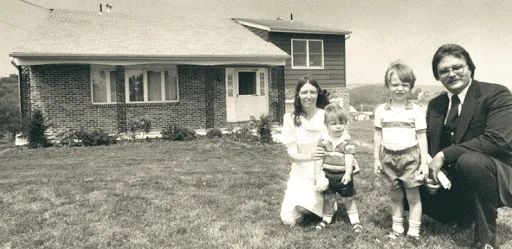
Stanley Watras and his family moved to Boyerstown, Pennsylvania, in January of 1984, where he began working as a construction engineer, helping to build the soon-to-be operable Limerick Nuclear Power Plant. A few weeks before the plant began its energy production, they installed radiation detectors at the exterior doors. Employees would walk through them at the end of their shift, ensuring that they were not tracking radioactive material outside.
However, each morning as Stanley arrived, he set off the radiation detectors while entering the building. After a few days, Stanley continued to set off the detectors until it was discovered that the reason why was radon in his home. Measurements revealed radon levels over 2,700 pCi/L, nearly 700x the EPA’s recommended action level.
Radon was not a new problem. Earlier studies had shown that it could cause lung cancer in uranium miners, but until Watras’ experience, it wasn’t addressed as a public health threat.
Today, radon is the second leading cause of lung cancer in the United States, responsible for approximately 21,000 deaths annually.1
*****
What is Radon? Why is it dangerous?
Radon is a naturally occurring chemical element and radioactive gas that is odorless, colorless, tasteless, and completely imperceptible to humans. It forms as part of the natural decay chain of uranium, which is present in varying amounts in rocks and soil throughout the world.
Quick science lesson.
In nature, radioactive elements undergo a series of transformations called a radioactive decay chain, where each unstable element decays until the chain ends with a stable element. Radon is a part of the radioactive decay chain of uranium-238. Through a series of radioactive transformations, uranium decays through several intermediate elements (protactinium, thorium, and radium) before producing radon-222. This particular isotope of radon has a half-life of just 3.8 days, making it highly unstable and continuously emitting alpha particles as it decays further into polonium, bismuth, lead (known as radon progeny or daughters), and eventually stable elements.

The danger of radon lies not in the gas itself, but in what happens when it decays inside your lungs. When you breathe in radon, it continues its radioactive decay process in your respiratory system. The decay products (primarily daughters polonium-218 and polonium-214) are solid particles that can stick to the lining of the lungs. These isotopes emit alpha radiation, which is particularly damaging to biological tissue at close range.
This radiation damages DNA, and over years of exposure, can lead to mutations that cause lung cancer. The risk is cumulative: the longer and more intense the exposure, the greater the likelihood of developing cancer. This is key.

*****
So what levels are safe?
There is no known safe level of radon. Even low levels of radon can pose a risk.
However, this is just part of the equation. There are a few numbers to consider.
Radon is measured in picocuries per liter (pCi/L).
- 0.4 pCi/L is the naturally occurring outdoor average concentration
- 1.3 pCi/L is the average inside U.S homes
- 4.0 pCi/L is the EPA’s action level
Now, the action level, 4.0 pCi/L, is the threshold at which the EPA “strongly recommends installing a mitigation system to reduce indoor radon levels”. The EPA also mentions “considering mitigation for levels between 2.0 and 4.0 pCi/L."
It is kind of a non-answer. And regulatory bodies across the globe don’t all have the same numbers…
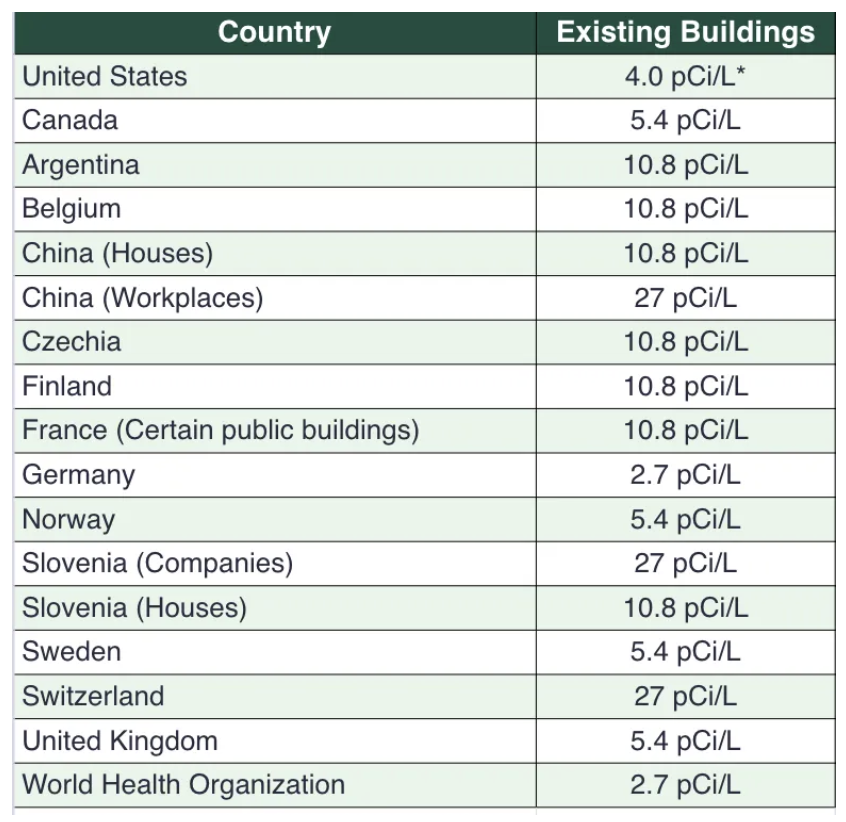
Yeah. It’s complicated. I will note that the World Health Organization (WHO) has an action level much lower than the EPA at 2.7 pCi/L.
Now, the EPA has done extensive risk modeling on radon exposure levels over a lifetime. If you are a non-smoker and exposed to that action level of 4.0 pCi/L over a lifetime (a cumulative risk assessment based on 75 years of exposure to that specific concentration), 7/1,000 people could get lung cancer.
Still not incredibly helpful, but one very noticeable thing is that smoking + radon exposure seems to have an exponentially negative impact.

*****
How common is this? Does it matter why you live?
For decades, the EPA estimated that approximately 1 in 15 American homes (6-7%) had elevated radon levels at or above the 4.0 pCi/L action level.2 However, a recent analysis done using advanced modeling and extensive testing data found that nearly 25% of the U.S. population, over 83 million people, may be living in homes with radon levels at or above 4.0 pCi/L3.
I believe this is a significant upward revision that suggests radon exposure is not an isolated problem but a widespread public health issue affecting one in four Americans.
The geographic distribution of radon risk is highly variable. The EPA has published a radon zone map that divides the United States into three zones based on predicted average indoor radon levels:
- Zone 1 (red): Counties with predicted average indoor radon levels >4 pCi/L
- Zone 2 (orange): Counties with predicted average levels between 2-4 pCi/L
- Zone 3 (yellow): Counties with predicted average levels <2 pCi/L
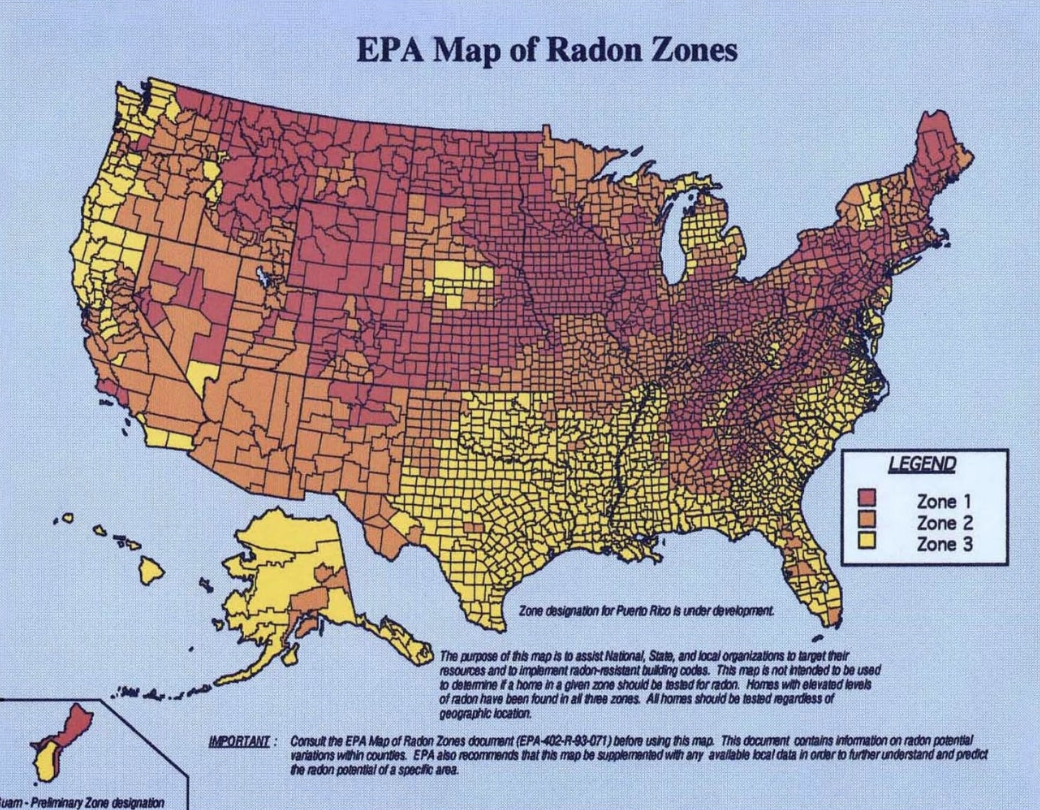
Now, this is still somewhat misleading, because no house is created equal...I am a certified radon measurement specialist in Minnesota and have measured levels in homes next to each other with a difference of 4.3 pCi/L. The only way to know your exposure level is to test your home.
*****
So how does this stuff get into our homes?
Radon gas moves through the ground and enters homes through any opening that connects the living space to the soil. Common pathways are sump basins, cracks in concrete floors and walls, gaps around service pipes, construction joints, or crawl spaces.
This process is driven by pressure differences between the inside of a home and the soil beneath it, called the ‘stack effect’, as homes naturally create a slight vacuum at their lowest levels due to several factors:
- Warm air rises and exits through upper floors, creating lower pressure at ground level
- HVAC systems, exhaust fans, and fireplaces draw air from the home
- Wind passing over the house creates pressure differentials

This pressure difference acts like a vacuum, actively pulling radon-laden air from the soil into the home through any available opening. The stronger the pressure difference, the more radon is drawn in.
Once inside, radon accumulates because homes are designed to be relatively airtight for energy efficiency. Radon levels typically fluctuate daily and seasonally, reaching higher concentrations during winter when homes are sealed tight, and heating systems increase the stack effect.
*****
So if testing is the key, how do I do it?
Fortunately, radon testing is straightforward, inexpensive, and you can do it yourself.
The keys are that you find a quality test from a reputable lab; most county health departments will have them available online. You want to test in the lowest livable level of your home (basement if you have one). Tests range in time, but most are at least 48 hours, and placement + following the “closed building requirements” are important.
I like how the Minnesota Health Department explains testing guidelines.
If your test is elevated, then installing a radon mitigation system is recommended.
*****
What is a radon mitigation system, and how does it work?
The most common and reliable method is called sub-slab depressurization, also known as active soil depressurization.

This system works by reversing the pressure difference that draws radon into the home. A mitigation contractor drills a small hole through the basement floor or slab and inserts a PVC pipe that extends up through the house and vents above the roofline. A specialized radon fan, installed in the attic or outside the home, creates suction on this pipe, drawing air from beneath the foundation and exhausting it safely above the house where it quickly disperses.
By creating negative pressure beneath the slab rather than within the living space, the system prevents radon from entering the home in the first place. Instead of being drawn upward into basements and living areas, radon-laden soil gas is intercepted and vented harmlessly outside. When properly installed, these systems can reduce radon levels by 90% or more, often bringing concentrations well below the EPA action level.
*****
My view on radon is to try to get the lowest levels possible, which means investing in an active radon mitigation system.
We installed one in our home (~$2-5k cost + ~$100 in yearly energy cost), which lowered our levels to 1.7 pCi/L in the basement and 0.7 pCi/L above our crawl space.
There was exploratory research done on radon mitigation systems and their ability to lower moisture sub-slab in the basement, which ultimately resulted in reductions in moisture levels in the basement, which can have positive impacts on the indoor air quality (EPA).
*****
1https://www.epa.gov/radon/health-risk-radon
2https://www.lung.org/media/press-releases/2025-radon-release-pa
3https://hsph.harvard.edu/news/millions-in-u-s-exposed-to-dangerous-radon-study-finds


