
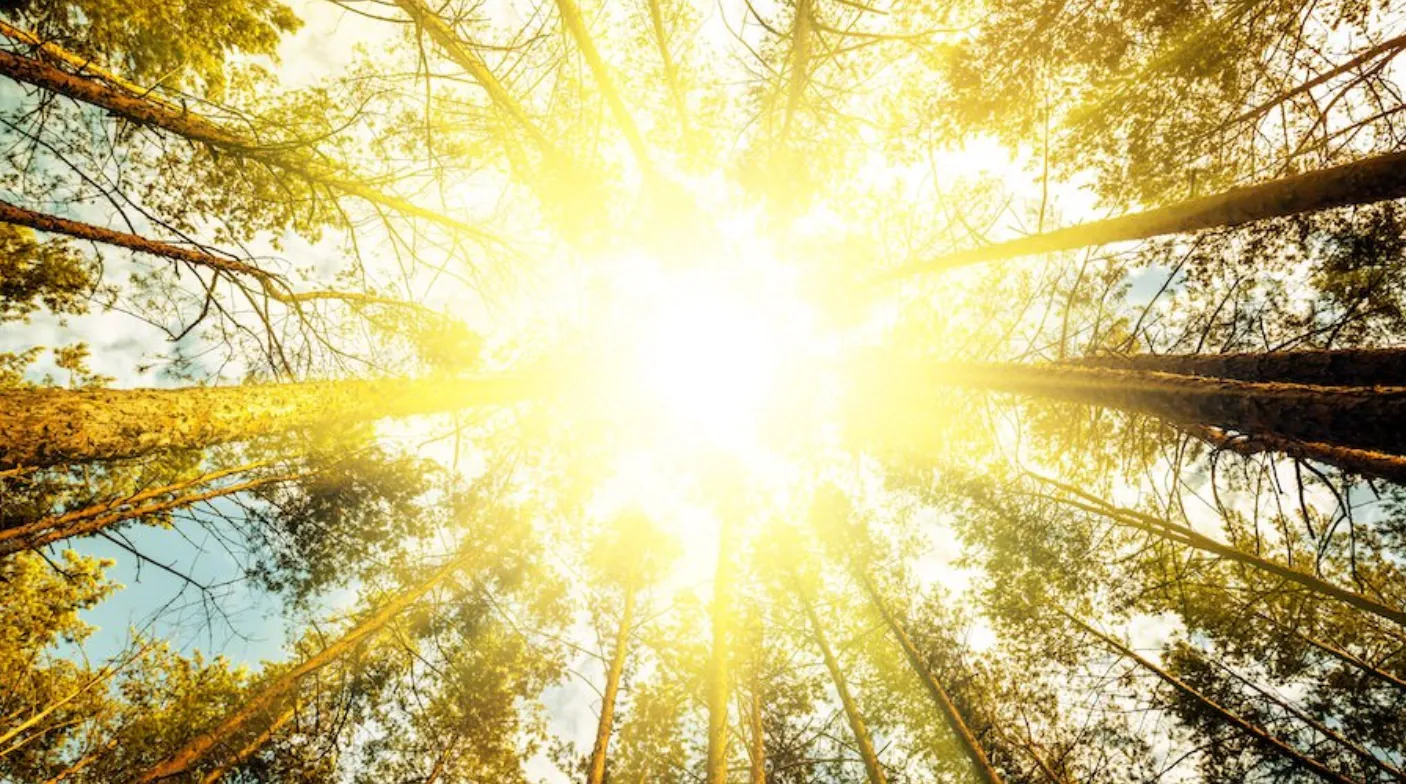
What you will notice…
☀️ Midday: Broad, relatively flat spectrum across the full visible range with strong blue and green content.
🌅 Evening / Sunset: The sun’s extreme low angle forces light through 30× more atmosphere. Rayleigh scattering aggressively strips the short wavelengths, leaving the spectrum heavily skewed toward orange and red. Blue light is effectively depleted.
🌕 Midnight: Three components stacked: reflected sunlight from the moon (cooler than direct sun), integrated starlight, and discrete atmospheric airglow emission lines, which create the spikes you see. This creates some blue and green, but predominantly skewed red.
It’s important to note that natural light is full-spectrum, meaning all different visible wavelengths of light are present.
*****
The Problem.
Look at that chart for a second.
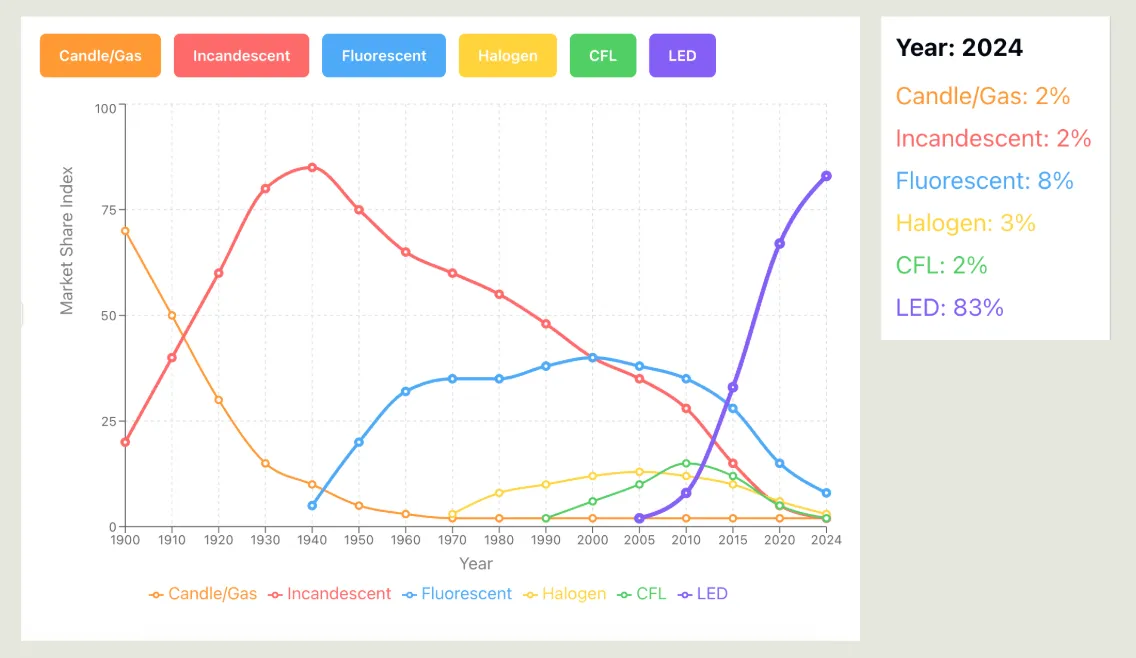
In 1900, nearly 70% of home lighting came from candles and gas. Warm, dim, amber light. By 1940, incandescent had taken over, with similar characteristics to candlelight and bulbs that run warm.
Then came fluorescent. And now, LED dominates the market at 83%.
Why? Energy efficiency. LEDs are energy efficient, long-lasting, and cheap. Same with fluorescent, specifically used in commercial applications (factories, hospitals, and schools) because of the form factor for these types of buildings.
Not to mention, with the rise of technology usage (phones, computers, and TVs) that are all LEDs, our lives are run by LEDs.
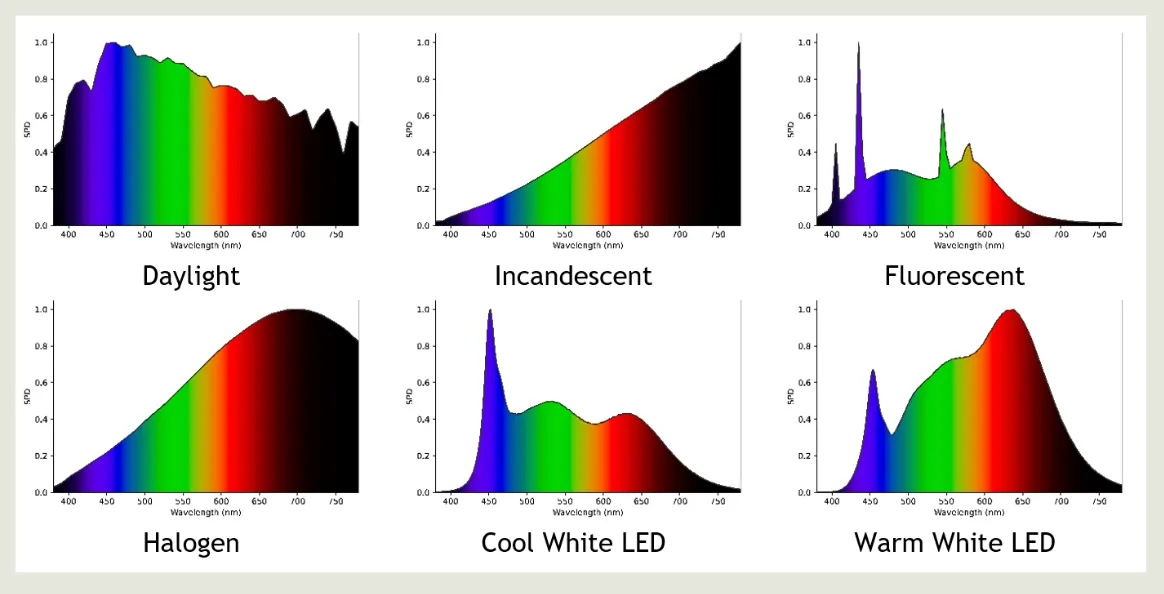
Back to the SPD graphs. These are the charts for the common lighting in homes today.
What do you notice?
LEDs have a massive blue-light spike & fluorescent (arguably worse) have a bunch of spikes and a half-spectrum.
So our homes are filled with LEDs and offices/schools with fluorescents that do not match our natural light spectrum. We’ve replaced a full, balanced spectrum with something our biology has never seen before, and we’re living under it all day, every day.
The goal is simple: match your light environment to what your body actually expects throughout the day. Bright and blue-rich in the morning and afternoon. Warm and dim as the sun goes down.
Most homes are accidentally backwards.
*****
Morning. Give me the blue light.
The most important light exposure of your day happens in the first 30-60 minutes after you wake up.
Morning light, specifically bright, blue-rich natural light, triggers a cortisol pulse that anchors your entire circadian rhythm for the day. This is the functional kind of cortisol. It wakes up your brain, sets your internal clock, begins daily body processes, and determines when melatonin will kick in 12-16 hours later.
The problem is that most of us spend our mornings inside. About half the year in Minnesota!
Indoor lighting typically delivers somewhere between 50 and 500 lux. Outside on a cloudy day, you’re getting 10,000 lux minimum. Full sun is 100,000 lux.

What I do in the morning:
- I try to get outside within the first hour of waking. 15 minutes does the trick. Even overcast days deliver substantially more light than indoors, and standing in front of a window is alright too (but less beneficial than outside due to how window panes are manufactured). Never look directly at the sun.
- I use a SAD lamp at my desk in my office. 10,000 lux, positioned about 18 inches away, turns on when I sit down. It doesn’t replace outdoor light, but it meaningfully closes the gap, especially in a Minnesota winter where the sun doesn’t always cooperate. I LOVE this for the winter. I keep it running most days until 3 pm (a nice light to improve Zoom picture quality too!
*****
Afternoon: Mood boost.
By midday, your body wants strong, cool light to sustain alertness and keep the daytime side of your circadian cycle running.
Cooler, blue-rich light during working hours supports focus and energy. Studies on workplace lighting show meaningful improvements in alertness and performance under bright, higher color temperature light during the day.
Around 2-3 pm, most people hit a natural dip. This is biological, not a caffeine problem. Your core body temperature dips slightly in the early afternoon as part of your normal circadian pattern. Bright light in this window can extend useful alertness without the side effects of another cup of coffee.
An afternoon walk is the perfect opportunity to get a natural mood and productivity boost!
*****
Evening. Keep it warm.
Two things matter in the evening: the color of your light and where it’s coming from.
Color temperature first. Warm, low-blue light in the evening is the goal. Think 2700K or below. The warmer the better. This is why incandescent bulbs are so good for evenings, they sit right around 2700K naturally, with almost no blue content.
Position matters just as much. Overhead lighting is stimulating by nature. Light coming from above mimics the sun. Your ipRGCs are positioned in the lower part of your retina, meaning they’re most sensitive to light coming from above and in front of you, exactly where overhead fixtures sit. Lamps positioned at eye level or below are far less stimulating to the circadian system. Same bulb, same color temperature, meaningfully different biological signal depending on where it sits in the room.
After sunset, overhead lights off. Lamps only.

What we did in the kitchen and living room:
- Every bulb was swapped to incandescent. Around 2700K, minimal blue, no flicker.
- We just have zero-flicker LED strips under the cabinets for precision work.
- Dimmer switches where possible. Brightness matters as much as color temperature.
Bathroom (the tricky one):
- You need bright light in the morning. But a blast of cool white overhead at 10 PM undoes everything you’ve been building toward all evening.
- We installed tunable circadian LEDs with adjustable color temperature. Cool and bright in the morning, warm amber by evening, automatically.
Screens:
- Blue light blocking glasses after about 8 PM, and Night Shift (flux) enabled on my phone and laptop.
*****
The numbers worth knowing when buying Lightbulbs.
When shopping for bulbs, here’s what to look for:
- Color temperature: Lower Kelvin = warmer = less blue. 2700K or below for evenings and bedrooms. 4000-5000K for daytime workspaces. I personally like warm light all day.
- Lux: Intense for morning circadian entrainment. SAD lamps deliver 10,000 lux at the specified distance.
- Flicker: Target below 1%. Look for “flicker-free” on the box of LEDs. Most incandescents don’t have any.
- CRI: Aim above 90. Low CRI makes colors look washed out and makes your eyes work harder.
****
Why did the lightbulb fail its exam?Because it wasn't very bright!
Talk soon,
Hunter


