
We spend one-third of our lives sleeping.
Sleep is a massive part of our health and wellness.
Dr. Matt Walker, probably the world’s leading sleep researcher, sums it up well…
“There is not one process in the human body (that we’re aware of) that isn’t improved by sleep.”
The data backs it up, too.
People who consistently sleep fewer than 7 hours per night face a 6–15% increased risk of death from all causes. Sleeping 5 hours or less raises all-cause mortality risk by roughly 15%. The associations with heart disease, diabetes, obesity, depression, and dementia are well-documented across dozens of large-scale studies.
In the short term, a single bad night of sleep can have its own challenges, including irritability, increased hunger, brain fog, poor reaction time, and weakened immune function.
Yeah, I have felt that a lot with a new pup in the house hahaha…
*****
Quick note on what I think goes into great sleep.
There are four dimensions to sleep.
- Quality: minimal awakenings
- Quantity: 7.5 to 9 hours per night
- Regularity: consistent bedtime and wake time
- Timing: sleep when your body is tired
Everything I’m about to walk you through is in service of these four pillars.
*****
Alright, so you just said one-third of our lives is spent in our bedroom.
So designing a bedroom environment that supports quality sleep is one of the highest-leverage investments you can make for your health.
The mental model I use: your bedroom should be a cave - dark, quiet, cool, clean.

*****
Light.
Your body starts producing melatonin, the hormone that signals sleep, as darkness falls.The process happens in your eyes. Specialized cells in the retina called intrinsically photosensitive retinal ganglion cells (ipRGCs) detect light, particularly blue light (~480nm wavelength), and send signals via the retinohypothalamic tract to the suprachiasmatic nucleus (SCN) in the hypothalamus. The SCN is your master biological clock, coordinating your circadian rhythm with the external world.

When light hits these cells, the SCN suppresses the pineal gland.
When darkness falls, that suppression lifts and the pineal gland begins producing melatonin.
This is many people talk about the importance of avoiding blue light at night. Blue light (LEDs, TVs, phones, computers, tablets), before bedtime, disrupts great sleep.
Studies support this.

A 2015 Harvard study demonstrated that reading from light-emitting eBooks (iPads) for four hours before bed significantly reduces evening melatonin levels by 50% compared to reading printed books. This exposure not only delayed the body’s internal circadian clock by an average of 1.5 hours but also increased the time it took for participants to fall asleep. Consequently, those using digital screens experienced reduced REM sleep and reported feeling significantly more groggy and less alert the following morning.
What I’ve done in my bedroom.
- No TV in the bedroom.
- Blackout blinds on every window. No light pollution from streetlights or neighbors’ porch lights. Total darkness is the goal.
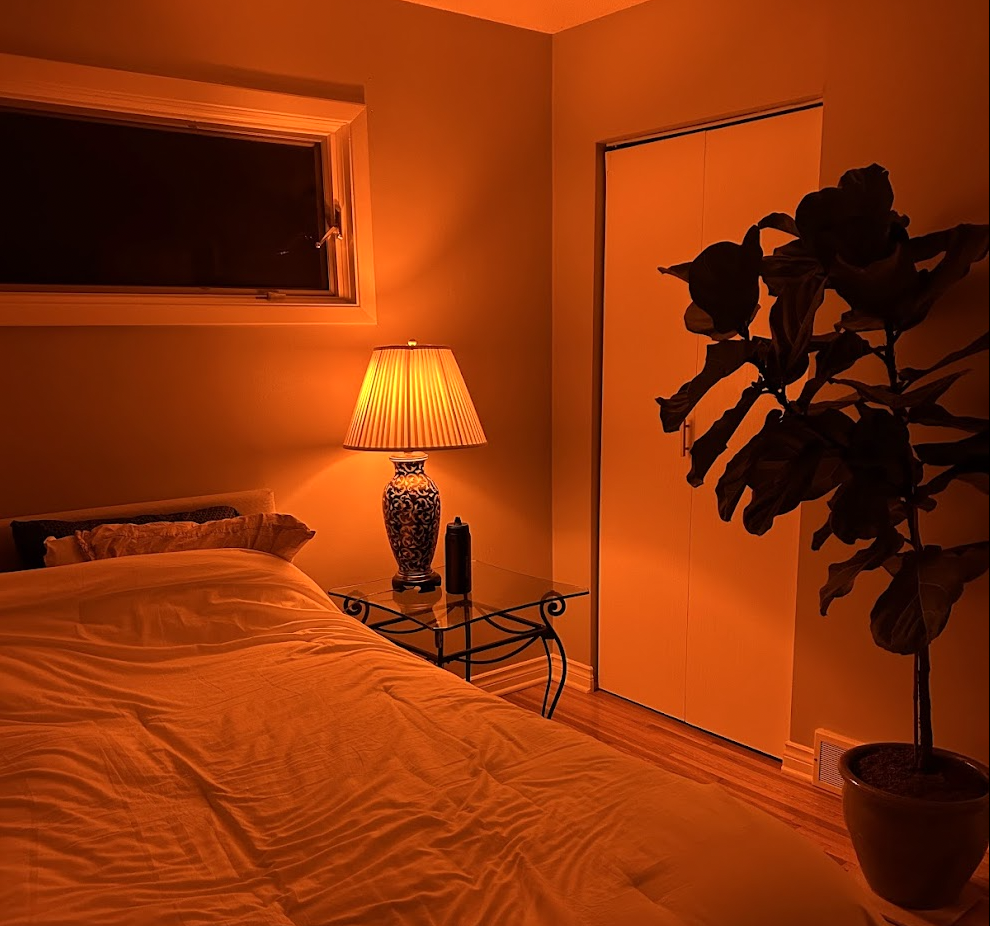
- Swapped every bedroom bulb to incandescent. Warm amber spectrum, very minimal blue light. Circadian LEDs (red lights) are good, I just prefer incandescents.
- Removed overhead lights, opted for lamps. We are in our bedrooms near sunrise and sundown, and our goal is to mimic the natural sun with our artificial lights as much as possible (why bright light is important in the morning, blue light is bad at night). Light direction is another important aspect; light comes from our sides rather than overhead (gonna explore all of this in another post).
For the nerds, this is the spectral power distribution graph of an incandescent…beautiful golden hue and rich reds!

*****
Temperature.
Your body needs to drop its core temperature by 2-3°F to initiate sleep. If your bedroom is too warm, achieving this drop is harder, and sleep onset is delayed or disrupted. The research says the sweet spot for bedroom temperature is around 65-67°F. This is why eight-sleep and other brands with bed cooling technology are so popular.
What I’ve done in my bedroom.
- We don’t have a cooling bed, so we use our smart thermostat to automatically drop to 67°F at bedtime and return to 69°F in the morning.
*****
Air quality.
Quality ventilation and airflow in the bedroom improve sleep.Indoor air quality is shaped by two main factors: what our homes are made of and what we do inside them. We want to minimize PM, VOCs, and CO2 accumulation.
I have written about CO2 before…and how accumulation occurs in the bedroom where we are exhaling while we sleep.
A 2015 study from Denmark’s Technical University tracked students sleeping in their dorm rooms under two conditions: windows open (average CO2: 660 ppm) versus windows closed (average CO2: 2,585 ppm). The researchers used actigraph monitors to objectively measure sleep quality and tested cognitive performance the next day.
The results. When bedroom CO2 stayed low, students showed significantly better objectively measured sleep quality, reported feeling more refreshed in the morning, experienced less next-day sleepiness, had better ability to concentrate, and performed better on logical thinking tests.
What I’ve done in my bedroom.
- Purchase an air purifier. Run it constantly at a higher mode, not auto. HEPA + Carbon filters recommended. I like the Austin Air Healthmate and Coway Airmega. (I am building a directory for finding the perfect air purifier currently. Message me if you want to chat about air purifiers!)
- Open windows throughout the day and run the overhead fan. Increases fresh air flow.
- Absolutely no candles, essential oil diffusers, or air fresheners in the bedroom.
- Vacuum bedroom (esp. if carpet), twice a week. Get rid of that dust that accumulates on the fan, under the bed, and on furniture.

*****
Chemical exposure.
We don’t want to introduce any chemicals into our bedroom environments.Chemical exposure in the home can come from multiple places, including cleaning products, personal care products, furniture, upholstery, and bedding. Cleaning products are a significant contributor because they end up on nearly every surface we touch.
These chemicals can impact our respiratory health (vapors and residues can irritate airways, trigger asthma, and increase the risk of chronic respiratory issues), skin health (contact can cause rashes or eczema), and immune health.
What I’ve done in my bedroom.
- Thoughtful furniture, bedding, and carpet selection. We don’t want any chemicals off-gassing or in contact with our skin.
- Mattress/Bedding/Pillows/Rugs: Organic, non-toxic. Something with the GreenGuard, GOTS, and Made Safe, OKEO-TEX certifications is great. These prohibit many chemicals like heavy metals, solvents, flame retardants, PFAs, VOCs, pesticides, phthalates, dyes, and bisphenols.
- Bed frame/nightstands/dresser: Solid wood, not particleboard or MDF. Particleboard is bonded with formaldehyde-releasing adhesives that off-gas for years.
- Clean room, clothes, and bedding with non-toxic products. Fragrance-free, non-toxic detergents for washing your bedding, clothes, and cleaning the room. I like Branch Basics or ATTITUDE products for all these things. Vinegar and water work great, too.
*****
EMFs.
Electromagnetic fields (EMFs) are an invisible but constant part of our modern indoor environment. They are created whenever electricity flows or devices communicate wirelessly.
Our indoor EMF environment is shaped by two main factors: the way our homes are wired and the devices we use daily. These exposures fall into three main types:
- Electric fields: Produced by voltage, they are present even when devices are switched off but still plugged in.
- Magnetic fields: Generated when electrical current flows through wiring or devices, such as when an appliance is actively running.
- Radiofrequency: Produced by wireless technologies such as Wi-Fi routers, cell phones, Bluetooth devices, and smart home systems.
Research into the health effects of EMFs is ongoing. I find the most well-documented health impacts are the ability for EMFs to stimulate the body's sympathetic nervous system, the "fight-or-flight" response, by inducing oxidative stress and lowering melatonin. Utimately, negatively impacting sleep and neurological function.
What I did in my bedroom.
- Place the Wi-Fi router 10 feet from human contact, and consider turning it off during the night. In most cases, the wifi router emits the highest levels of RF in a home. Consider moving to another location away from sleeping areas.
- Place phones/tablets/smart watches and other devices at least 3 feet from your bed during sleep. These smart devices with Bluetooth connection emit RF frequencies, and placing them at least 3 feet from the bed helps reduce exposure.
- Remove power strips from around the bed. This is a big emitter, the reason for the higher electric fields.
- Move the headboard 6 inches from the wall. This reduces frequencies from the electrical current within the walls.
- Be aware of what’s behind bedroom walls. Refrigerators are big emitters of magnetic fields. Make sure beds aren’t against the walls near the kitchen.

I'm continuously learning and refining. Wishing you restful sleep!
Hunter


