
Everyone says it. A fresh coat of paint changes everything. New color, new energy. Walk into any home improvement store, and you’ll hear it – painting is the easiest and cheapest way to update a space.
But what if that “fresh paint smell” isn’t actually fresh? What if it’s the opposite?
The largest surface area inside your home is the walls and ceilings…your indoor air quality is largely impacted by your paint.
Our interior trim has seen better days and could use a new coat of paint, so I am in the thick of it. Let me tell you what I know…
*****
What paint are most people using today?
It is estimated that 600 million gallons of interior paint are applied in homes each year (that’s 900 Olympic-sized swimming pools…whoa). If you’ve painted recently, chances are high you used Sherwin-Williams or BEHR. These two brands dominate the residential market. Each brand has multiple product lines that range in price and quality. The higher-tier paints contain more solids ( resins and pigments) and less water, resulting in better one-coat coverage, superior durability against scrubbing, and a smoother finish.
Now the two most popular product lines for each brand are Duration (Sherwin-Williams) and Ultra (BEHR), both falling almost directly in the middle of the product range.

*****So what is in paint?
Buckle in, this is a lot.

Let’s break down a typical interior latex paint (like the ones above).

You’ve got:
-
Titanium dioxide: this is the white pigment that makes paint opaque. It’s in about 90% of all paints worldwide. Generally considered safe, but there’s emerging research on nanoparticles causing cell damage and genotoxicity. The manufacturing process also creates toxic waste that harms soil and marine life.
- Binders (acrylic/latex resins): these hold everything together and make the paint stick to your wall. Water-based paints use acrylic or vinyl acetate polymers. They can slowly degrade and release formaldehyde over time.
- VOCs (Volatile Organic Compounds): these are solvents that keep the paint liquid until it dries. When they evaporate (off-gas), you get that paint smell. Common VOCs include toluene, xylene, ethylene glycol, and formaldehyde. Not all VOCs are harmful, but most contribute to indoor air pollution, respiratory irritation, headaches, and long-term health effects. “Low-VOC” paints have less than 50 grams per liter. “Zero-VOC” paints have less than 5 g/L in the base, but colorants can add more.
- Biocides and antimicrobials: paint is basically food for bacteria, mold, and fungi. To keep it from spoiling in the can (and prevent mold growth on your walls), manufacturers add preservatives. The most common are isothiazolinones, a family of chemicals known to cause skin sensitization and allergic reactions. These biocides are in concentrations below 1% by weight, but they’re in there, and they off-gas.
- Fungicides: paints marketed as “mold-resistant” or “antimicrobial” have added fungicides. These help prevent mold growth on the paint film (especially in bathrooms and kitchens), but they’re additional chemicals leaching into your air over time.
- APEs (Alkylphenol Ethoxylates): used as surfactants (improve application to the wall) in some paints. These are endocrine disruptors that can mess with hormones. Many companies are phasing them out, but not all paints are APE-free.
- Heavy metals: some pigments still contain small amounts of aluminum, zinc, or other metals. Lead is banned (we’ll get to that), but other metals persist.Many of these chemicals have negative health impacts.
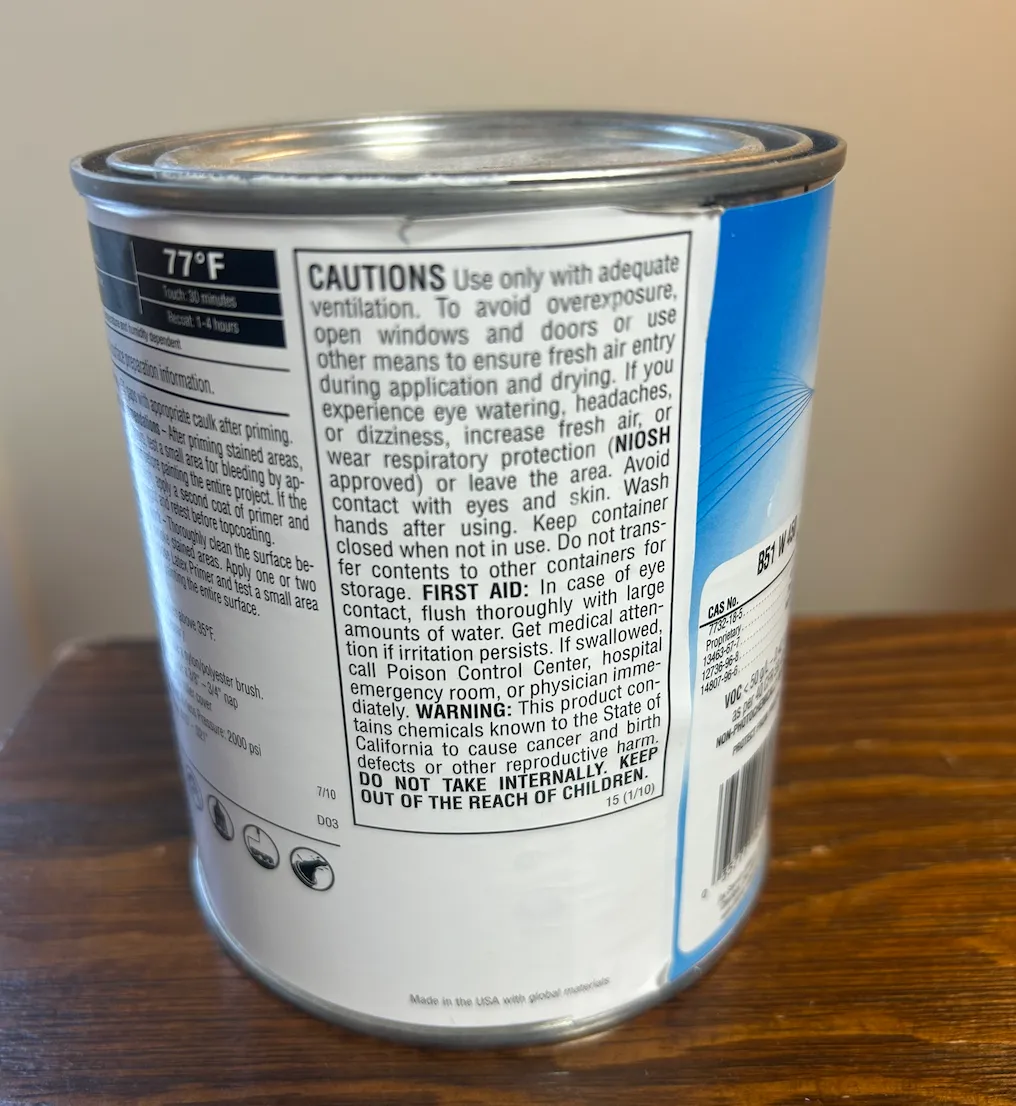
No wonder you see this warning label on every can…
*****
Alright, you just blasted off a ton of chemicals, and I am more confused…
I get it, there is one real problem you want to address.
Off-gassing. The release of chemicals during the curing process.
When you first apply paint, chemicals evaporate quickly – that’s the smell. The EPA and paint manufacturers will tell you ventilation is important “during application and drying.” True.
But it’s more than that.
One independent study of interior oil-based and water-based paints found that most off-gassing occurs within 48 hours, but it can last longer.
Paints can off-gas for up to six months after application, especially when applied in warm, humid, and poorly ventilated spaces.
Most of the chemicals listed above are present in the off-gassing process, with VOCs and Formaldehyde the most prevalent. Formaldehyde is released from binders as they degrade. Biocides leach from the paint film (that’s their job – to keep killing microbes).
Studies in journals such as the International Journal of Environmental Research and Public Health and Reviews on Environmental Health have shown links between long-term VOC exposure and respiratory issues, pulmonary health effects, and even some cancers. Short-term exposure can cause skin irritation, eye irritation, headaches, dizziness, and nausea.
This stuff is not good to be exposed to short-term or long-term, especially for children, pregnant women, and people with existing respiratory conditions.
*****
There is another health problem with some paint. Lead.
Lead was added to paint for decades because it made colors brighter, helped paint dry faster, and made the finish more durable. It was everywhere - walls, trim, doors, windows, porches, railings, even cribs and toys.
In 1978, the Consumer Product Safety Commission banned lead-based paint for residential use, stopping the manufacture and sale. But lead paint was already on millions of walls.
The EPA statistics3…
- 87% of homes built before 1940 have lead paint
- 69% of homes built 1940-1960 have lead paint
- 24% of homes built 1960-1978 have lead paint
- About 35% of U.S. homes overall contain some lead-based paint
Now, lead paint itself isn’t necessarily dangerous – if it’s in good condition and you leave it alone. The problem is when it deteriorates (peeling, chipping, chalking) or when you disturb it during renovation. Sanding, scraping, and demolition – all these create lead dust. And lead dust is a serious health hazard.
Children are especially vulnerable. Lead affects almost every organ system, but the developing brain is most sensitive.
The only way to know if your home has lead paint is to test it. You can’t tell by looking. You need an X-ray fluorescence (XRF) test or lab analysis of paint chips.
If you do have lead paint and want to remove it, there are certain requirements to follow. Federal law requires contractors working with lead paint to be EPA-certified in lead-safe practices. If you’re DIYing, you need to follow lead-safe work practices (no dry sanding, no power washing, containment, proper cleanup, HEPA vacuuming).
*****
So, how do I paint without all these negative health impacts?
Good question. Let’s start with product choice.
The good news is that most brands today offer “low-VOC” (less than 50 grams per liter (g/L)) and “no-VOC” (less than 5 g/L) paints.
And there are certifications, like the GreenGuard Gold and Green Seal, that verify these VOC marketing claims made on packaging with VOC testing that meets the California Department of Public Health (CDPH) Standard Method for the Testing and Evaluation of Volatile Organic Chemical Emissions, and have restrictions on heavy metals and other toxic chemicals. This is a great start!
For the more skeptical people like myself, I need to point out a few problems with these.
They follow the test by following the EPA VOC list (180+ chemicals), great.However, the EPA has exempted over 30 VOCs from regulatory definition because they have negligible photochemical reactivity for forming smog. Which means that while they do not significantly contribute to ozone pollution (the EPA’s focus here), some, such as acetone, tert-butyl acetate, and others, can pose human health risks, despite being used in "zero-VOC" paints.
Along with this, you will remember other chemicals. APEs, and biocides, that have health impacts, but still have not been addressed by certifications and claims.
So it comes down to researcing individual brands, validating their claims against the product's safety data sheet (SDS).
Two brands that have done rigorous testing are Healthier Homes (HH) Paint and AFM Safecoat. HH paint is unique because of its ability to seal the painted surface to prevent chemical off-gassing from materials behind the walls (another problem, especially for new drywall and insulation after a home build or remodel).
*****
*****
Wow, that has been a lot, and we only made it to paint choice. It gets more straightforward from here.
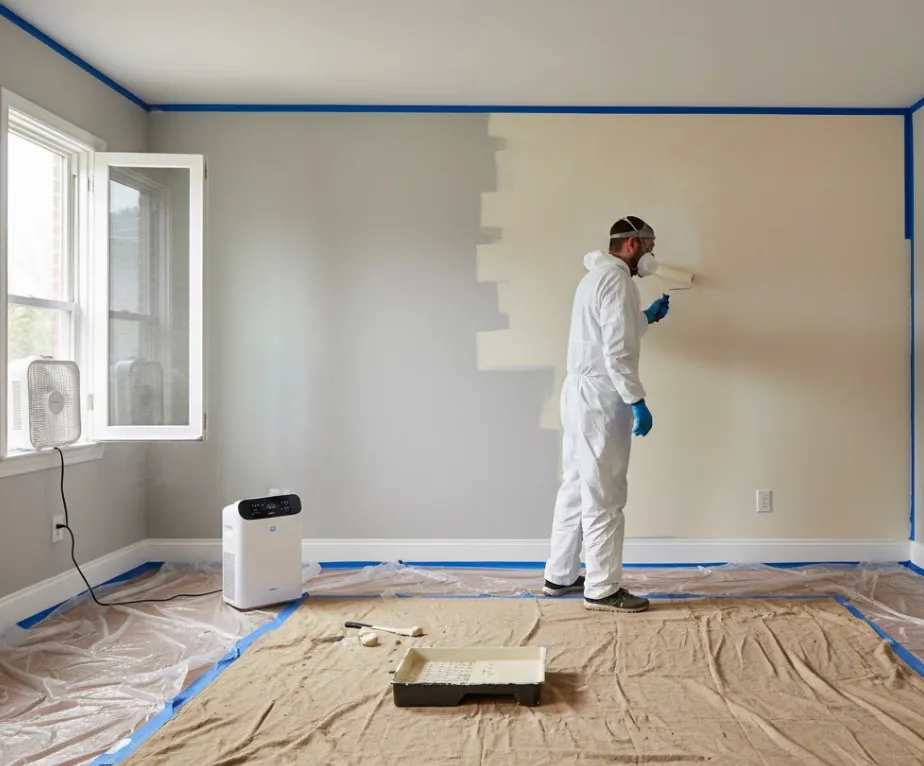
You got your product. Here is the right way to paint.
First. If your home was built before 1978, assume there’s lead paint until you test and prove otherwise. Don’t dry sand. Don’t scrape. Don’t create dust without containment. Hire a certified lead-safe contractor or educate yourself on proper lead-safe work practices.
If you’re clear on lead (or you’re working in a newer home), proceed with prep.
Prep work is 80% of the job.
Clean the surface. I mean, really clean it. Dirt, grease, mildew – if you paint over it, the paint won’t stick (and can contribute to off-gassing).
Also worth mentioning. Fix the moisture problem. If you have peeling paint, it’s usually a moisture issue. Painting over it won’t fix anything. Find the source (leaky roof, condensation, plumbing issue) and fix it. Then paint.
Don’t paint over mold. If you have mold, you have a moisture problem. Mold-killing paint or antimicrobial paint won’t solve it – you’ll just trap mold under a layer of biocides. Fix the moisture, remove the mold (with a certified mold remediation expert), let it dry completely, then paint.
Ventilation matters, and not just for a day.
Open windows. Use fans. Create cross-ventilation during painting and for at least a week afterward. Don’t sleep in a freshly painted room for at least a week, ideally longer.
If you can smell paint, VOCs are still off-gassing. Keep air moving. Investing in an air purifier is already a good idea for any home, but even more important for one you are painting. Should have a carbon and HEPA filter. Price = quality.
Application technique.
Use a proper primer for your substrate. Primer isn’t just “cheap paint” – it’s formulated to bond to the surface and provide a base for topcoats. Skipping primer (or using the wrong one) leads to poor adhesion and early failure.
Multiple thin coats are better than one thick coat. Thick coats take longer to cure, trap more VOCs, and are more likely to sag or peel.
Don’t paint in extreme temperatures or humidity. Follow the manufacturer’s guidelines. Paint cures best at 50-85°F and moderate humidity (<60%).
Proper personal protection equipment.
Paper masks (N95) don’t work for VOCs. You need a NIOSH-approved respirator with:
- OV (Organic Vapor) cartridges (black) – Filter VOCs
- P100 or P95 filters – Block paint mist
- Combination OV/P100 – Best for most jobs
Half-face respirators normally cost $30-50 plus cartridges. Cartridges last ~8 hours or until you smell paint through them.
Check fit. Cover cartridges, breathe in gently. The mask should pull tight with no air leaking. Also, wear gloves and safety glasses.
You are now ready to paint!
Hunter


