Hunter’s Healthy Household Guide
You Deserve to Live in a Healthy Home. But Getting There Can Be Overwhelming.
We spend 90% of our lifetime indoors, yet most of us have never tested what we're breathing, drinking, or surrounded by in our own homes. The quality of our indoor environment: air, water, lighting, and materials profoundly impacts our energy, focus, sleep, and long-term health.
Some people experience clear symptoms from toxins in their home environment: persistent headaches, fatigue, allergies, or sleep issues that seem to have no obvious cause. Others feel fine but could benefit from simple optimizations that support their families safety, happiness, and longevity.
The challenge? There are dozens of potential home health factors, and it can feel overwhelming to know where to start or which changes will actually make a difference.
I felt the same way when my fiancé and I bought our first home, a charming but 72-year-old house in Minneapolis. The inspection revealed a laundry list of potential issues:a basement prone to moisture and mold, outdated lighting that flickered and strained our eyes, and radon concerns common in older Minnesota homes. It was overwhelming to know where to start, so I dove into months of extensive research to understand which factors actually have the biggest positive impact on our health. What I quickly realized is that out of hundreds of potential hazards, not all are created equal, and most challenges can be solved with simple product upgrades and behavioral changes.
After implementing the most impactful improvements, our home went from draining our energy to actively supporting our well-being. Now I help you cut through the noise, identify what's actually affecting your home environment, and focus on the changes that deliver the biggest results.
Here are the two quick wins to identify toxins and improve your house’s health.
- Hunter's Three Daily Habits are simple behavioral changes you can start today that cost nothing but deliver noticeable improvements to your health and energy.
- Hunter's Two Simple Tests help you quickly assess your home environment without expensive equipment or overwhelming research, just your senses and basic tools you likely already have.
Hunter's Three Daily Habits
- Run bathroom and kitchen exhaust fans during and 15 minutes after use. Cooking and showering create massive amounts of moisture, grease particles, and combustion byproducts that can quickly degrade your indoor air quality.
Gas stoves release nitrogen dioxide and formaldehyde, while hot showers can raise bathroom humidity to 80-90%, well above the 30-60% range needed to prevent mold growth. Without proper ventilation, these pollutants and excess moisture circulate throughout your home via your HVAC system, affecting air quality and raising humidity levels in every room. Cooking odors aren't just smells, they're often VOCs and fine particles that can irritate respiratory systems and linger for hours in fabrics and surfaces.
Bonus tip: Wipe down shower walls and fixtures after use to remove surface moisture that fans can't eliminate.
❗The key insight: Source control is always more effective than trying to clean contaminated air later. Capturing pollutants at their origin prevents whole-house contamination and reduces the load on your air filtration systems. Moisture control is mold prevention.
- Open windows and/or doors daily for 20 minutes (twice a day is best). In most homes, air naturally changes only 0.3-0.7 times per hour, meaning it takes 2-6 hours for all the air in your home to be replaced. This slow circulation allows pollutants from cleaning products, furniture, and everyday activities to build up to levels 2-5 times higher than outdoor air.
Our modern homes are built to be energy-efficient and "tight," which keeps heating and cooling costs down but also traps stale, polluted air inside. Opening windows creates cross-ventilation that can increase air exchange to 5-10 times per hour, rapidly flushing out accumulated toxins and bringing in fresh oxygen.
During winter or rainy weather: If opening windows isn't practical, run your HVAC fan continuously (set to "on" instead of "auto") to keep air circulating through your filtration system. Many systems also have an "air exchange" or "fresh air" setting that brings in outdoor air while pre-conditioning it.
❗The key insight: Let your home "breathe" daily, even when weather conditions aren't perfect. Your indoor air quality will improve dramatically with this simple habit.
- Take off shoes at the door and use a two doormat system. Your shoes track in far more than visible dirt, they carry pesticides from treated lawns, heavy metals from urban dust, bacteria from public restrooms, and microplastics from deteriorating pavement. Studies show that shoes can transfer these contaminants throughout your home, where they accumulate in carpets and dust that your family breathes daily.
A simple two-mat system (one outside, one inside) combined with a no-shoes policy can reduce indoor pollutant levels by up to 85%. The outdoor mat captures the bulk of debris, while the indoor mat catches what remains. This is especially important if you have children who play on floors or family members with allergies or respiratory sensitivities.
Bonus tip: Vacuum entry areas and high-traffic zones twice a week (with a HEPA-filtered vacuum if possible). Even with the best shoe policy, some outdoor contaminants still make it inside on clothing and pets. Regular vacuuming with HEPA filtration captures these particles before they become airborne or spread throughout your home.
❗The key insight: Your floors become a reservoir for outdoor toxins. This simple boundary prevents contamination from spreading throughout your living spaces where you eat, sleep, and spend most of your time.
Hunter's Two Simple Tests
- The Sniff Test (VOC Detection)
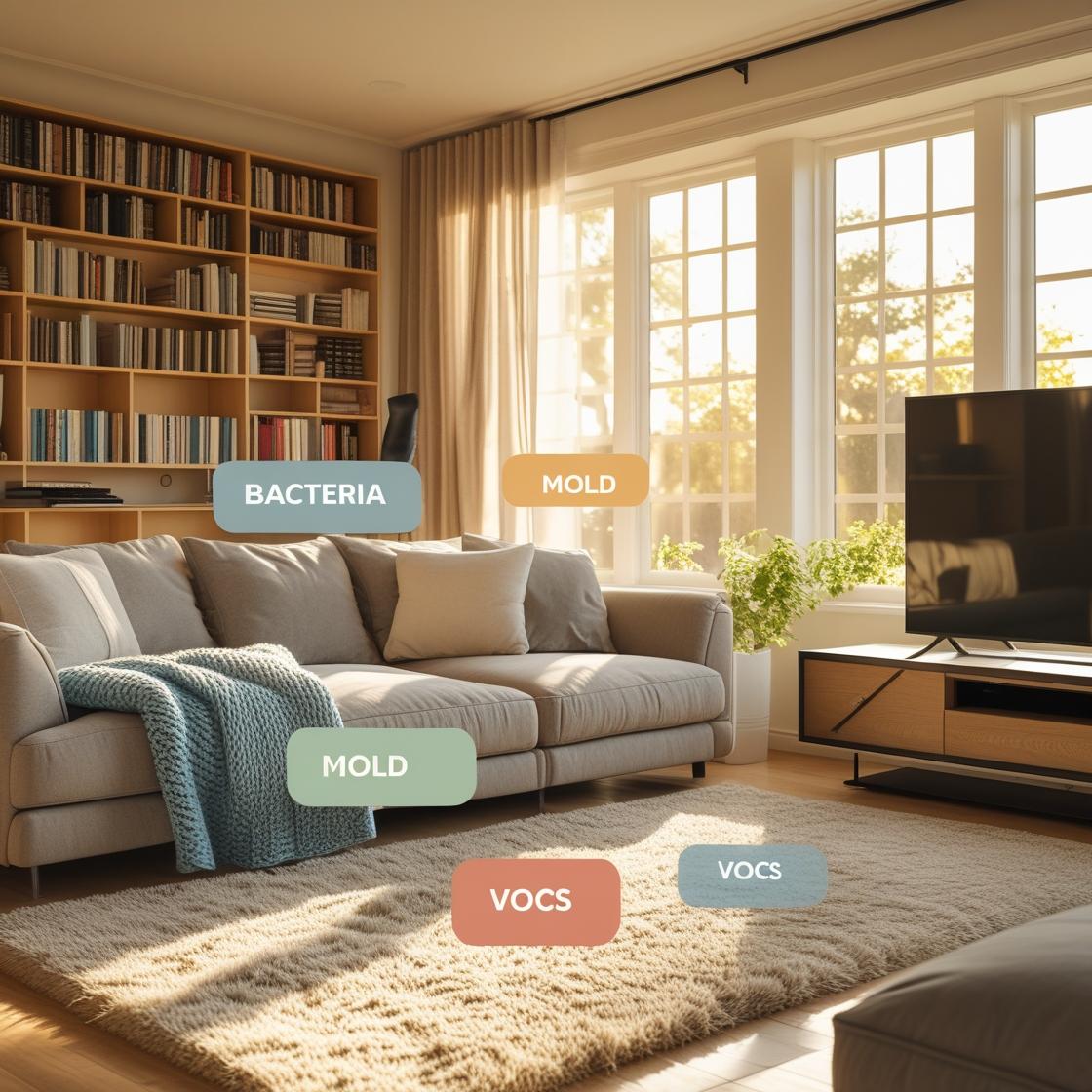
Why This Matters: Volatile Organic Compounds (VOCs) are invisible gases that slowly release from furniture, carpets, paint, and building materials in a process called "off-gassing." These chemicals can trigger headaches, respiratory issues, and brain fog. The EPA lists many of these as hazardous air pollutants, yet they're everywhere in our homes.
The Test: Your nose is one of your most powerful health tools.
● Turn off your HVAC, fans, and close windows. Do this on a sunny day (sunlight activates VOCs, making them easier to detect).
● Step outside for 30 minutes to reset your senses. Even better, grab a friend to help. Two noses are better than one!
● Visit each room where you spend the most time (bedroom, living room, kitchen, bathroom, office).
● Smell for…
○ Musty odors = potential mold/mildew
○ Chemical/paint smells = VOC off-gassing from furniture or materials
○ Sweet/fruity odors = certain harmful chemicals
○ Rotten egg smell = gas leak (leave immediately!)
Take Action: Document which rooms have the strongest odors. If you find problem areas, increase ventilation in those spaces and consider an air purifier with activated carbon. When buying new furniture or materials, look for low-VOC or VOC-free options.
👨 Hunter’s Note: I noticed a chemical smell in our living room during the afternoons when sunlight hit our rug (a new rug we had bought online). After documenting the smell and researching the product online I found that the rug had traces of formaldehyde off-gassing. We tried a baking soda treatment, but ultimately ended up returning the rug and finding a non-toxic wool option.
- The Slo-Mo Light Test (Flicker Detection)
Why This Matters: Most LED bulbs and screens flicker at rates invisible to the naked eye, but your brain still processes this constant strobing. This hidden flicker can cause eye strain, headaches, difficulty concentrating, and disrupt your natural sleep-wake cycle. Poor lighting is one of the most overlooked factors affecting our daily energy and sleep quality.
The Test: Use your phone's slow-motion camera feature to record your LED bulbs and screens.
● Point the camera at the light source and start recording in slo-mo. Smooth, consistent light is good—if you see obvious flickering or strobing, that's a problem.
Take Action: Replace high-flicker LED bulbs with flicker-free versions (look for bulbs specifically labeled "flicker-free" or with high-frequency drivers). Use blue light filters on screens after sunset, and consider full-spectrum lighting that mimics natural daylight patterns.
👨 Hunter’s Note: I did this on all my lightbulbs in my bedroom and office first where I spend the most time throughout the day. I had bad flicker in both and ended up switching out the bulbs with flicker free warmer light bulbs. There are a bunch of different options, this free lightbulb database is a good place to look.
I hope these were helpful! If you are not subscribed already, sign up for my newsletter below for more practical tips to improve your household environment.
If you're in Minnesota or Wisconsin and want to go deeper, I offer comprehensive home environment health testing services and would love to answer any questions you have on potential toxins in your house. Fill out the form below!
Best,
Hunter Babcock

.png)
.png)
.png)


