Over our lifetime, we’ll drink more than 15,000 gallons of water. Most of us get that water from a municipal water system, where regular testing is required.
But 43 million Americans (15% of the population) rely on private wells for their drinking water.
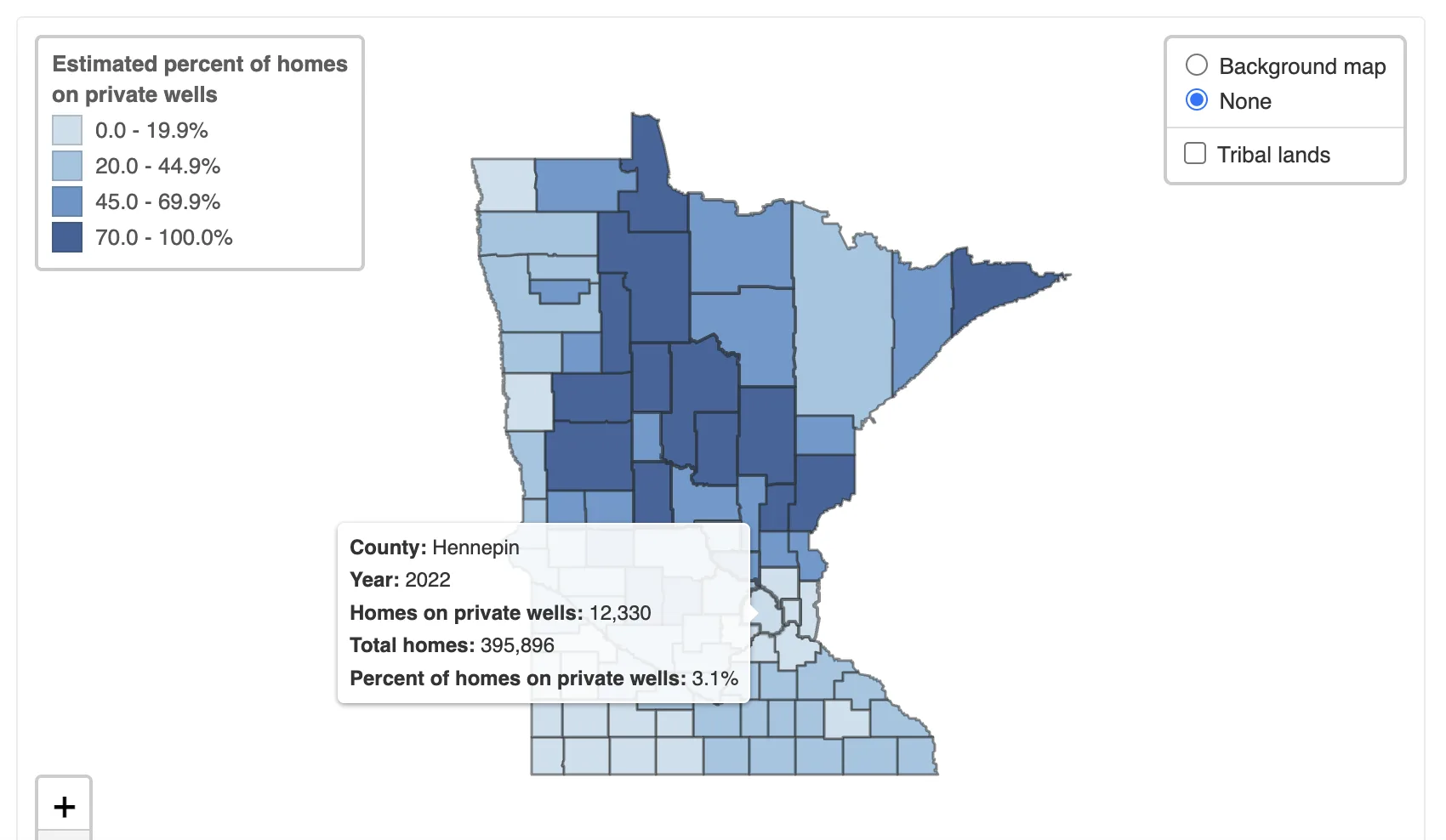
In Minnesota, that number is even higher. Approximately 1.1 million Minnesotans (20% of the population) get their drinking water from a private well.
Unlike municipal water systems, private wells aren’t subject to federal drinking water testing requirements after they’re built. In most states, that responsibility falls on the homeowner.
And here’s why that matters.
Groundwater can contain naturally occurring contaminants like arsenic, manganese, and radium, along with pollutants from human activity, including nitrates, pesticides, and industrial chemicals.
In fact, a U.S. Geological Survey study found that more than 1 in 5 private wells sampled contained at least one contaminant above a human-health benchmark.
Many of these contaminants are invisible, odorless, and tasteless. Water can look, smell, and taste perfectly normal while containing substances that may pose health risks with long-term exposure.
Let’s talk about well water.
So why do people use wells, and how do they get built?
Mostly because city water doesn’t reach them. Running a water main out to a rural property can cost far more than drilling a well, so outside of town limits, a well is very common.
Here in Minnesota, well construction is regulated. Every new well has to be installed by a contractor licensed by the Minnesota Department of Health (MDH), and the owner or contractor has to notify MDH before drilling starts.
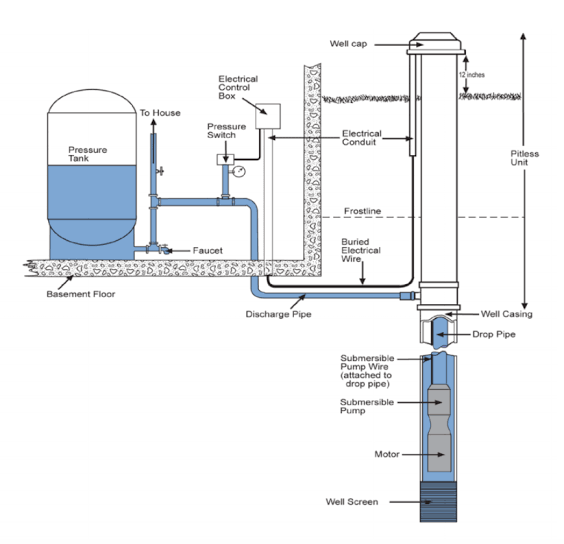
A modern drilled well works roughly like this:
- A rig bores a hole down through soil, sand, gravel, and sometimes bedrock until it hits a water-bearing layer (an aquifer).
- Steel or plastic casing is set in the hole to keep it from collapsing and to block shallow surface water from sneaking in.
- The gap between the casing and the hole is filled with grout (cement or bentonite clay), pumped from the bottom up, to seal it.
- A screen at the bottom lets water in while keeping sand out.
- A submersible pump pushes water up to a pressure tank in your basement.
- The casing sticks up at least 12 inches above the ground with a sealed cap, so surface water can’t pour in from the top.
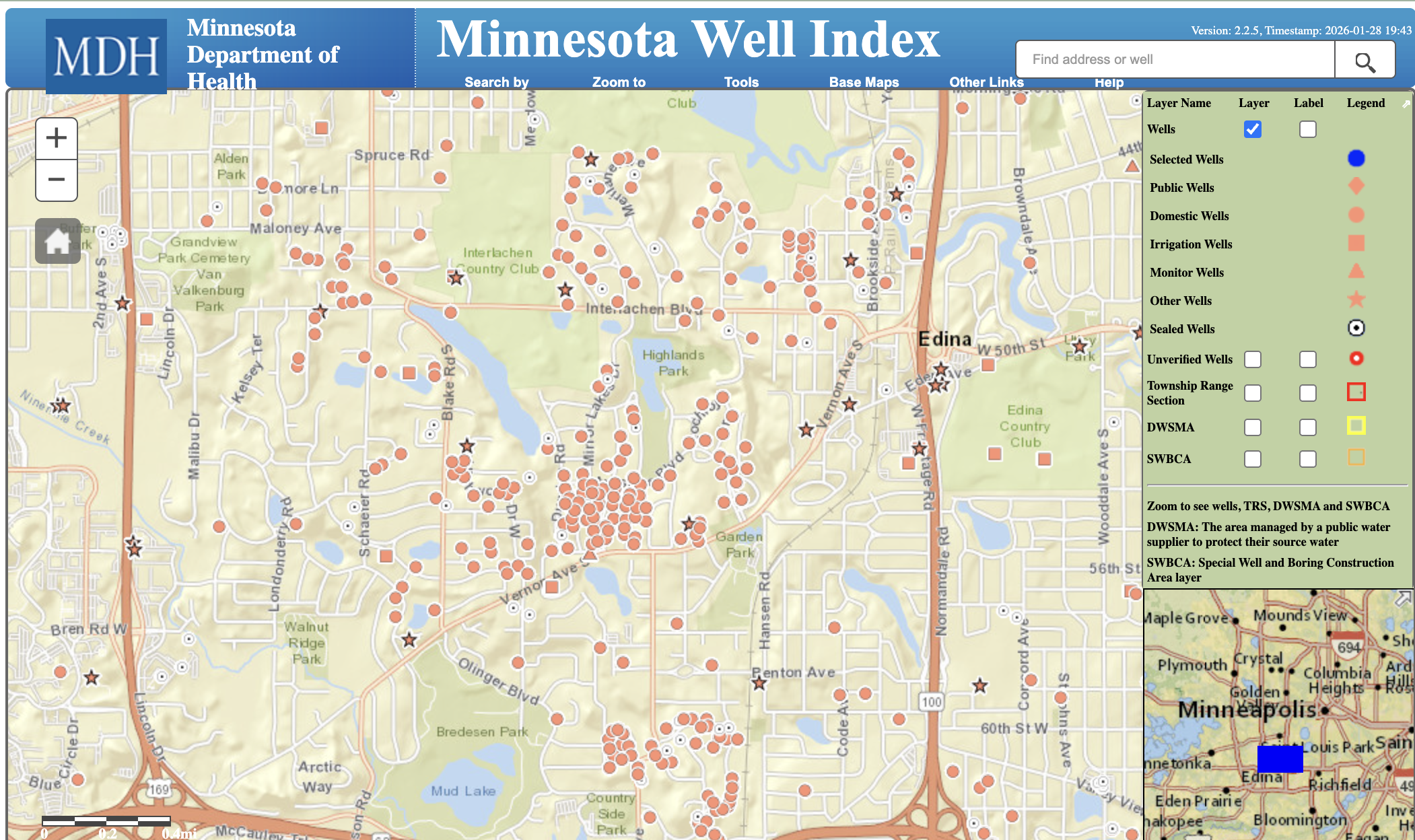
When it’s done, the contractor files a well record (it ends up in the public Minnesota Well Index) and has to test the new well for bacteria, nitrate, and arsenic.
Cost varies a lot with depth and geology. National cost guides put drilling alone at roughly $15 to $25 per foot, with most residential wells between 100 and 200 feet deep.
So what’s actually in well water?
The best national snapshot comes from a U.S. Geological Survey study that sampled about 2,100 private wells across 48 states. They took samples before any home treatment, so they were seeing the raw groundwater.
23% of wells (more than 1 in 5) had at least one contaminant above a human-health benchmark.
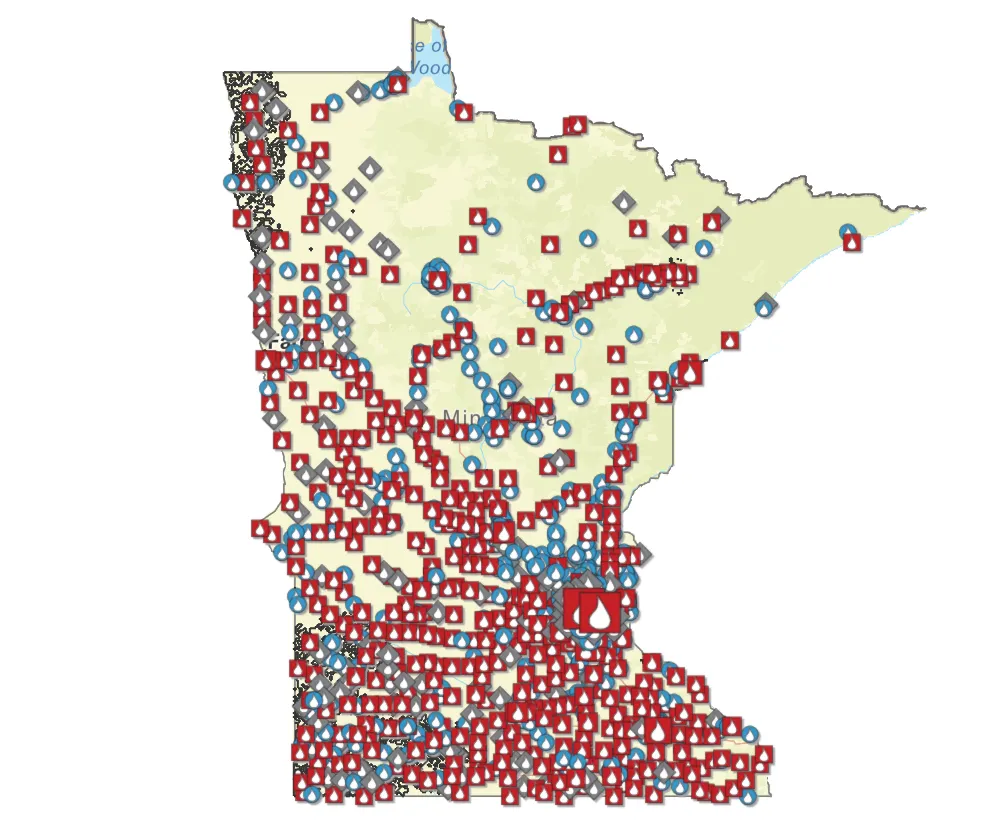
What shows up depends heavily on where you live. The geology, soil type, land use, and how old your well is all have a significant impact on the water quality.
It’s also worth knowing that well water and municipal water tend to have different contamination challenges.
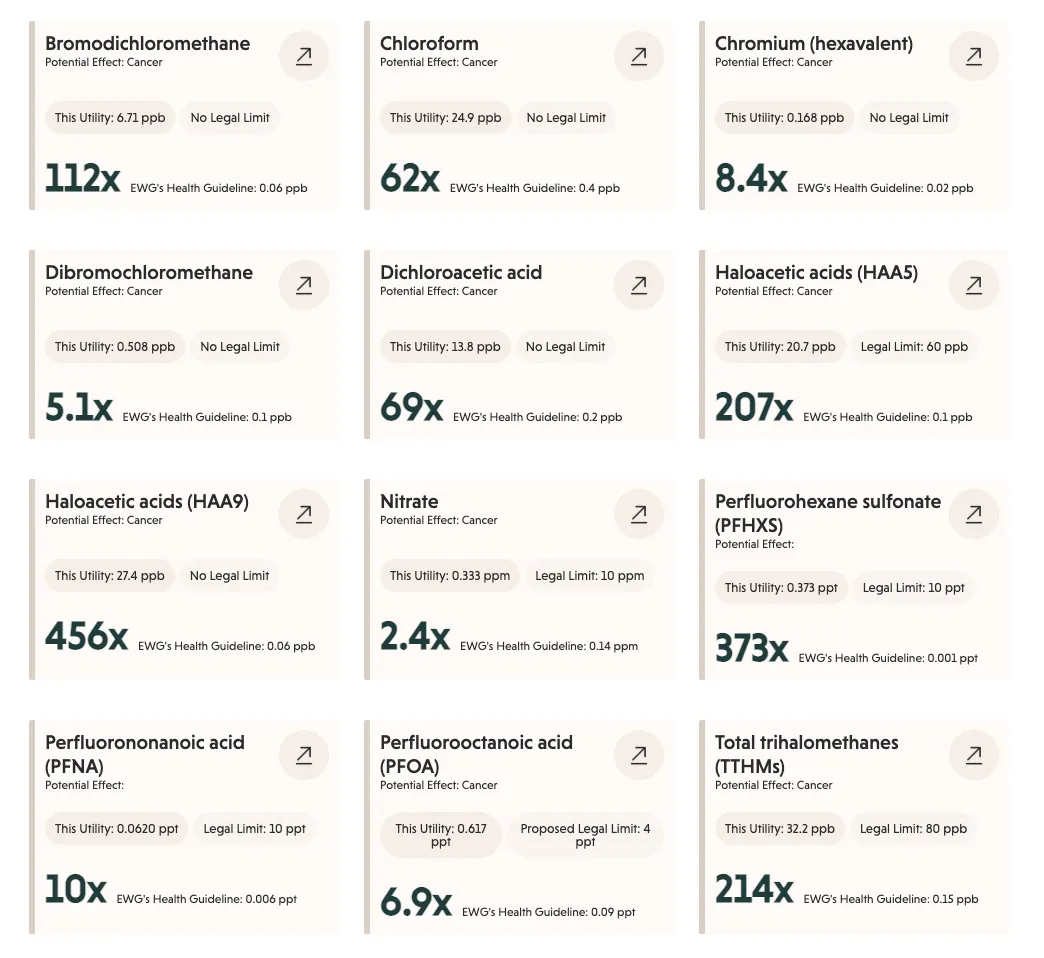
Municipal water contamination mostly comes from the system itself: disinfection byproducts from chlorine, lead service lines in older cities, and PFAS from rivers and lakes.
Now, private well water issues come from the ground itself and from what’s happening on the land around you. Naturally occurring chemical elements like arsenic, manganese, and uranium dissolve straight out of the rock and glacial sediment your well draws from. Nitrates and bacteria come from what’s on the surface (fertilizer, manure, septic systems) seeping down into the aquifer.
Minnesota recommends regular testing for five well contaminants.
Why? Because these are the most common contaminants in our region, and they all have negative health impacts on the people consuming them.
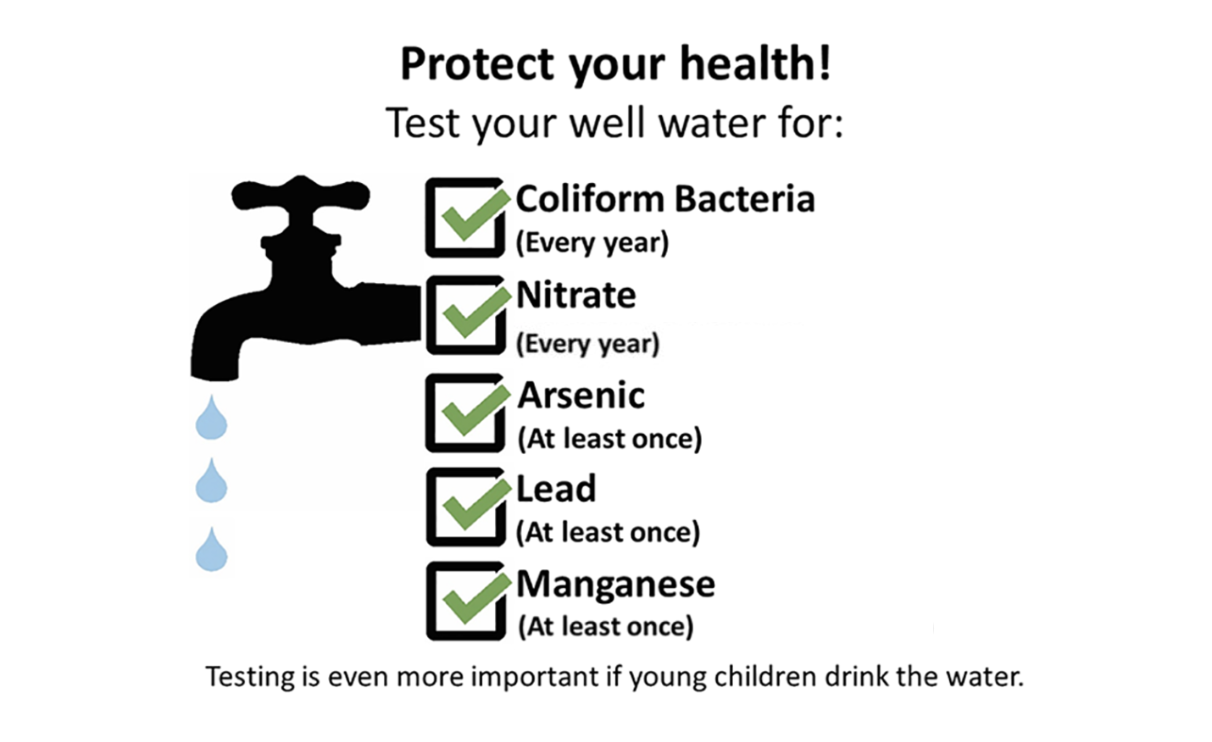
For the nerds. Let’s look at each of the five in more depth.
1. Coliform bacteria. Test every year.
Coliform bacteria themselves usually aren’t what makes you sick. They’re an indicator that pathways exist for other bacteria, viruses, or parasites to get in too.
And they’re common. In a statewide University of Minnesota study of private wells, about 30% of samples tested positive for total coliform.
Southeast Minnesota, where karst geology (sinkholes, cracks, underground caves) lets surface water drop straight into groundwater, we see higher concentrations. Shallow wells, old wells, and wells near livestock are higher risk too.
MDH’s action level: any coliform detected. The usual fix is shock disinfecting the well and fixing whatever let it in (a cracked cap, bad grout, a low spot that pools water around the casing).
2. Nitrate. Test every year.
Nitrate comes mostly from fertilizer, manure, and septic systems. Too much of it interferes with how blood carries oxygen, and infants are at the highest risk.
Statewide, most wells (about 97%) meet the standard. However, central Minnesota’s sand plains (sandy soil lets water drain fast into the aquifer) and southeast Minnesota’s karst region (same sinkhole problem as bacteria) see the highest levels. And shallow wells carry most of the risk.
In southeast Minnesota, the numbers got bad enough that the EPA stepped in. In 2023, the EPA cited Minnesota Department of Agriculture data showing 12.1% of private wells tested in the karst region exceeded the nitrate limit, and asked the state to come up with a plan to address it.
MDH’s action level: above 10 mg/L (measured as nitrate-nitrogen). The usual fix is a certified reverse osmosis (RO) system for the whole home or point of use (i.e., at the kitchen sink), plus removing nitrate sources near the well. And do NOT boil it. Boiling evaporates the water and concentrates the nitrate.
3. Arsenic. Test at least once.
Arsenic comes from the rock and soil itself. Long-term exposure is linked to lung, skin, and other cancers.
And it’s more common here than in most places. About 10 to 11% of new Minnesota wells exceed 10 µg/L, compared to 7% in the national USGS sample, and arsenic is detectable in about half of new wells.
In Minnesota, it’s mostly a glacier story. About 14,000 years ago, the last glacier left behind a clay-rich material called the Des Moines lobe till, which runs through western, central, and south-central Minnesota, and wells drilled into it see higher concentrations.
MDH’s action level: any level may be harmful, and MDH highly recommends acting above 10 µg/L. Similar to nitrate, the usual fix is a certified RO system for the whole home or a point-of-use system (i.e., at the kitchen sink).
4. Lead. Test at least once.
Lead can damage the brain, kidneys, and nervous system, and kids are the most vulnerable.
It comes from the well system and plumbing: brass faucets and fittings, lead “packers” above the well screen (common in wells drilled before 1980), and older pumps made with leaded brass.
MDH’s action level: any level of lead is harmful. The usual fix is finding and replacing the source (old brass fittings, an old pump), flushing the tap before drinking, and/or using a certified RO filter. More on how lead gets into water in Lead in Drinking Water.
5. Manganese. Test at least once, and before a baby drinks the water.
Manganese is a natural mineral. In small amounts, it’s a nutrient (we get plenty from food). In drinking water at higher levels, it’s been linked to problems with memory, attention, and motor skills, and infants are the most sensitive.
When MDH and Dakota County tested 274 private wells in Inver Grove Heights, 71% exceeded the infant guidance and 56% exceeded the adult guidance. MDH has estimated that about half of private wells statewide may exceed the infant guidance value.
MDH’s action level: above 100 µg/L for babies under one, above 300 µg/L for everyone else. The usual fix is a water softener or a dedicated iron/manganese filter.
So if your water source is a private well, it is important to regularly test the quality and then address it with water conditioning and filtration.
Hunter
We built a bunch of FREE resources for you!
- Take our home health quiz (~5 min)
- View a recent home assessment report
- Try out our indication guide to lead pipes
- See your radon risk with our Minnesota radon map
- Calculate what the best air purifier is for your home from our database
- Schedule a free 15 minute chat with our founder about any questions you have