TLDR: LED lightbulbs are everywhere. They are affordable and energy-efficient! But they aren’t inherently health-promoting. How they are built is interesting. They have blue light. They flicker. They negatively impact sleep and productivity. Read to learn why.
LEDs are everywhere…
In 2015, only 4% of US households used LEDs for most of their lighting. By 2020 it was 47%. By 2024, 63% of US households reported using at least one LED bulb. In about a decade, this lighting technology went from novelty to default in nearly every home in the country.
Why?
Energy efficient. The electricity required to produce equivalent light to an incandescent bulb drops by 80%+, and by roughly 40 to 50% versus fluorescent.
Lasts “forever”. They can last 25,000+ hours, versus about 1,000 for an incandescent.
Affordable. Haitz’s Law. LEDs get cheaper and more efficient on a predictable curve. You can get them for under $2 a bulb at most Home Depots.
And government energy efficiency standards accelerated the switch. The Energy Independence and Security Act of 2007 phased in over the 2010s, and by 2023 federal rules effectively ended sales of most traditional incandescents (they simply can’t hit the required efficiency).
According to the EIA’s Residential Energy Consumption Survey, in 2015 only 4% of US households used LEDs for most of their lighting. By 2020, it was 47%. By the 2024 survey, 90% of US households reported using at least one LED bulb.
What’s actually inside an LED bulb, and how does it work?
Well, I broke open a standard LED bulb to find out.
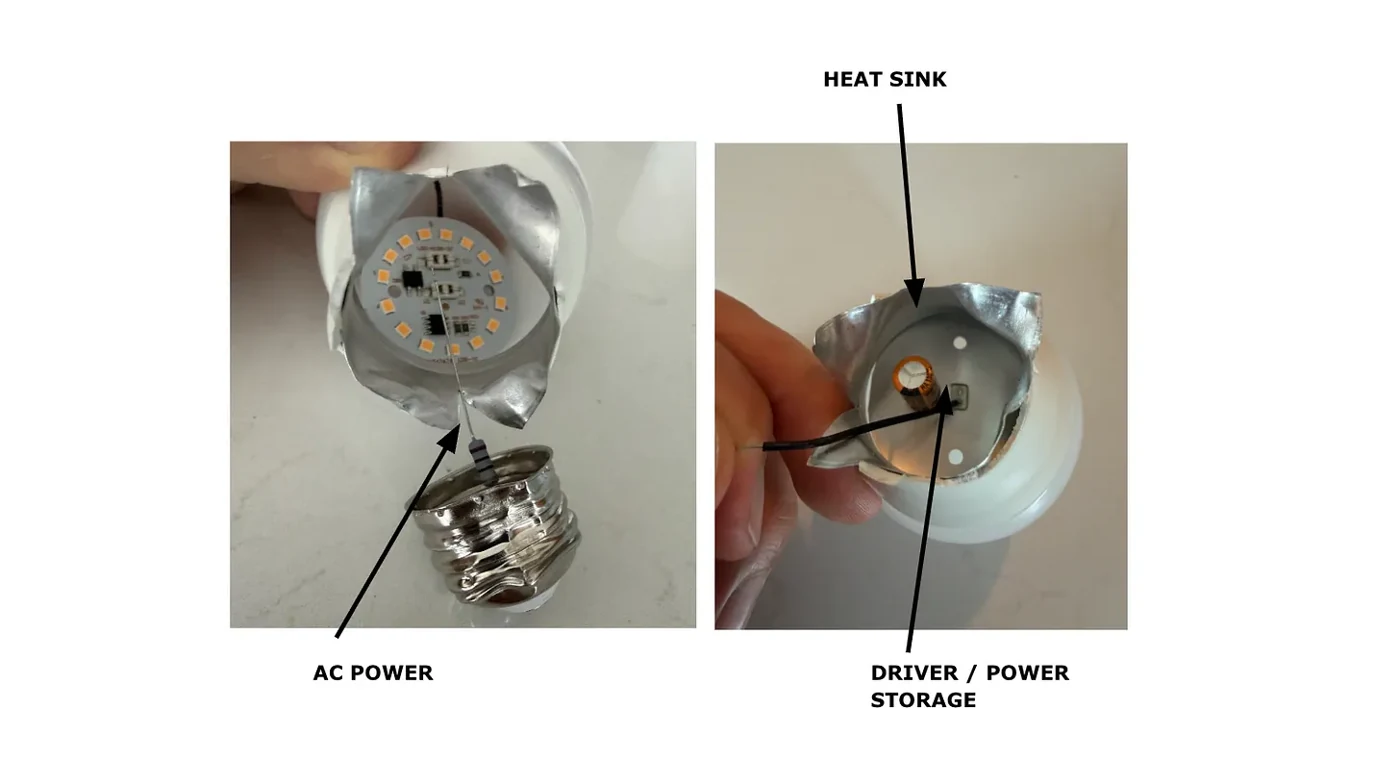
LEDs are essentially mini semiconductors. They have multiple parts.
It starts at the base, where the alternating current (AC power) from your home’s electrical circuit flows in. Now, our electrical grid runs on alternating current (AC) rather than direct current (DC), which means the electric current “pulses,” which is much easier and cheaper to send over long distances from power plants than direct current (DC). In the United States, it is delivered in our homes at 60 Hz, meaning the power pulses 120 times a second.
This pulsing current travels into the bulb and hits the driver, where it becomes direct current. This is an important step because the light-emitting diodes (LEDs) need smooth, steady direct current to run properly. When the driver isn’t working properly or is cheap, WHICH MOST ARE, then you get flicker (more on that later).
The direct current then reaches the LED board, which is a flat aluminum disc studded with a ring of small chips. Those chips are the light-emitting diodes, the things that actually make the light. On mine, a couple dozen little yellow-orange squares in a circle. And here’s the strange thing about them: a diode only emits one narrow band of color. It’s a tight spike of pure blue, right around 450 nm (more on this later).
So to get a full spectrum of color and the visible white light, the manufacturer adds a phosphor coating. That yellow-orange coating painted over each chip absorbs some of that blue and re-emits it across yellow, green, and red; some original blue passes straight through. Your eye blends the passed-through blue with the converted yellow and calls it “white.” So a “white” LED is really a blue diode wearing a yellow coat.
Now why do these two LED bulbs have different color phosphor on them? You might be familiar with color temperature, measured in Kelvins. The color of the phosphor helps to determine that color temperature. So the bulb on the left is most likely a 2700K amber warm color light, and the right is a 5000K, more white light.
Wow.
There are two more pieces of the light bulb worth mentioning. The heat sink wrapped around the body is finned aluminum. The diodes hate heat, and the little they produce (plus the heat the driver makes) has to go somewhere, so the body pulls it off and dumps it into the room. This helps to improve the life of the bulb.
Lastly, the diffuser, which is the white frosted dome, scatters the light from the ring of chips so you see an even glow instead of a cluster of harsh bright dots.
So that’s how a light bulb works.
Earlier I mentioned two problems with LEDs. Flicker & blue light spike.
Let’s look at both of those things quickly.
So why does it flicker?
Remember the driver, the little board whose whole job is turning your wall’s pulsing AC into smooth DC. Flicker is that job done poorly.
The reason it’s so easy to botch comes down to one word: inertia. An old incandescent barely flickers, because its filament is a hot piece of metal and, like a cast-iron pan, it stays hot through the dips in the current. An LED has no such thermal inertia. A diode is on when it has current and off when it doesn’t, instantly, with no afterglow. So if the driver lets any of that 60 Hz pulsing through, the light pulses right along with it.
Dimmers make it worse. Most LEDs dim using pulse-width modulation, which is a fancy way of saying they rapidly switch the bulb fully off and on and just spend more time “off” to look dimmer. A well-made dimmable bulb does it fast enough that you never notice; a cheap bulb on a mismatched dimmer can flicker hard, buzz, or both. If you’ve ever put a bargain LED on an old dimmer switch and gotten terrible flicker, that’s why. This overhead bedroom lightbulb is a prime example (don’t watch if you are sensitive to flickering light)
Why care about a flicker you can’t even see? Because it can still register in your eyes & brain. Research links it to eyestrain, headaches, migraines, and fatigue, even when it’s happening too fast to consciously notice.
Think of it this way. Why do nightclubs have strobe lights? To stimulate our nervous system and keep us awake and alert, in fight-or-flight mode. This is a smaller version of that happening anytime that lightbulb is on…
A test you can run tonight. Open your phone camera, switch to slow-motion video, and point it at your bulb. The slow-mo frame rate is just fast enough to catch the flicker, so you will see it when you play back that video.
So why is it so blue?
Back to that pure-blue diode and its yellow coat. To see the problem, it helps to pull the bulb’s light apart into its two ingredients.
First, the raw diode. On its own, it emits a tight spike of blue, peaking around 455 nm.
Then the phosphor takes some of that blue and re-emits it as a broad, gentle hump centered around 560 nm, covering the greens, yellows, and reds.
Stack them together, and you get the “combined white output” your eye actually sees. And look what survives: that sharp blue spike is still right there, poking through, no matter how warm the bulb is labeled.
So why does a spike of blue matter? Because the cells that set our circadian rhythm (the ipRGCs in our eyes) are tuned to blue light. The more blue hitting them, the more your body gets told it’s daytime.
So these LEDs are telling our body to “be awake” all the time they are on. Flip this light on in the bedroom, and it is suppressing melatonin right when you’re trying to wind down. During the day, this is fine, even helpful. The problem is timing: wrong signal at night.
So knowing all this, the quality of the LED and the placement of the LED in the home matter. There are awesome LED brands that have figured out how to reduce the blue light spike and to tune out the flicker. Or just use incandescents.
Best,
Hunter
PS - My mother-in-law is an avid reader of the newsletter! But she said my posts can get long 😮. I mean, it’s fair; a 12-minute read on a roof or carpet or LEDs may be more textbook material. So I added the TLDR section. I hope she likes it. I wonder if she made it this far 😂
We built a bunch of FREE resources for you!
- Take our home health quiz (~5 min)
- View a recent home assessment report
- Try out our indication guide to lead pipes
- See your radon risk with our Minnesota radon map
- Calculate what the best air purifier is for your home from our database
- Schedule a free 15 minute chat with our founder about any questions you have
.webp)