My favorite memories of Boy Scout summer camps in Northern Wisconsin were stargazing late into the night, lying in my sleeping bag, eating beef jerky, and trying to guess different constellations while avoiding the mosquitoes attacking me through my layers of bug spray and netting covering my face.
There is something so awe-inspiring about the night sky that makes you feel small and insignificant, but also so appreciative of the beauty of the earth we get to live on.
I remember year after year it being harder to get a good view.
It is no secret that our skies today are washed out by artificial light. Because of light pollution, the Milky Way is now hidden from more than one-third of humanity, including nearly 80% of North Americans. And more than 99% of people in the U.S. and Europe live under skies bright enough to dim the stars.
Let’s talk about it.
So what is light pollution?
Light pollution is exactly what it sounds like: outdoor artificial light where we do not want it, when we do not want it. The industry term is artificial light at night, or ALAN.
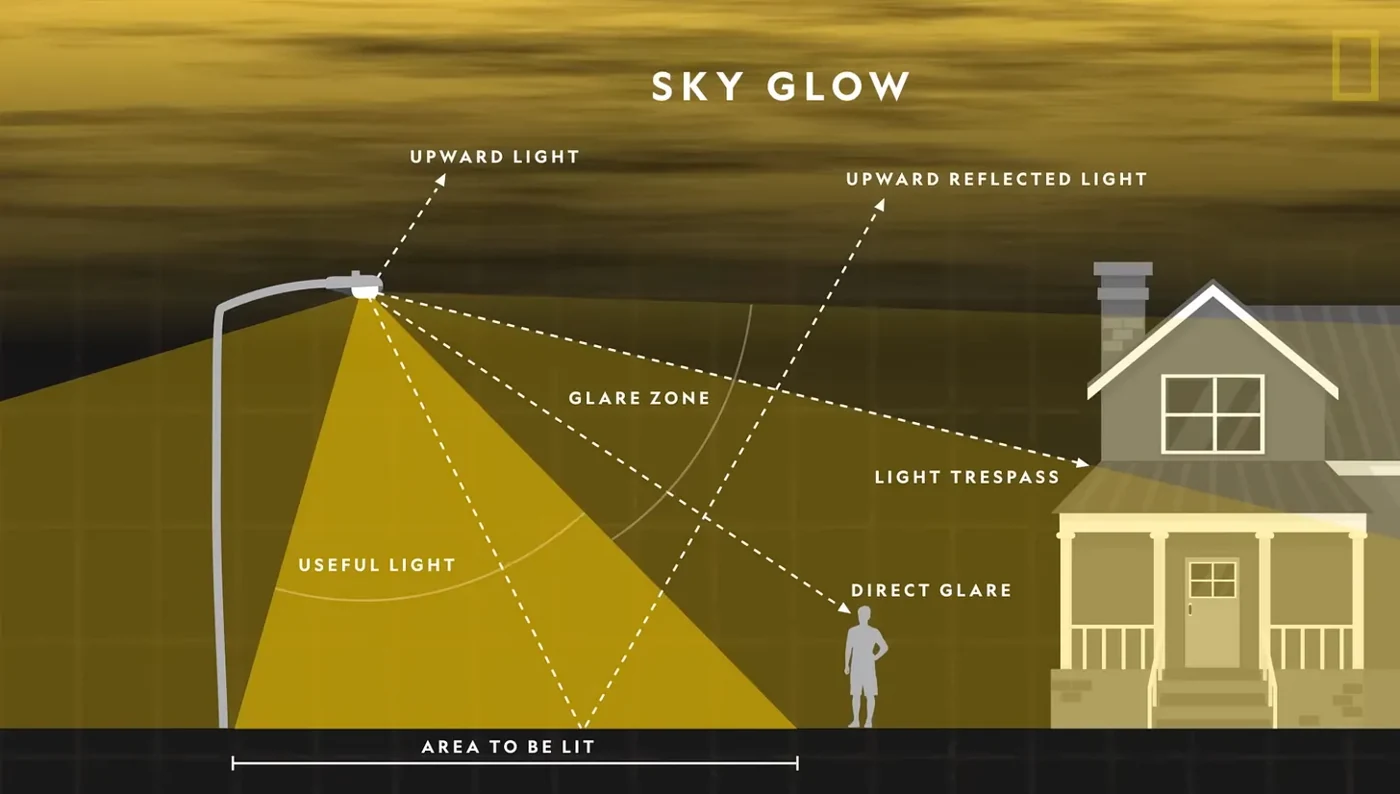
Look at that diagram. Only the yellow cone in the lower left, the “useful light,” is doing the job the fixture was installed to do. Everything else is waste:
- Light trespass is light spilling across a property line into a place it was never meant to go (your bedroom window, for example).
- Glare is excessive brightness that hits your eye directly and actually makes it harder to see. Shoutout to my friends who hate driving at night!
- Upward light and upward reflected light are photons shot straight into the sky, or bounced off the ground into it.
- Sky glow is the diffuse orange dome you see hovering over any city. It is the combination of all upward light. This is what erases the stars.
So there are multiple aspects of artificial light at night that contribute to light pollution.
So how bad is it?
To be honest, not great, and getting worse.
The clearest way to see it is from space. Satellites like NASA’s Suomi NPP have been photographing the Earth at night for over a decade. This is a picture of the East Coast.
It is a beautiful picture. It is also a map of a major problem.
- The night sky over North America is getting brighter by an average of 10.4% per year, according to a 2023 study by Christopher Kyba and colleagues published in Science. A child born in a place with 250 visible stars would see only about 100 by their eighteenth birthday.
- Nearly 50% of the land area of the continental United States is affected by light pollution.
- Around 90% of U.S. residents live under light-polluted conditions.
The LED revolution made this worse. LEDs were supposed to save energy and reduce light pollution because they can be aimed so precisely. Instead, we mostly just used the savings to install more light, brighter, everywhere. The industry has a name for this. It is called the rebound effect.
And it is not just about the lack of visible stars…
Light pollution has a major negative impact on our health.
It revolves around the hormone melatonin.
Melatonin is the signal that tells your body it is night. Your pineal gland releases it after dark, and it does far more than make you sleepy. It lowers your core body temperature, nudges your blood pressure down, helps regulate glucose, and acts as a broad antioxidant while you sleep. It is the conductor that keeps your circadian rhythm, the roughly 24-hour internal clock running in nearly every cell you have, in time with the actual day.
That clock is set almost entirely by light hitting your eyes. Specialized cells in your retina (intrinsically photosensitive retinal ganglion cells) have the job of detecting light and reporting to your master clock whether it is day or night. They are most sensitive to blue light, exactly the kind LED streetlights and phone screens throw off.
And it does not take much.
When melatonin is suppressed night after night, four things start to go wrong.
- Your sleep gets worse. This is the most direct one. Less melatonin, later, means it takes longer to fall asleep, sleep is lighter and more fragmented, and the whole rhythm drifts later. A 2020 study in JAMA Psychiatry led by Diana Paksarian looked at over 10,000 US adolescents and found that teens living in areas with the most outdoor artificial light at night went to bed later and slept less than those in darker areas. The streetlight leaking through the blinds is doing measurable damage.
- Your metabolism suffers. Melatonin and your circadian clock help regulate glucose and appetite. A 2022 experiment at Northwestern by Dr. Phyllis Zee showed the likely mechanism: healthy adults who slept just one night under moderate room light had higher next-morning insulin resistance and elevated nighttime heart rates compared to those who slept in the dark.
- Your mood takes a hit. Circadian disruption and depression are tightly linked, and light at night appears to feed the loop. That same JAMA Psychiatry adolescent study found that teens in the brightest areas had significantly higher rates of mood and anxiety disorders.
- And risk of cancer increases. The hypothesis, first raised by Richard Stevens in the 1980s, is that chronically suppressed melatonin raises the risk of hormone-driven cancers like breast and prostate. The mechanism is plausible (melatonin has genuine tumor-suppressing activity in the lab), and the human data keep pointing in the same direction. The standout study is MCC-Spain, published in Environmental Health Perspectives in 2018 by Ariadna Garcia-Saenz and Manolis Kogevinas at the Barcelona Institute for Global Health. Using International Space Station imagery to measure the actual blue-light exposure of about ~4,000 people, they found that those living with the most outdoor blue light at night had roughly 1.5 times the risk of breast cancer and 2 times the risk of prostate cancer compared to the least-exposed, even among people who had never worked night shifts.
While a lot of the research is still ongoing, my view is that we want to support our body's natural circadian rhythm as much as possible, which means being aware of artificial light at night.
So how lit up is your house?
Here is my favorite resource, and it is free: the Light Pollution Map.
Zoom in on your own home. The map overlays satellite sky-brightness data on a normal map, color-coded from black (pristine dark sky) through blue and green (suburban) to red and white (heavily polluted city core).
It is a great tool for planning a stargazing trip. But it is also a bit of a gut check for where you live. When I look at the Twin Cities, the whole metro glows white, and you have to drive well north before the map goes properly dark.
To be clear, a lot of light pollution cannot be avoided. If you live in a city, I am not telling you the answer is to move.
So what should you do about it?
I have talked about how to improve our indoor light environments to positively impact our sleep and circadian rhythm. This is focused on the outdoor light impacts.
The guiding principle is simple: light should point down, be no brighter than needed, and only be on when needed.
DarkSky (a global nonprofit group that works to stop light pollution and protect the night sky) and the Illuminating Engineering Society boil this down to five principles: useful, targeted, low level, controlled, and warm-colored.
- Buy fully shielded, downward-facing fixtures. Look for the DarkSky Approved seal. These are certified to emit zero uplight, and (per the new white paper) increasingly to control that sneaky near-horizontal light too.
- Aim for warm color temperatures, 2700K or lower. Blue-rich white light scatters more in the atmosphere and suppresses melatonin more. Warmer light is friendlier to your eyes, your sleep, and the sky.
- Put outdoor lights on motion sensors or timers. A light that is only on when you need it is the easiest win there is. It saves the sky and your power bill at the same time.
- Point it at the ground, and no brighter than the task needs. A pathway needs a soft pool of light at your feet, not a floodlight aimed at the horizon.
There are two things I think are even more important.
Out walking or driving at night. This is a hard one. As much as you can avoid driving at night as possible is the best option. When walking, wearing a baseball cap can help to reduce overhead light exposure, and wearing glasses with anti-glare and blue light reduction is helpful.
Addressing light trespass in our sleeping areas should be the most concerning to us. The fix is to get blackout curtains or shades for the bedroom. Most of us cannot change the streetlight outside, but we can keep its light off our faces at night.
Hunter
We built a bunch of FREE resources for you!
- Take our home health quiz (~5 min)
- View a recent home assessment report
- Try out our indication guide to lead pipes
- See your radon risk with our Minnesota radon map
- Calculate what the best air purifier is for your home from our database
- Schedule a free 15 minute chat with our founder about any questions you have
.webp)