We spend roughly 90% of our lives indoors.
And the EPA estimates that indoor air can be two to five times more polluted than the air outside.
The place where you sleep, work, eat, and watch Love is Blind is very likely the dirtiest air you breathe all day.
The good news: a good air purifier, running continuously in the right room, can dramatically reduce what's in your air.
The bad news: most people grab a nice-looking box off the shelf at Target, plug it in, and assume the problem is handled. It usually isn't.
I've measured many homes with purifiers running away in a corner, while the PM and VOC readings look almost identical to a house with nothing running at all.
Here is the secret… the brand matters. The filter matters. The CADR matters. And the size of the unit relative to the room matters a ton. Get any one of those wrong, and you're basically running a fan that also costs you money in replacement filters.
So let's walk through all of it.
What's In Your Home's Air?
Before we talk filters, it's worth understanding what we're filtering.
Indoor air pollutants fall into two big buckets: particles and gases. Most purifiers are built for particles. Some handle gases too. Very few do both well.
Particles
PM2.5: fine particles 2.5 microns or smaller. These penetrate deep into your lungs and bloodstream. Sources include cooking, candles, fireplaces, wood smoke, tobacco, and outdoor air leaking in.
PM10: coarser particles up to 10 microns. Dust, pollen, pet dander, and mold spores live here. Most mold spores are between 1 and 30 microns, which means a true HEPA filter catches the vast majority of them.
Ultrafine particles: anything below 0.1 microns. Not regulated by the EPA, hard to measure with consumer tools, and increasingly implicated in cardiovascular and neurological issues.
Gases and VOCs
Formaldehyde: off-gasses from pressed wood furniture, cabinetry, flooring, and some paints. Known human carcinogen.
Other VOCs: cleaning products, personal care products, new carpet, candles, synthetic fabrics, renovation materials.
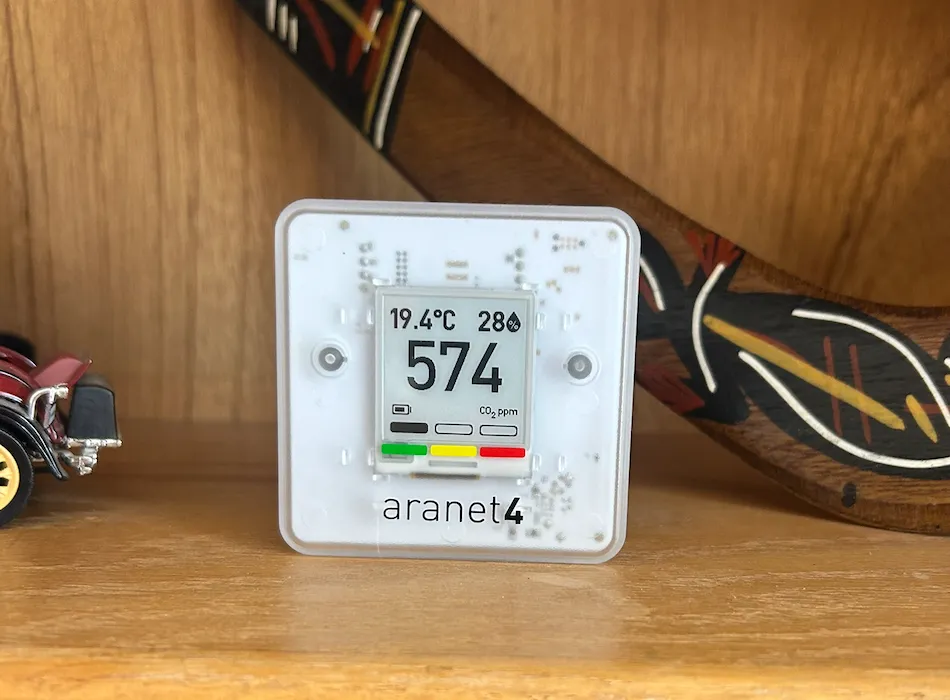
CO2: not a VOC but worth a mention. Elevated CO2 from people in a poorly ventilated room affects cognitive performance. (I've written about this separately.)
Cooking byproducts: nitrogen dioxide, acrolein, and a big spike in fine particles from high-heat cooking. Your range hood is your first line of defense here, not a purifier.
A true HEPA filter handles particles. Activated carbon handles gases. You generally need both, and they're fighting each other inside the same box (more on that in a minute).
So What Do You Actually Do About It?
A few things…
Stop adding pollution at the source. Don't buy carpets, rugs, and furniture made with harmful chemicals. Don't paint with harmful chemicals. Get rid of the candles. Ditch the synthetic fragrance cleaning products.
Ventilate. Open your windows when the outdoor air is clean. Germans have been doing this daily for centuries and call it Lüften. It works when the outside AQI is good. Change your HVAC filters and use the best MERV for your system (more on this later).
Filter what's left. That's what an air purifier does. And that's where most people get tripped up.
Source control and ventilation come first. A purifier is a complement to those, not a replacement.
What Actually Makes a Good Air Purifier?
Two things matter most: the filter and how much air moves through it.
The Filter
You want a true HEPA filter. Not "HEPA-type." Not "HEPA-like." Not "HEPA-style." Those are marketing terms with no real definition behind them.
True HEPA, as defined by the U.S. Department of Energy, captures at least 99.97% of particles at 0.3 microns. That threshold was originally written for nuclear facilities in the 1950s, and it stuck as the consumer standard.
Why 0.3 microns? Because that's roughly the size a HEPA filter is worst at catching. A purifier handles bigger particles easily (they get physically intercepted) and smaller particles easily too (they bounce around randomly and hit the fibers). The mid-size particles, roughly 0.1 to 0.3 microns, are the trickiest.
A Quick Note on MERV
MERV stands for Minimum Efficiency Reporting Value. It's the rating system for furnace and HVAC filters, developed by ASHRAE. The scale goes from 1 to 16, and you'll see it on the cardboard-framed filter you slide into the return vent at home.
Here's the important thing: MERV and HEPA are not measuring the same thing, and they're not designed for the same job.
MERV rates a filter's average efficiency across three particle size ranges: 0.3–1.0, 1.0–3.0, and 3.0–10.0 microns. A MERV 16 filter (the top of the consumer scale) captures at least 95% of particles in each of those ranges. HEPA, on the other hand, is a single, non-negotiable minimum of 99.97% at the hardest particle size to catch (0.3 microns). So even the best MERV filter lets through roughly 170x more particles at that size than a HEPA filter.
The reason your furnace doesn't just come with a HEPA filter in it: airflow resistance. HEPA is dense. If you tried to pull your home's entire HVAC airflow through HEPA media, you'd strangle your blower motor, rack up energy costs, and probably cook your furnace. HVAC systems are designed around lower-resistance filters (MERV), and portable air purifiers are designed around their own powerful fans that can push air through the much denser filter.
So the two systems are complementary, not competing. Run the highest MERV filter your HVAC system can handle (most modern systems can handle MERV 13, some can do MERV 16 with the right blower) to catch a lot of particles passively as air moves through your house. Then run a true HEPA purifier in the rooms where you spend the most time (bedroom, office, living room).
CADR Is the Number That Actually Matters
A great filter doesn't mean much if the unit can only pull 40 cubic feet of air through it per minute. The air in your room has to actually reach the filter to get cleaned.
The metric that captures this is Clean Air Delivery Rate, or CADR, measured in cubic feet per minute (CFM). It's the rate at which a purifier delivers filtered air into the room.
The EPA and AHAM (the Association of Home Appliance Manufacturers) both consider CADR the single most important number on a purifier spec sheet.
How Much CADR Do You Need?
The industry shorthand is AHAM's formula:
Room size (sq ft) = Smoke CADR × 1.55
That number is based on 4.8 air changes per hour (ACH), which is what AHAM recommends to continuously remove about 80% of cigarette smoke particles in a steady state.
To me, 4.8 is a minimum. It's the target the industry landed on for "good enough" in a living room, not what you'd want in a space where somebody sleeps or works eight hours a day. For comparison, hospital patient rooms typically target 12 ACH, and operating rooms are often 15–25 ACH. That's the kind of turnover you want in a place you actually breathe in for hours.
My view on purifier sizing: shoot for 8–12 ACH in the rooms that matter most. Bedrooms, offices, nurseries, any space where someone is sitting or sleeping for long stretches. For pass-through spaces (entryways, bathrooms), you can go lower. For spaces with ongoing pollution sources (kitchen during cooking, a room with a wood stove, a house with wildfire smoke outside), go higher still.
For the Nerds
To calculate your own target CADR:
- Room square footage × ceiling height (usually 8 ft) = cubic feet of room volume
- Multiply by your target ACH
- Divide by 60 to get the CADR (measured in CFM) needed
A 250 sq ft bedroom with 8 ft ceilings is 2,000 cubic feet. At 10 ACH, that's 20,000 cubic feet per hour, or 333 CFM. At 15 ACH, you're at 500 CFM. That's a much bigger purifier than most people realize they need.
Here's the catch. Most people don't run their purifier at full speed because full speed is loud. If you're running it at a quieter setting, the effective CADR is way lower than the spec sheet number. Which is why I oversize almost every unit in my house. More on that in a minute.
Look for the AHAM Verifide Seal
AHAM runs a certification program called Verifide that independently tests purifiers to confirm the manufacturer's CADR claims are accurate. The seal shows three CADR numbers (tobacco smoke, dust, pollen) and a suggested room size.
If a unit doesn't have the AHAM Verifide seal, the manufacturer is essentially telling you to trust their numbers on the box. Sometimes that's fine. Often it's not.
My rule: if you're spending more than a hundred bucks, make sure it's AHAM Verifide. It's the closest thing we have to an unbiased referee in this market.
I Built a Tool for This
Sizing a purifier correctly is annoying. You have to calculate room volume, pick an ACH target, compare CADR ratings across a dozen brands, cross-reference filter types, and price-check along the way.
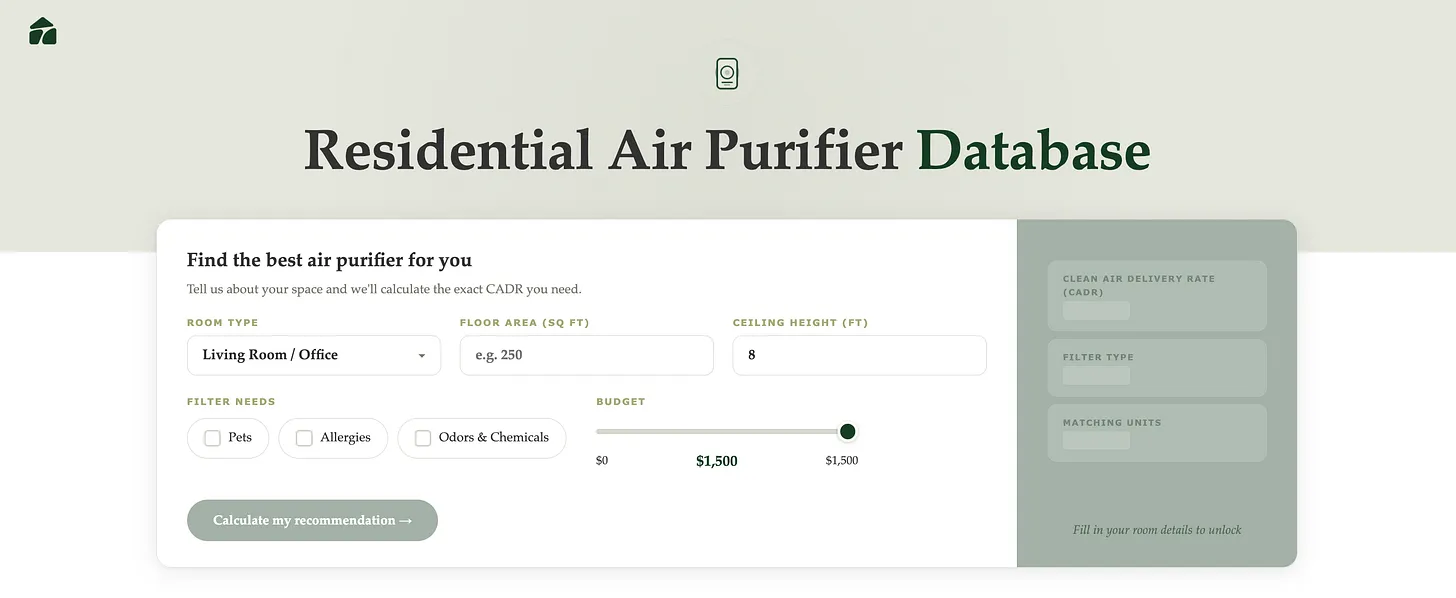
So I built a Residential Air Purifier Database. Here's how it works:
- Pick your room type (bedroom, living room/office, kitchen, nursery, etc.)
- Enter the floor area and ceiling height
- Check off any specific filter needs (pets, allergies, odors & chemicals)
- Set your budget
The tool applies an ACH target based on the room type (somewhere in the 8–12 range, depending on how the space is used), calculates the exact CADR you need, figures out the right filter type for your specific needs, and returns the units that actually match.
It's free, and I am not affiliated or sponsored by any of these brands. However, I do have favorites (message me if you want my three favorites)!
Try the Air Purifier Database →
The Other Stuff That Matters
Throughput and filter quality are the big two. But it's worth mentioning a few other buying factors.
Noise. If it sounds like a jet engine, you'll turn it off. And a purifier that's off is a very expensive paperweight. Most manufacturers only publish CADR at the highest fan speed, which is usually around 50–60 decibels (roughly the sound of a normal conversation). At night, you want it closer to 40 decibels, which is library-quiet.
The problem: running a purifier at a lower speed drops its effective CADR a lot. If the manufacturer rates it at 200 CFM on high, it might only be 120–140 CFM at the quiet setting. So if you want a purifier you can actually sleep next to, you need to oversize it. Buy one with more CADR than you think you need, so you can run it at a lower speed and still hit your ACH target. I baked this into my tool.
Filter changes and maintenance. If a filter has to be replaced every 3 months, most people won't do it. And a saturated filter loses efficiency fast. I look for units with a 6+ month filter lifespan or longer. Costs less over time, and you actually remember to change it.
Aesthetics. Yes, really. If it looks ugly, your spouse will ban it from the house (I love you, Lauren!). The best purifier is the one that actually gets used in the space that needs it.
Price. You can spend $100 or $1,500 on a purifier. To me, it is an investment in your health. A good rule of thumb for air purifiers is higher price = higher quality. You get what you pay for.
A Word on VOCs
VOCs need a completely different filtration medium than particles: activated carbon. Carbon traps gas molecules by adsorption, which is a different physical process than the particle trapping HEPA does.
Here's the catch: most HEPA purifiers include a thin sliver of activated carbon as a pre-filter. It'll help with mild kitchen smells. It will not meaningfully reduce formaldehyde offgassing from new cabinets or VOCs from a recent renovation. For that, you need a purifier with pounds of carbon.
So, there are VOC-focused purifiers. If you have a VOC concern, you're usually better off with two separate units (one for particles, one for gases) than a combo unit trying to do both.
Use the Database
I hope you love the air purifier database!
Hunter
We built a bunch of FREE resources for you!
- Take our home health quiz (~5 min)
- View a recent home assessment report
- Try out our indication guide to lead pipes
- See your radon risk with our Minnesota radon map
- Calculate what the best air purifier is for your home from our database
- Schedule a free 15 minute chat with our founder about any questions you have