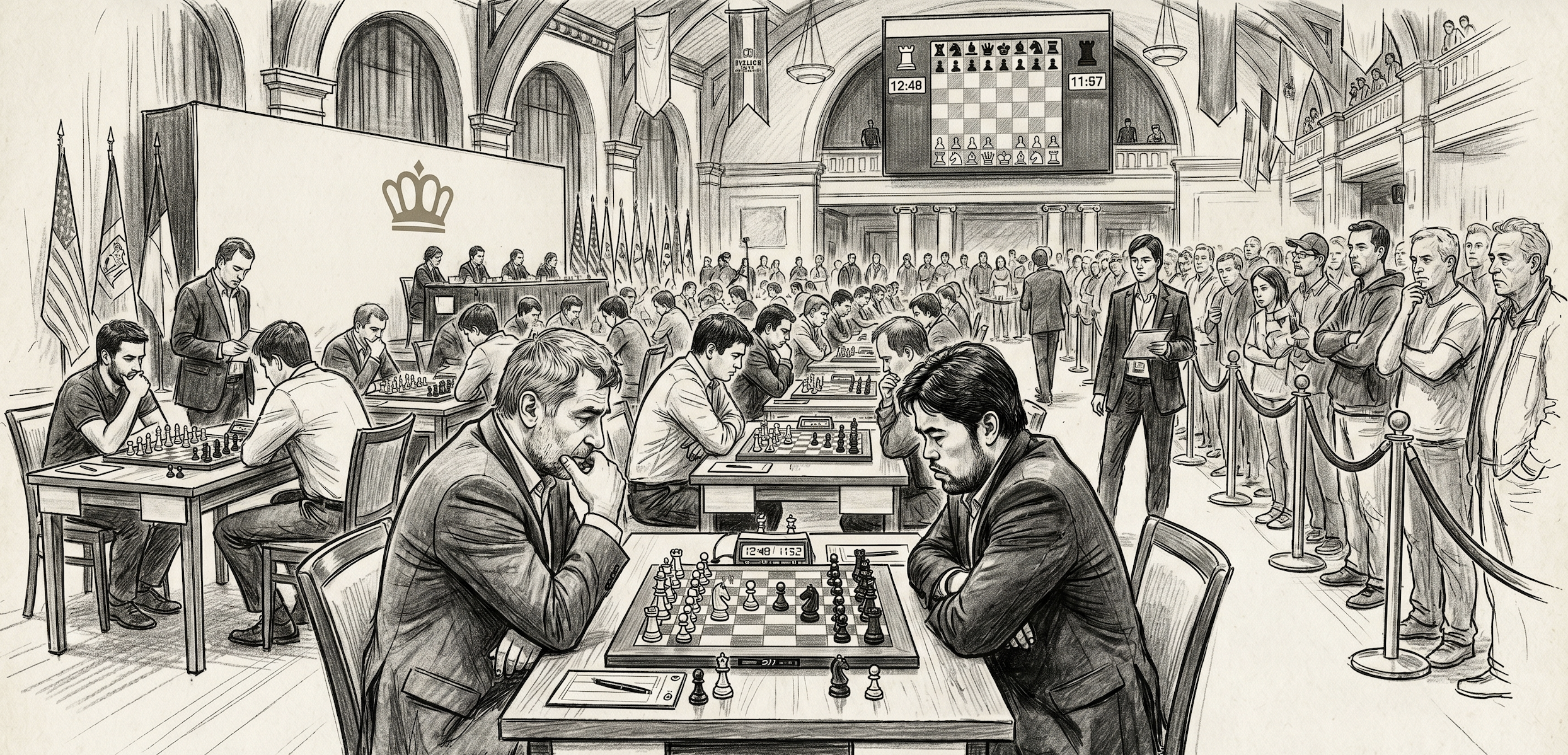
Between 2017 and 2019, a team of researchers from Maastricht University and MIT ran an experiment inside chess tournaments in West Germany.
The venue was a large church community hall in a suburban residential area. Every Monday night at 6 pm, players would arrive for their round. The tournament ran seven rounds over eight weeks each spring. Registration was open to any level of chess player willing to pay 30 euros, but limited to 80 players each year.
What the players didn't know was that the researchers had installed three air quality sensors inside the room. Two sensors measured PM2.5, and one sensor tracked CO2, temperature, humidity, and noise.
Quick Note: PM2.5 is the fine particulate matter, smaller than 2.5 micrometers in diameter, like smoke, dust, vehicle exhaust, burning candles, cooking emissions, wildfire particulates, etc. They can travel deep into the lungs and pose significant health risks, such as respiratory issues and cardiovascular disease.
The sensors recorded every minute and uploaded to a cloud server. Players were told the sensors were there for scientific purposes, but not what was actually being studied.
Then the researchers did something clever. They fed every move from every game (over 30,000 total, from 121 players across 609 games) into Stockfish, a chess engine with an Elo rating of 3,548 (the highest Elo ever achieved by a human is 2,882, by Magnus Carlsen). Stockfish evaluated each move independently, treating it as its own puzzle: given the position on the board, what's the best move? How far off was the player's actual move from optimal?
This gave the researchers two clean outcome measures for every single move in the data set: did the player make a meaningful error, and if so, how big was it?
The players in the sample ranged from beginners to masters (best players). They were mostly men, average age 53. Some had played only two official matches in their careers. Others had played 279. And every one of them had a strong incentive to perform: tournament results were submitted to the German Chess Federation for an official recalculation of each player's rating score, which determines their matchups in future competitions. The winner also took home 400 euros.
Here's What the Researchers Found
A 10 µg/m³ increase in indoor PM2.5 raised a player's probability of making a meaningful error by 2.1 percentage points (a 26.3% increase relative to the baseline error rate of 8%).
Context for the Air Quality Nerds
It's also worth pausing on what a 10 µg/m³ change in PM2.5 actually means. During the tournaments, indoor PM2.5 ranged from about 14 to 70 µg/m³, with an average of 27.1 µg/m³ (slightly above the European target of 25 µg/m³, but below the EPA's 24-hour standard of 35 µg/m³). A 10 µg/m³ increase represented about 75% of the standard deviation in their sample. So the entire range of air quality in this study fell within the range of what most people experience in normal indoor environments.
And a 10 µg/m³ swing is the kind of change that happens routinely indoors: you light a candle, you cook dinner on a gas stove, your HVAC filter is a few months past due, or the outdoor air quality shifts from good to moderate.
For the Chess Nerds
This means a one standard deviation increase in air pollution caused a player to perform as if their Elo rating had dropped by 220 points.
Time Pressure Made It Worse
The tournament's time control rules made the effect even more visible.
Each player was given 90 minutes for the first 40 moves, plus 30 seconds per completed move (110 minutes total for the first 40 moves). If you didn't finish 40 moves in time, you lost. This created a natural experiment within the experiment: as players approached move 40 with their clock running down, the average time per move dropped steadily, and the cognitive demand spiked.
In that high-pressure window (moves 31 through 40), a 10 µg/m³ increase in PM2.5 raised error probability by 3.2 percentage points and increased the size of those errors by 20.2%.
The researchers controlled for temperature, CO2, noise, humidity, opponent strength, accumulated tournament points, and the current state of the game. They tested for traffic congestion as a confounder (stress from commuting to the venue). They ran the numbers with and without games that ended before move 40. The results held across every test.
Then They Tried to Replicate It
Using the same methodology, they analyzed 20 years of games from the Chess Bundesliga (Germany's top national league, one of the strongest chess competitions in the world, featuring grandmasters and world champions, including Magnus Carlsen). The data set: 473 players, 102,755 moves, 2,301 games, played across 64 different venues in 26 cities between 2003 and 2019. They matched each game to outdoor PM10 readings from nearby air quality stations, and in a final step, used wind direction as an instrumental variable to isolate the causal effect.
The same pattern held. Air pollution increased errors, and the effect was strongest under time pressure. The only difference was magnitude: the Bundesliga players (who are substantially stronger) were less affected than the players in the original tournament. Which itself tells you something: weaker players are more vulnerable to the cognitive drag of bad air.
Why This Matters Beyond Chess
This was a crazy study and fun to read!
For non-chess players like me, you might find this even more interesting…
The researchers were careful to note that this isn't just a chess story. The skills required to play chess well (problem solving, pattern recognition, evaluating alternatives under time pressure) overlap heavily with the skills demanded in strategic decision-making roles across the economy.
The paper's conclusion: poor air filtration in office buildings and other indoor workplaces is degrading the quality of strategic decisions being made inside them.
How's your office air quality?
Hunter
Steffen Künn, Juan Palacios, Nico Pestel (2023). Indoor Air Quality and Strategic Decision Making. Management Science 69(9):5354-5377. https://doi.org/10.1287/mnsc.2022.4643
We built a bunch of FREE resources for you!
- Take our home health quiz (~5 min)
- View a recent home assessment report
- Try out our indication guide to lead pipes
- See your radon risk with our Minnesota radon map
- Calculate what the best air purifier is for your home from our database
- Schedule a free 15 minute chat with our founder about any questions you have