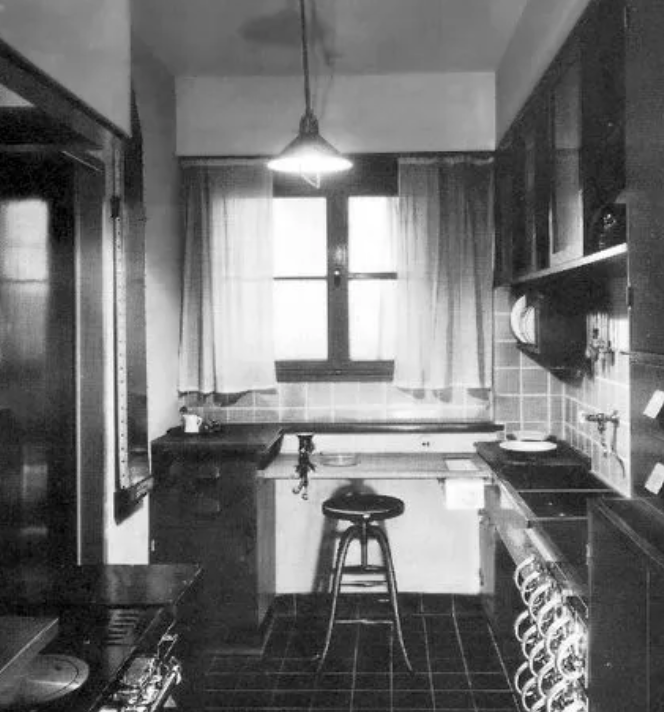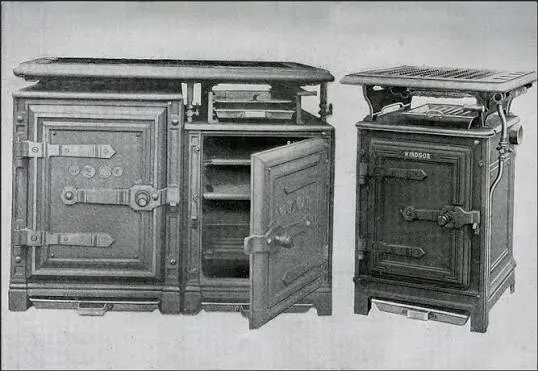
How gas took over the American kitchen.
Gas cooking is older than you’d think. James Sharp patented a gas stove in England in 1826. But it stayed a novelty for decades. People had cooked over wood and coal for thousands of years, and they didn’t trust the strange new fuel.
Two things changed that. First, the infrastructure. Gas companies originally piped gas into cities for street lighting and lamps. As electric lighting threatened that business in the late 1800s, the gas industry needed new reasons to keep the gas flowing. Cooking was the answer.
Second, the appliance got better. In 1915, the American Stove Company introduced a workable oven thermostat, so a cook no longer had to babysit the firebox. Enamel coatings in the 1910s made stoves easy to clean. The gas industry’s trade association directly subsidized stove development and built showrooms to demo the appliances to a curious public.
By the 1930s, gas had a real fight on its hands with electric.
So how many of us are cooking with gas?
A lot of us. The most recent federal numbers (the EIA’s 2024 Residential Energy Consumption Survey) count about 36.8 million U.S. households whose main range runs on natural gas, plus another 4.8 million on propane and 5.8 million on dual-fuel setups, about a fourth of households in our country.
It’s wildly regional. In New Jersey, California, Illinois, and New York, somewhere around 60 to 70% of homes cook with gas. In much of the South, it’s under 20%. Older homes are far more likely to have it than new builds.
The health problem with gas stoves.
Two separate things happen when you cook.
First, the food itself throws off ultrafine particles. This happens on any stove (gas, electric, induction). One U.S. apartment study clocked ultrafine particle counts peaking at 150,000 to 500,000 particles per cubic centimeter within about ten minutes of cooking. Frying and high heat make the most.
Second, gas combustion adds nitrogen dioxide (NO2) on top. NO2 is a gas that irritates the airways and is tied to asthma.
The Stanford group (Yannai Kashtan and the Jackson Lab) has been the most prolific team on this question. They instrumented over 100 homes, combined the measurements with national housing data, and ran the math by region, income, and home size. Their December 2025 synthesis paper landed on some interesting numbers:
- About 22 million Americans are exposed to NO2 above the WHO long-term safety limit from gas and propane cooking alone. No outdoor pollution counted toward that total.
- Switching to electric cuts personal NO2 exposure by 25% or more nationwide. For the heaviest gas cooks, the cut is closer to half.
- Smaller homes get hit hardest. People in homes under about 800 sq ft breathe roughly four times the long-term NO2 of people in homes over 3,000 sq ft. Same stove. Less air to dilute it.
Their earlier 2024 paper put it in health terms: long-term NO2 from gas stoves is statistically linked to roughly 50,000 cases of childhood asthma in the U.S.
Then there is benzene.
The same Stanford group also showed that gas burners and ovens produce benzene, a confirmed carcinogen linked to leukemia and other blood cancers.
A single burner on high, or an oven set to 350°F, raised kitchen benzene above the upper end of secondhand-smoke benzene levels in every kitchen they tested. And benzene doesn’t politely stay in the kitchen. Their modeling found that bedroom benzene can stay elevated for hours after the stove is off, sometimes above chronic exposure benchmarks.
For kids, it’s worse. They breathe more air per pound of body weight than adults, so the same air delivers a bigger dose. Stanford’s modeling put kids’ incremental lifetime cancer risk from the highest-emitting stoves at about 1.85 times that of adults.
So what is the solution?
On the surface, “use your range hood” is the answer. But that is a little misleading as a lot of hoods are doing very little to help.
Two failure modes:
- Recirculating hoods. A huge share of installed hoods (especially in apartments and condos) don’t vent outside at all. They pull air through a charcoal filter and dump it back into the room. They were designed to catch grease. They do nothing for NO2 or benzene.
- Vented hoods that capture poorly. Even a properly ducted hood only catches air that rises into it. Front burners typically get captured at 30 to 50% efficiency. Stanford’s benzene work found that high-efficiency hoods (≥75% capture) substantially cut exposure, but most installed hoods don’t hit 75%.
Opening windows plus running the hood beats the hood alone. Cross-ventilation (windows on opposite walls) beats one window. But none of it gets you down to electric-stove levels.
The other option, go electric or induction.
Standard electric (coil or radiant). There’s no combustion, and it’s an affordable option. It works with any cookware, it’s simple and reliable, and it has minimal EMF concerns. The downsides are about cooking feel: it’s slow to heat and laggy to respond, the surface stays hot after you turn it off (burn risk).
Induction. It also skips combustion (no NO2, no benzene), but unlike standard electric, it’s fast, boiling water in about half the time, and it’s the most efficient of the three, with about 85% of the energy reaching the pan. The surface stays cool, and the control is precise enough to rival gas. However, it’s the most expensive and needs magnetic induction-compatible cookware. It also generates a magnetic field that warrants standing back slightly and keeping pots centered.
Happy & healthy cooking,
Hunter
We built a bunch of FREE resources for you!
- Take our home health quiz (~5 min)
- View a recent home assessment report
- Try out our indication guide to lead pipes
- See your radon risk with our Minnesota radon map
- Calculate what the best air purifier is for your home from our database
- Schedule a free 15 minute chat with our founder about any questions you have