In 2024, U.S. fire departments responded to about 1.39 million fires.
351,000 total residential structure fires (25% of the reported fires) caused 3,000 civilian deaths (77%), 9,330 civilian injuries (79%), and $11.7 billion in direct property damage (63%).
That means, a house fire was reported every 96 seconds in 2024, and a house fire death occurred roughly every three hours.
…but when working, smoke alarms are present in your home, the risk of dying in a home fire is cut by 60%.
Each year in the U.S., more than 400 Americans die from unintentional carbon monoxide (CO) poisoning, more than 100,000 visit an emergency department, and more than 14,000 are hospitalized.
…but when working, carbon monoxide alarms are present in your home, the risk of dying from CO poisoning is cut by 50%.
The history.
Fire deaths have fallen dramatically over the long arc. The total number of fires in 2024 was 54% lower than in 1980, and fire deaths were down 40% over the same period. That’s a public health win, and has much to do with the prevalence of detectors.
But the trend has stalled and even reversed recently. The 2024 death toll of 3,920 was up 6.8% from 2023, and it’s actually 37% higher than the record low recorded back in 2012. Fire officials point to a few culprits: modern homes are full of synthetic furnishings that burn hotter and faster and put off more toxic smoke, and lighter-weight construction can fail sooner. The U.S. Fire Administration estimates we now have less time to escape a house fire than ever before.
Accidental CO deaths are going up, not down. The number of accidental CO poisoning deaths rose about 86% from 2012 to 2022, and 2022 saw more accidental CO deaths than any year since at least 1999.
Why? A big driver is portable generators. As major storms and power outages have become more frequent, more people run generators, and generators are associated with about 40% of CO deaths tied to consumer products. People fire one up in an attached garage or too close to a window during an outage, and it fills the house.
How home fires actually start.
Cooking is the number one cause of home fires, by a wide margin. From 2016 to 2020, cooking caused an average of 166,430 home fires per year. Heating equipment (space heaters, especially) is another big one, particularly in a Minnesota winter.
But the fires that kill you in your sleep often start somewhere else entirely: inside your walls. Electrical issues are a major cause of fatal home fires, and arcing faults (where electricity jumps a gap in damaged or loose wiring) are responsible for starting more than 28,000 home fires a year, according to the Electrical Safety Foundation International.
Here’s the key difference…
A cooking fire announces itself. Smoke fills the room, your detector alarms, you act. A smoke detector is a reactive device (it does nothing until there’s already smoke in the air), but for visible fires, that’s usually enough.
An electrical fire in the wall is different. It can smolder and arc for weeks or months before there’s any smoke for a detector to catch. By the time your smoke alarm goes off, the fire is already loose in the structure.
Where did these detector devices come from?
The smoke detector has a weirdly long history. The first electric fire alarm was patented in 1890 by Francis Robbins Upton, an associate of Thomas Edison. But it was really a heat detector (it rang a bell when a room got too hot), not a smoke detector.
The smoke part came by accident. In the 1930s, Swiss physicist Walter Jaeger was trying to build a sensor for poison gas. It wasn’t working. Then he lit a cigarette and noticed the smoke set off his device. He’d stumbled into the principle behind the ionization smoke detector without meaning to.
For decades, things were huge and expensive, fine for factories but not your living room. The breakthrough for homes came in the 1960s, when Duane Pearsall and Stanley Peterson developed a practical, battery-powered smoke detector. In 1969, BRK Electronics (the company behind the First Alert brand) made the first battery-operated smoke alarm to earn a safety certification. Early units ran over $100 each and sold around 200,000 a year. By the mid-1970s, prices dropped, and the U.S. started requiring them in new homes.
The carbon monoxide detector is much younger. Early “detectors” were crude (in 1925, AT&T patented one where you crushed a glass vial and watched cotton turn dark in the presence of CO). Battery-powered home CO detectors didn’t ship until 1993. The first combination smoke/CO detectors hit the market in 1996.
Today, nearly all U.S. households, about 99%, have at least one smoke alarm installed. However, carbon monoxide (CO) protection is significantly lower, as only about 55% of homes have a dedicated or combination CO detector.
For the nerds: the device that watches your wiring.
When we purchased home insurance with State Farm last year, we were given this device called a Ting. To be honest, I got it because we got a discount on our policy, but now I know why it’s so important, and insurance companies are trying to get every homeowner to have one.
So what is it? It’s a small sensor you plug into any standard wall outlet, and it watches your home’s entire electrical system for the earliest signs of trouble. It takes 30 million electrical measurements per second, looking for the tiny voltage anomalies (micro-arcing) that show up long before a wire actually catches fire.
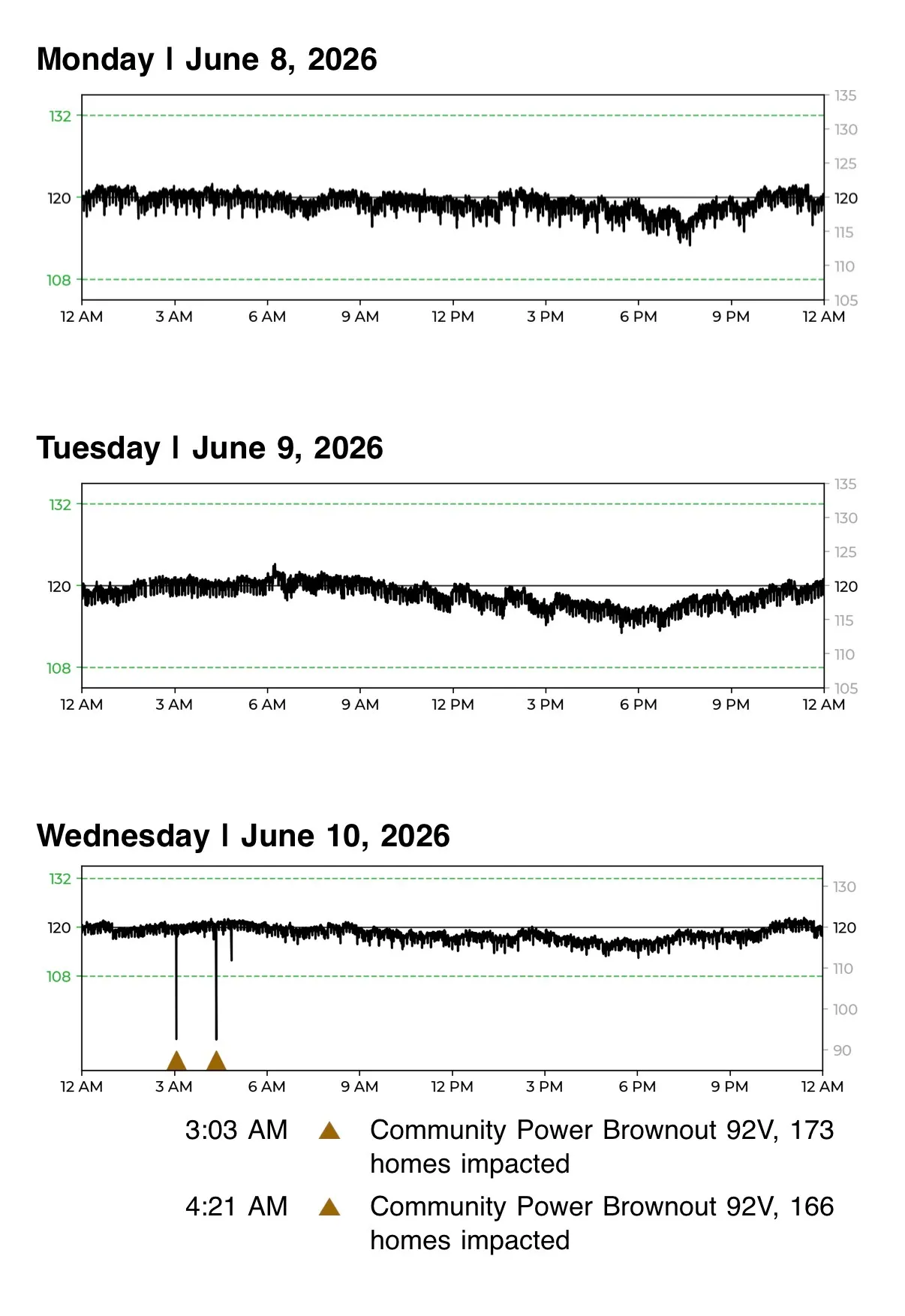
Each week, I get a report where I can see outages and any anomalies. If it spots a hazard, a member of Ting’s team actually calls you, walks you through isolating the problem at your breaker panel, and if it’s serious, helps you get a licensed electrician out (with a credit toward the repair).
The mechanism is clever. When wiring starts to fail (a loose connection, a damaged cord, a corroded outlet), it produces tiny intermittent electrical discharges called scintillations. These generate high-frequency pulses that propagate through the home’s wiring. Over time, this “arc tracking” can evolve into a full arc fault big enough to ignite a fire, a process that can take weeks to years. Ting is listening for those early pulses.
And you only need one. Because all your home’s circuits share a common neutral back at the breaker panel, a single Ting can detect arcing anywhere in the house, on either 120V or 240V leg, not just on its own circuit.
The growth and the numbers are worth a look:
- Now installed in over a million homes.
- The company says it has identified and resolved more than 15,000 hazards before they could start a fire, and states Ting prevents about 4 out of 5 electrical fires.
Alright, so what does the building code say about detectors?
Here’s what the 2020 Minnesota Residential Code (R314 and R315) and Minnesota Statutes 299F.362, 299F.50, and 299F.51 require.
Smoke alarms. Required in every dwelling. They must be located:
- In each sleeping room (bedroom)
- Immediately outside each separate sleeping area
- On each additional story, including basements and habitable attics (crawl spaces and uninhabitable attics don’t count)
A couple of placement quirks worth knowing: alarms must be at least 3 feet horizontally from a bathroom door (steam triggers false alarms) and shouldn’t sit right next to cooking appliances. For new construction, smoke alarms must be hardwired, have battery backup, and be interconnected, so when one goes off, they all go off.
Carbon monoxide alarms. Required in every single-family home and dwelling unit that has fuel-burning appliances or an attached garage. They must be:
- Installed within 10 feet of each room used for sleeping
- On each level containing sleeping areas
- Inside the bedroom itself if a fuel-burning appliance is in that bedroom or its attached bathroom
CO alarms must be UL 2034 certified, and combination smoke/CO units must meet both UL 217 and UL 2034.
My habit: test every month.
You can have every alarm placed perfectly to code and still die in a fire if the thing doesn’t work when it counts. Batteries die. Sensors wear out. The unit on your ceiling looks identical whether it’s protecting you or not.
So here’s the routine, and it takes about 90 seconds:
- Test every alarm once a month. Press and hold the test button until it sounds. Walk the house, hit everyone.
- Change the batteries once a year. Easy memory trick the CDC and Minnesota fire officials both recommend: do it when you change your clocks for daylight saving time.
- Replace smoke alarms every 10 years. The whole unit, not just the battery. Most have a date stamped on the back.
- Replace CO alarms on the manufacturer’s schedule (usually 5 to 7 years). The sensor degrades whether or not it’s ever seen any CO.
Now go check those detectors in your house!
Hunter
We built a bunch of FREE resources for you!
- Take our home health quiz (~5 min)
- View a recent home assessment report
- Try out our indication guide to lead pipes
- See your radon risk with our Minnesota radon map
- Calculate what the best air purifier is for your home from our database
- Schedule a free 15 minute chat with our founder about any questions you have