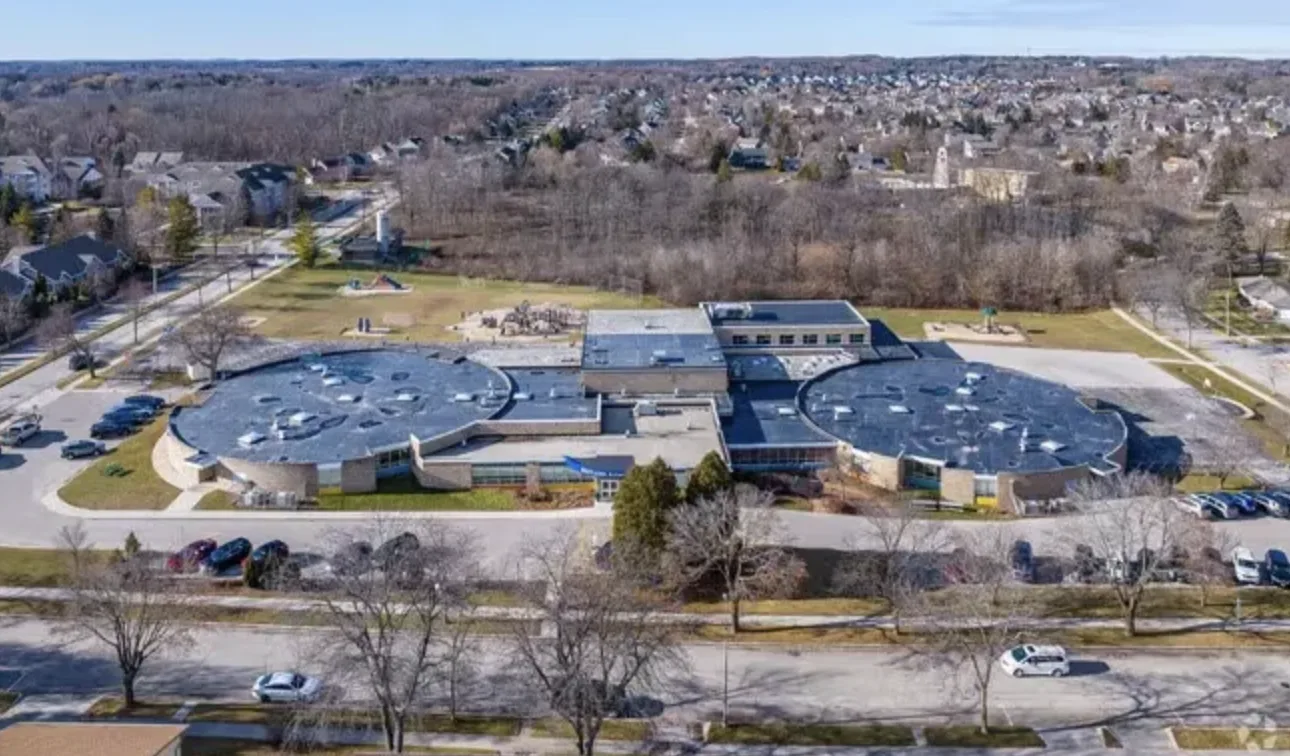
By the time a student graduates from high school, they have spent roughly 15,600 hours inside a school building.
That’s second only to the time they spend at home.
It’s about 650 days, or nearly two full years of a child’s life spent inside a school, around the clock. It’s more than 7 years of a full-time, 40-hour-a-week job.
That is a lot of time. It also happens to be the crucial developmental years of our lives, with rapid physical growth, hormonal changes, and brain and social development.
There are ~54 million K–12 students in the U.S. today.
There are ~131,000 K-12 schools in the U.S. today.
Most of these students spend their day in a school environment that is aging.
The average main school building in the U.S. is 49 years old, and 38% were built before 1970.
The Government Accountability Office estimates 41% of districts need to update or replace HVAC systems in at least half of their schools.
More than 5 million U.S. students attend K-12 schools reliant on public water systems that issued drinking water violations in the past year.
The EPA estimates nearly 1 in 5 schools has at least one room above the 4 pCi/L radon action level.
Most classrooms are still lit by flickering fluorescent tubes.
And according to data from the CDC, up to 40% of U.S. school districts have reduced or eliminated recess since the mid-2000s.
So students are spending more time inside in suboptimal learning environments.
Children are not small adults. Pound for pound, they eat more food, drink more water, and breathe more air than we do, so whatever is in a classroom’s air or water, a child takes in more of it relative to their size. Their airways are narrower, their natural defenses (like nasal filtration and the blood-brain barrier) are still developing, and they spend more time near the floor with hands in their mouths.
They’re also more sensitive to light. Kids have larger pupils and show more melatonin suppression from light than adults, so the lighting they sit under all day has a bigger effect on their internal clock and sleep.
It is hard not to say that these environments are contributing factors to students’ learning and overall health.
Nearly 1 in 13 school-age kids has asthma, and it’s the leading chronic-illness cause of missed school, about 13.8 million missed days a year. Schools are full of common triggers: dust, mold, cockroach and mouse allergens, and harsh cleaning chemicals.
There’s a whole body of research looking at how the school building itself affects how kids feel, think, and perform.
Air quality. In Finland, researchers surveyed more than 4,200 sixth graders across nearly 300 schools, along with their principals. Low ventilation rates, moisture and dampness, and inadequate ventilation were each independently linked to more respiratory symptoms. Inadequate ventilation was also tied to more missed school days.
Air quality. A research team in the U.S. measured ventilation directly in 100 elementary classrooms in the Southwest. 87 of the 100 were below the ventilation standard. They then matched those measurements to test results and found that every 1 liter per second, per person increase in ventilation was associated with about a 2.9% increase in math scores and 2.7% in reading.
Light. In one study, third graders spent a full school year in classrooms with adjustable lighting, where a bright, cool “focus” setting (1,000 lux, 6,500 K) was used during reading. By midyear, students in the focus lighting improved their oral reading fluency by 36%, compared to 17% for students in standard lighting (500 lux, 3,500 K).
Noise. In France, researchers studied more than 500 kids (ages 8 to 9) across 35 primary schools, where the average noise level was around 50 dB. Standardized test scores in math were 5.5 points lower for every 10 dB increase in noise.
Pests. An asthma study led by Dr. William Sheehan at Boston Children’s Hospital, followed 284 students with asthma across 37 schools and collected dust from their classrooms. Mouse allergen showed up in 99.5% of school dust samples, at levels much higher than in the kids’ own homes.
There is significant evidence that school buildings affect student health, thinking, and performance.
Good news. There is momentum in healthy learning environments!
I want to share a cool example I saw recently in Austin, TX.
Kindling Academy is a new school in Austin, Texas, with the goal of becoming, in their words, “The Healthiest School in America.” They’re starting small, with a single mixed-age pilot classroom of kids ages 4 to 8, blending Montessori structure with project-based learning.
It was founded by Rachel and Mike Feldstein. Wellness (air quality) entrepreneurs and parents.
On their site, under a section called “Where Most Schools Get It Wrong,” two of the six issues they list are environmental. They point to harsh lighting that messes with sleep, cleaning products and air “fresheners” full of chemicals, and stale air.
They also make a really good point. That when one kid gets sick, the whole family feels it. Parents get sick, work gets missed, the week falls apart.
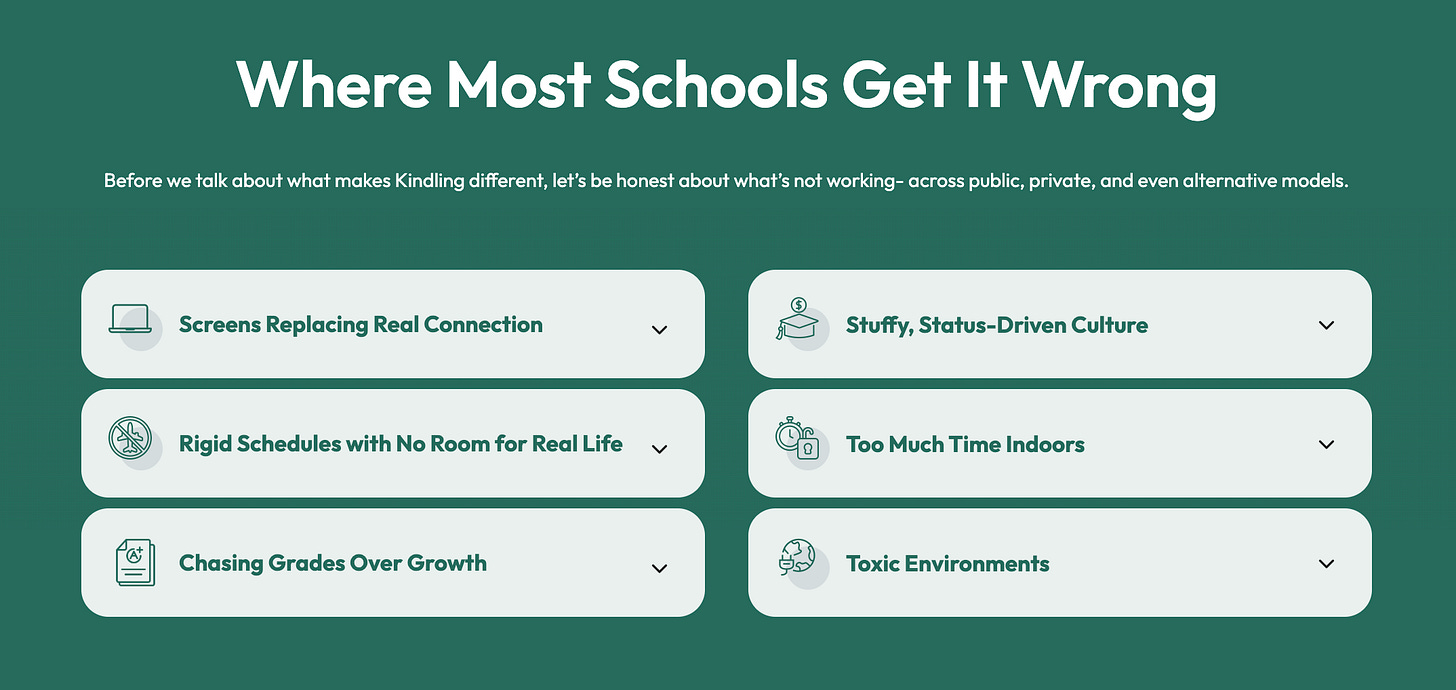
They are taking actions like installing air purifiers in every classroom, utilizing a circadian rhythm lighting system, only cleaning with Non-toxic cleaning products, providing purified drinking water, and giving lots of time outdoors every day, rain or shine, with outdoor spaces treated as part of the classroom.
Super cool!
This was fun to dive into, and I’m still learning. If you’re a parent, teacher, or work in a school and have seen any of this firsthand, let me know. I reply to every message.
Wishing everyone a happy (and healthy) school year,
Hunter
We built a bunch of FREE resources for you!
- Take our home health quiz (~5 min)
- View a recent home assessment report
- Try out our indication guide to lead pipes
- See your radon risk with our Minnesota radon map
- Calculate what the best air purifier is for your home from our database
- Schedule a free 15 minute chat with our founder about any questions you have