A few years ago, my grandpa was diagnosed with Alzheimer’s.
It is a progressive, irreversible brain disorder that slowly damages nerve cells, and if you know someone who has been through it, you know there is no linear path to how it unfolds.
At first he was forgetful. Then it moved from memory to mobility. Stairs were challenging. The shower was challenging. Getting into the car got hard. Then it was both at once. Not being able to focus on the Cardinals baseball game on TV. Not remembering where he was in his home.
My grandma became his full-time caregiver, doing everything she could to help him stay where they had built their life together. She held it together for a long time.
But after a few incidents in the home, it reached the point where he had to move to a place to receive more care. The house they loved could not keep up with the way he was changing, and neither could one person caring for him inside it.
A lot of families have a version of this story. A grandparent, a parent, a friend. And underneath it is something almost universal: nearly all of us want to stay in our homes for as long as we can. But our homes are not built for how we actually age. They need to evolve to meet us where we are.
So let’s talk about it.
America is aging.
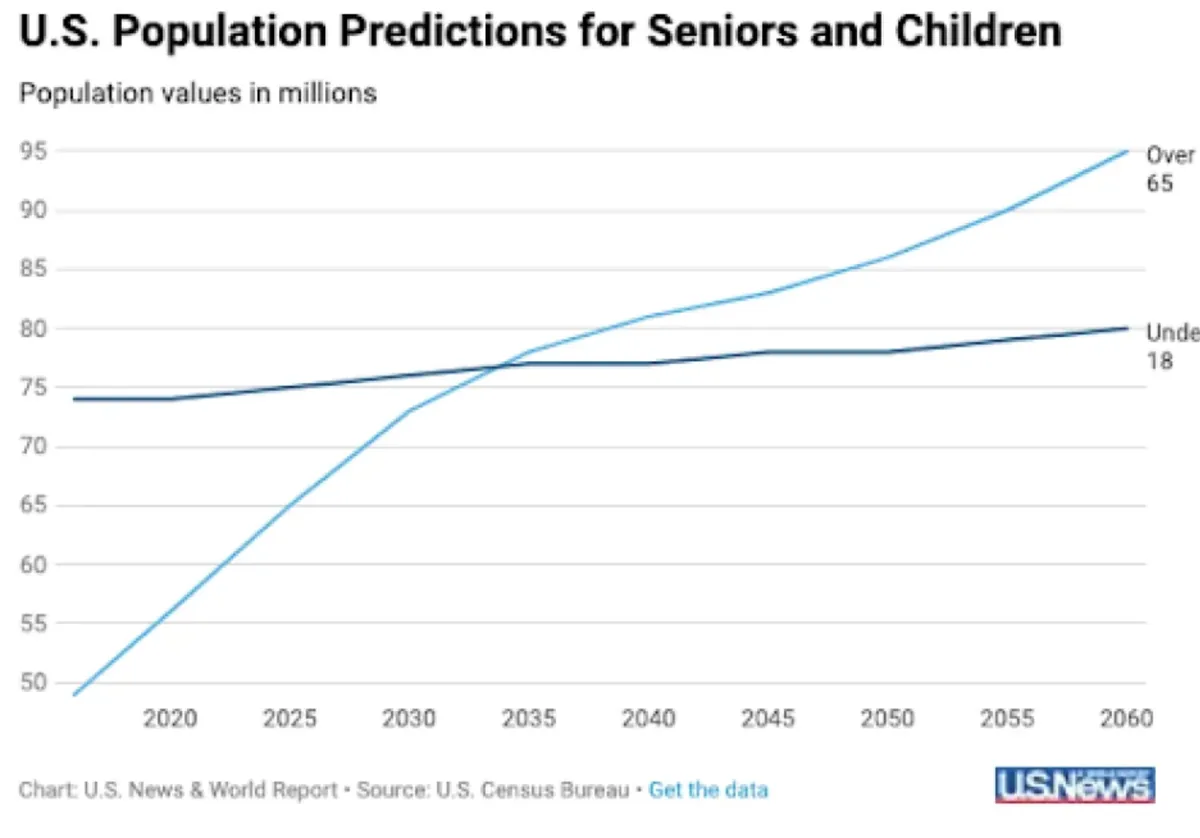
We are in the early innings of the largest demographic shift in modern history.
About 10,000 Americans turn 65 every single day. There are already more than 61 million people 65 and older in the U.S., about 18% of the population, projected to climb past 80 million by 2050.
They are also living longer than any generation before them.
And these are people who are staying put, too. Average homeowner tenure has nearly doubled since 2005, and something like 40% of baby boomers have been in the same home for more than 20 years.
And when you ask them, they want to live in that home for as long as possible.
But most homes are not built for how aging actually unfolds.
Only 10% of homes are “aging-ready,” meaning they have an environment that supports accessibility.
So you have a house nobody wants to leave, occupied by someone who is slowly changing, in a structure not designed for their daily needs. And when those three things collide, there is usually one specific event that sets everything else in motion.
A fall.
Falls are the leading cause of both fatal and nonfatal injury among older adults, and more to the point, they are the single most common reason someone loses their independence and ends up leaving home.
More than 1 in 4 adults 65+ fall each year. That is about ~14 million people.
In 2021, falls caused about 38,000 deaths among older adults, and emergency departments logged roughly 3 million fall-related visits.
Wisconsin had the highest age-adjusted fall death rate in the country (about 176 per 100,000 older adults), more than five times the lowest state. The cold, the ice, the stairs to the basement, the long winters indoors. This is very much a problem for our geography.
The challenging part about a fall is that it can have an impact on both the body and the mind.
After a fall, or even a close call, a lot of older adults quietly start doing less. They stop walking to the mailbox. They skip the grocery trip. They hold the counter.
This is a rational response to a frightening event, but a bigger problem. Less movement means weaker legs and worse balance, which means a higher chance of the next fall, which means more fear. Researchers call it a fear-restriction-deconditioning cycle, and it can spiral someone from “independent” to “assisted-living” in under a year.
The fall is often less devastating than the retreat from life that follows it.
Aging in place is deeply tied to identity, to independence, to dignity.
And the health outcomes are better when people age in place. NIH research shows that people who age where they want maintain stronger social connections, better mental health, and greater autonomy for longer.
Social connection in particular turns out to be one of the strongest predictors of long-term health for these people. Roughly a third of seniors report feeling lonely, and isolation has been linked to a meaningfully higher risk of dementia and heart disease.
And then there is the money for long-term care facilities, which average $5,000 a month, and memory care runs higher. Research has been done and shows that staying home safely, by comparison, can save a household on the order of $24,000 a year.
Safe aging in place needs multiple aspects to work.
Medical. Access to routine medical support. Medication adherence. Strength and balance maintained. Vision and hearing checked and corrected.
Social. Someone checking in. Friends to meet with and activities to do. Neighbors, family, friends, and a community.
Environment. The house itself.
They are all incredibly important. I am really passionate about the environment aspect and have been through it with my family, so here is what I would tell you if you are helping someone age in place.
This would be my healthy home aging-in-place list.
- Bathroom (highest-risk room): Install grab bars at the toilet and shower entry, lag-screwed into studs to hold body weight. Where a remodel is possible, add a walk-in shower, a comfort-height toilet (17–19″), a handheld showerhead, a fold-down shower seat, and slip-resistant flooring/mats with real suction backing.
- Stairs: Often the deciding factor in whether someone can stay home. Add handrails on both sides, secured into studs and running the full length, plus high-contrast tape or lighting on tread edges. For bigger mobility drops, consider a ramp for a few exterior risers, a stairlift, or relocating the bedroom and a full bath to the first floor.
- Entry & doorways: Provide at least one zero-step, covered entry (ramp, regraded walkway, or small platform lift), sensor lighting, and non-slip flooring in the entryway. Widen doorways to at least 32″ (ideally 36″) for walker/wheelchair clearance, and swap round knobs for lever handles throughout.
- Kitchen: Lever faucets, pull-out/roll-out shelving, D-shaped cabinet pulls, front controls on the stove (with a hot-surface indicator), side-by-side or accessible-height fridge/freezer, and open under-counter seated workspace all keep cooking safe and independent longer.
- Flooring & hallways: Remove or securely tape down all loose rugs, one of the most common trip hazards. Use smooth, non-glare, slip-resistant flooring with color/texture contrast at level changes, and keep hallways wide, well-lit, and clear of cords.
- Lighting, electrical & safety: Install new smoke/CO detectors, automated lighting or a video-monitoring/emergency alert system, and place all switches/thermostats no higher than 48″ from the floor for easy reach.
- HVAC & windows: Favor units with easily accessible filters, quality air filtration, and cross-ventilation. Choose lower-sill or taller windows with easy-to-operate hardware for natural light without a stretch.
- Storage & closets: Adjustable rods/shelves, closet lighting, and easy-open doors that don’t obstruct access.
- Overall floor plan: Where possible, keep main living (including a full bath) on a single story, with no steps between rooms and enough clear turning space (5′×5′) in the living area, kitchen, a bedroom, and a bathroom.
- Exterior: Low-maintenance siding (vinyl or brick) and low-maintenance landscaping reduce the physical upkeep burden as mobility declines.
A healthy home is one you can age in forever!
This one is personal for me. If you are helping someone you love stay in their home, I would love to hear from you.
Hunter
We built a bunch of FREE resources for you!
- Take our home health quiz (~5 min)
- View a recent home assessment report
- Try out our indication guide to lead pipes
- See your radon risk with our Minnesota radon map
- Calculate what the best air purifier is for your home from our database
- Schedule a free 15 minute chat with our founder about any questions you have