I’ve worked remotely for the past five years.
And like most remote workers, I care a lot about my workspace.
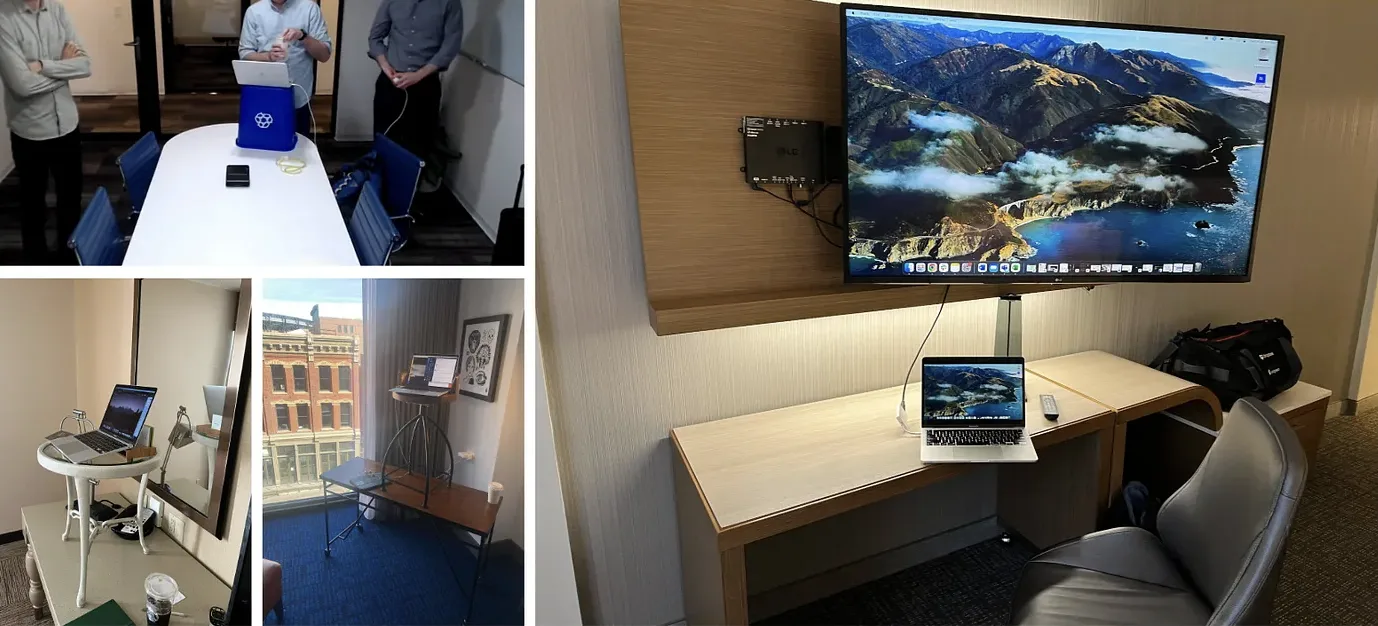
At my company, we even made it a game. We’ve done “Guess That WFH Setup,” where everyone submitted photos of their home offices, and we had a dedicated Slack channel for sharing DIY setups when we’re traveling.
My co-workers Charley and Colin were by far the most creative. Here are some of their best setups…
Our workspace is a significant part of our lives.
~162 million people are employed in the United States (U.S. Bureau of Labor Statistics, Aug. 2026).
56% of the U.S. workforce, roughly ~91 million people, hold office-compatible or “knowledge work” jobs that do not require physical or manual labor.
And with most working full-time, 8 hours a day, five days a week, 48 weeks a year, over a 45-year career. That’s about 86,000 hours. That is roughly ten full years of your life.
A lot of people are at a desk for a lot of their life. So the setup matters.
But what, exactly, makes a desk setup healthy?
Let’s start with the most obvious question: should you be sitting or standing?
Around 2010, large population studies started linking prolonged sitting with higher rates of early death.
One of the most widely cited studies followed more than 222,000 Australian adults and found that the more people sat, the higher their risk of dying during the study period.
The headline became “sitting is the new smoking,” and standing desk sales exploded.
But then the argument got messy.
People who sit all day also tend to exercise less and be in worse shape to begin with. So the question became: was sitting for work itself the problem, or was it simply a marker of a more sedentary lifestyle?
And then studies started suggesting that standing all day might actually be worse.
The problem is that every study and report looks at “health” through a single lens. None weigh multiple aspects of health together, which is why conclusions about what's “best” often contradict each other.
A more complete picture has to account for four important dimensions: musculoskeletal health, heart health, metabolic health, and mental health.
Musculoskeletal health. Standing for moderate amounts, broken throughout the day, could help reduce neck/upper back pain, but standing too long could increase lower back pain.
Heart & metabolic health: Standing still isn’t cardio. Most people see minimal increase in calories burned (<10 extra calories an hour) from standing throughout the day. In one study, when people swapped about an hour and twenty minutes of sitting for standing each day, blood sugar and body fat dropped only slightly. Blood pressure, cholesterol, and weight didn’t change at all.
Mental health. Some people report a mood boost from using a standing desk. Part of that may be psychological, since doing something you perceive as healthier (and a bit more challenging) can lift your mood on its own.
So standing desks seem to be good for breaking up long stretches of sitting, easing neck and upper back pain, and giving a mood boost. However, they’re not a workout or something you should do for hours on end.
So what actually works?
Movement & Variety.
The strongest evidence for a healthy desk setup is actually having multiple different desk setups.
It isn’t one perfect setup. It’s a rotation of sitting, standing, walking, and exercise.
Ergonomists have a saying for this: the best posture is your next posture. Static load is the enemy. The body wants variety.
I have found that my most productive days include…
Sitting at my desk for focused, detailed work. With my cup of coffee, SAD lamp on, and trying to maintain a neutral posture in my chair. I think the type of chair isn’t actually that important. The furniture company Branch built a free ergonomics calculator that I found pretty informative for screen & keyboard placement.
Stand to break up the sitting. I aim for getting 2 hours of standing throughout the day. It doesn’t matter as much when, but not standing for more than an hour at a time. I find that on longer Zoom calls and when presenting, standing is best.
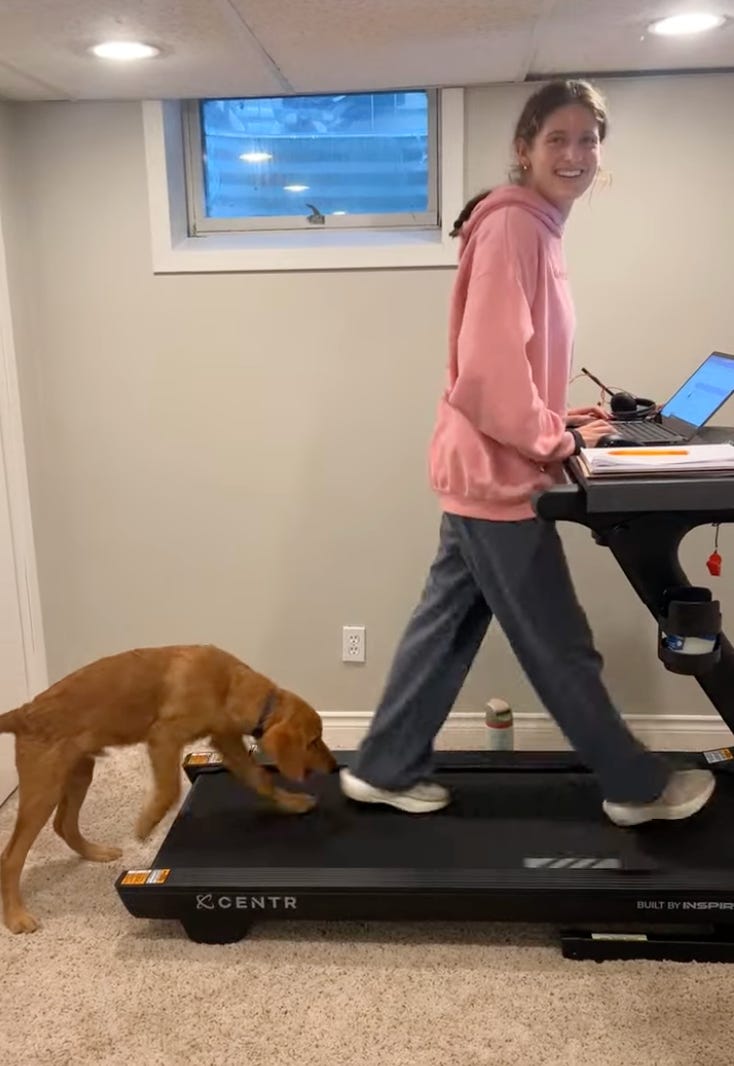
Walk throughout the day. Internal meetings and thinking through a problem all work on foot. Walking outside (in nature) can be extra helpful for creativity too. And the pup love its!
Last winter we got a treadmill, and I built a desk for it. I love to walk and work on it during the winter; my wife and pup do too!
Mix and match. This is probably the biggest benefit of remote work. Most days I go to a coffee shop to change the scenery for my deep work. Some days I can sit on my patio for meetings.
I came to believe that maybe the desk setup doesn’t actually matter as much as how you use it. Now my limitation is that I can move my workspace freely.
If you are in an office every day, I would focus on your neutral sitting position and movement breaks (blog on that coming soon).
Hunter
We built a bunch of FREE resources for you!
- Take our home health quiz (~5 min)
- View a recent home assessment report
- Try out our indication guide to lead pipes
- See your radon risk with our Minnesota radon map
- Calculate what the best air purifier is for your home from our database
- Schedule a free 15 minute chat with our founder about any questions you have