I saw this yesterday…Lüften
A German practice of opening your windows daily, which went viral in the U.S. on social media as a trend called “House burping.” Opening all windows in your house for 15 minutes, no matter the outside temperature, daily, to improve indoor air quality.
Great idea, nothing novel. But the origins are pretty interesting.
Lüften.
The German word lüften (pronounced “LEWF-ten”) translates roughly to “airing out.”
Traditional German lüften involves opening multiple windows across your home to create cross-ventilation, allowing fresh outdoor air to completely replace stale indoor air in a short burst (typically 5-15 minutes). The key is creating a draft that rapidly exchanges the air, not just cracking a window for hours.
The lüften practice comes in different forms:
Stoßlüften (shock ventilation): Opening windows wide for 5-15 minutes
Querlüften (cross ventilation): Opening windows on opposite sides of the home to create a through-draft
Kipplüften (tilted ventilation): Leaving windows slightly ajar for longer periods (though Germans consider this less effective and energy-wasteful)
Where This Came From.
The German commitment to lüften has roots back to the 1850s-1890s, when scientists fought intellectual wars over how disease actually spread.
In the 1850s, Munich was notoriously filthy, with waste and sewage frequently dumped into streets or cesspools, leading to severe sanitary issues. This resulted in high rates of infectious diseases, culminating in a major cholera epidemic in 1854 that claimed the life of Queen Therese.
Enter Max von Pettenkofer, a Bavarian chemist and the world’s first Professor of Hygiene. He studied how the environment in which people live impacts their health.
He noticed that people in crowded rooms felt terrible. Headaches, fatigue, and sluggishness. But nobody knew why. Everyone talked vaguely about “bad air” and “miasmas” (basically, smelly air was thought to make you sick). But there was no way to measure it.
In 1858, Pettenkofer published a groundbreaking paper on ventilation in residential buildings. His insight was that human bodies constantly release stuff into the air. We breathe out CO2, we sweat, and we shed skin cells. We emit various bioeffluents (body-release pollutants).
Now, measuring all that directly would be impossible.
But CO2? That he could measure accurately (he actually invented a titration method to do it), and CO2 levels track pretty closely with all the other bioeffluents. It’s a great indicator of poor air quality and ventilation.
So he took his titration apparatus all over Munich (into homes, schools, hospitals, inns, anywhere people gathered). He measured CO2 levels in rooms people said had “good air,” and rooms people said had “bad air.”
He found an interesting pattern.
Outdoor air had very little CO2, around 300-400 parts per million (ppm). But indoor air varied vastly. In rooms where people felt fine and could think clearly, CO2 stayed below 1,000 ppm. In rooms where people complained of stuffiness, headaches, and fatigue, CO2 climbed well above that threshold, sometimes reaching 2,000 or 3,000 ppm.
He proposed that 1,000 ppm should be the maximum acceptable level for indoor spaces. This became known as the “Pettenkofer number.” 1
Why does that matter?
Because Pettenkofer’s 1,000 ppm number has stood the test of time.
170 years of research later, we still use it. The EPA, WHO, ASHRAE, and building codes worldwide reference 1,000 ppm.
And CO2 is still the best indicator of ventilation quality.
Here’s why. Humans exhale CO2 at a consistent, predictable rate based on our metabolism. When CO2 levels rise indoors, it means one of two things is happening (or both).
Too many people are in the space for the amount of fresh air coming in
The air isn’t being exchanged with outdoor air frequently enough
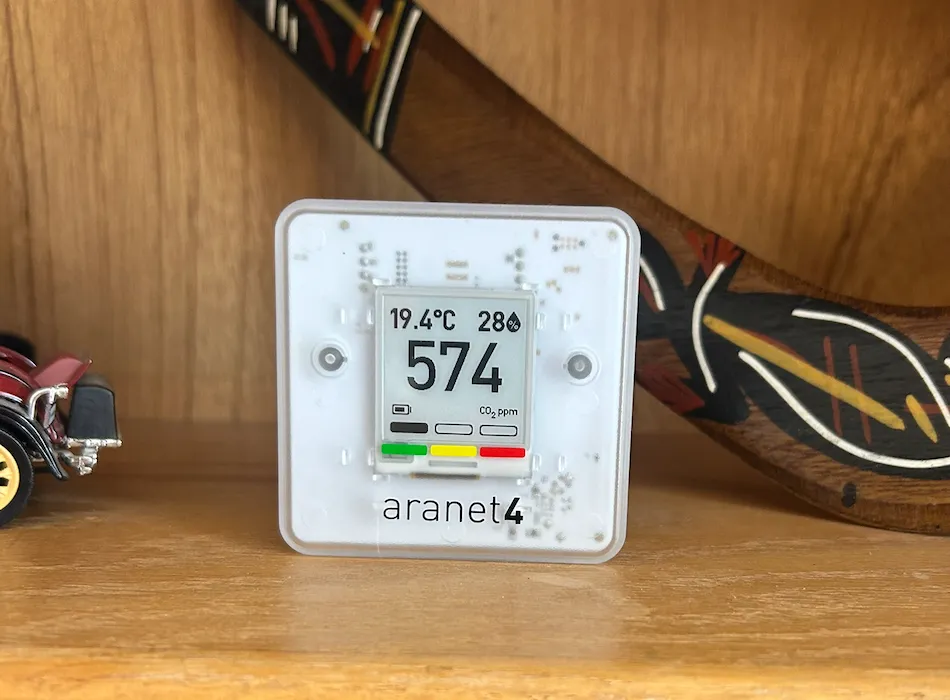
In homes I test, including my own, I utilize a CO2 measurement device to get a sense of the ventilation in each room.
Why?
Think of it like this. When you exhale, you release about 40,000 ppm of CO2 with every breath. That CO2 mixes into the room air. If fresh outdoor air (which has ~400 ppm CO2) is constantly flowing in and pushing that exhaled CO2 back out, levels stay low. If fresh air isn’t flowing in fast enough, the CO2 accumulates.
So when I measure 1,500 ppm in a bedroom, I’m not just seeing “slightly elevated CO2.” I’m seeing proof that whatever else you’re exhaling (viral particles, VOCs from your breath, humidity, etc.) is also accumulating. The air isn’t being refreshed fast enough.
That’s why CO2 is such a useful measurement. It gives us a real-time window into something we can’t see: the air change rate.
The air change rate, measured in air changes per hour (ACH), looks at how many times the entire volume of air in a room gets replaced with fresh outdoor air.
A typical (energy-efficient, tightly sealed) home in the U.S. with all windows closed has about 0.3 to 0.6 air changes per hour (ACH) just from natural leakage through cracks, gaps, and intentional HVAC makeup air. That means it takes 90-200 minutes to completely replace the air once.
For comparison.
0.3-0.6 ACH: Typical, naturally, in a modern home (often insufficient)
1-2 ACH: Minimum recommended for occupied spaces
4-6 ACH: With proper mechanical ventilation systems (bathroom)
7-15 ACH: With proper mechanical ventilation systems (kitchen & bedroom)
I like to see homes ideally with 5+ ACH, especially in places where we spend most of our time, like our bedrooms.
Studies agree.
A 2015 study from Denmark’s Technical University tracked students sleeping in their dorm rooms under two conditions: windows open (average CO2: 660 ppm) versus windows closed (average CO2: 2,585 ppm). The researchers used actigraph monitors to objectively measure sleep quality and tested cognitive performance the next day.
The results. When bedroom CO2 stayed low, students showed significantly better objectively measured sleep quality, reported feeling more refreshed in the morning, experienced less next-day sleepiness, had better ability to concentrate, and performed better on logical thinking tests. 2
So, back to Lüften, and why opening your windows is important.
When you create cross-ventilation by opening opposite windows, you generate more ACH. This rapid exchange helps to flush out accumulated CO2 from human respiration, particulate matter (PM), and VOCs.
If you are opening your windows, make sure:
Check outdoor air quality first. An AQI of <50 is ideal. If it is wildfire season in your region, this approach may worsen indoor air.
Cross-ventilation is even better. If your home layout allows, open windows on opposite sides of your home - this creates the crucial through-draft.
Timing is important. Early morning (6-8 am), outdoor AQI is normally lowest. Late evening (8-10 pm), temperature stabilizes, and can help remove CO2 buildup before bed.
Avoid during rain or lawn treatment. This can bring in more humidity (mold spores) and unwanted chemicals (pesticides)
If opening the windows is NOT in the cards, don’t worry, there are lots of other ways to improve indoor air quality, more on this another time!
Hunter
We built a bunch of FREE resources for you!
- Take our home health quiz (~5 min)
- View a recent home assessment report
- Try out our indication guide to lead pipes
- See your radon risk with our Minnesota radon map
- Calculate what the best air purifier is for your home from our database
- Schedule a free 15 minute chat with our founder about any questions you have