In October 1987, the Environmental Protection Agency (EPA) began installing new carpet at its headquarters in Washington, D.C. The carpet went in gradually over several months, 243,000 square feet of it.
Then people started getting sick.
At first a few workers complained about the fumes. By January 1988, the complaints were loud and constant: burning eyes, sore throats, headaches, dizziness, difficulty concentrating, joint and muscle pain, nausea. Some employees were taken to the hospital. A handful could no longer enter the building without becoming severely ill.
By April 1988, according to a case report by EPA scientists William Hirzy and Rufus Morison, roughly 124 of the agency’s 2,000 headquarters employees had gotten sick from the new carpet off-gassing. Seventeen could no longer work at their normal stations. Eight had developed new sensitivities to things they’d tolerated fine before: perfume, auto exhaust, tobacco smoke. At least two quit. The EPA removed all of the carpet.
The culprit? 4-phenylcyclohexene, or 4-PC, a byproduct of the styrene-butadiene latex used to glue carpet backing together. It is what gives new carpet that “new carpet smell.” The EPA eventually replaced its flooring with a different, urethane-backed version, and the problem went away.
Let’s talk about carpet.
We put it almost everywhere.
Carpet was once a luxury reserved for the very rich. Cheap fossil fuels and mass production changed that. Between 1960 and 1993, U.S. carpet purchases grew by 654% while the real cost dropped through the floor. By 2000, carpet and rugs made up about 60% of the U.S. flooring market.
That share has been sliding ever since as hardwood and luxury vinyl take over living rooms and kitchens. By 2025, soft surfaces (carpet plus rugs) accounted for 43.4% of the flooring market by volume. But it is still the single largest flooring category in the country, and its hold on one particular room is basically unassailable: the bedroom.
Which matters more than it sounds. You spend roughly a third of your life in your bedroom, breathing air close to the floor for eight hours at a stretch.
So what’s actually the problem?
There are two problems.
Problem one: what synthetic carpet gives off.
New synthetic carpet off-gasses volatile organic compounds, and to understand where they come from it helps to know that a carpet is really three layers stacked together. Each one contributes its own chemistry.
- The face fiber (the part you walk on) is almost always a petroleum-derived plastic: nylon, polyester, or polypropylene. As these fibers are made and as they slowly break down, they release VOCs. Any dye and topical treatment applied to them adds more solvents like toluene and xylene, and stain-resistance coatings have historically added PFAS.
- The backing is where the worst offenders usually hide. Around 95% of synthetic carpet uses a styrene-butadiene rubber (SBR) latex backing, and that backing is the source of the single most famous carpet chemical: 4-PCH. It’s the compound behind the “new carpet smell,” and it’s been linked in the literature directly to sick-building complaints.
- The adhesive that binds the layers (and glues the carpet to the floor in glue-down installs) is the third source. These adhesives commonly contain formaldehyde along with benzene and toluene.
Stack those three layers and a single synthetic carpet can emit more than 40 distinct chemicals. Heat and humidity speed the release up.
Problem two: what the carpet holds onto.
Carpet is a dust sponge.
A 2022 dust study in Environmental Science & Technology Letters out of a team including researchers at the Green Science Policy Institute described carpet’s dual role as both a source and a repository of dust-borne contaminants. Dust settles out of the air and gets tracked in on shoes, then works its way down into the carpet, where the fibers hold onto it far better than a hard floor ever could. Foot traffic then kicks it back up.
The challenge for young children.
Babies and toddlers live on the floor. They crawl through the exact layer where heavy, semi-volatile chemicals settle. Their hands go to their mouths constantly. They breathe faster and take in more air per pound of body weight than an adult does, so the same dust concentration delivers a bigger dose to a smaller body.
This is why so much of the carpet-dust research is built around children specifically. The EPA’s own CTEPP study measured preschoolers’ exposure to pesticides and other chemicals through carpet dust, air, and hand wipes.
The vacuuming myth.
Vacuuming feels like the obvious answer to a dirty carpet, so it’s worth being clear about what it actually does.
A bad vacuum can leave a room worse than it found it.
Here’s why. A vacuum pulls air (and dust) up through the machine and then blows it back out the exhaust. If the filter can’t hold the finest particles, the machine simply relocates them, sucking dust off the floor and firing it out the back as an airborne cloud. On top of that, the beater bar and the airflow disturb the pile and launch settled dust that was sitting quietly a second ago.
Researchers have measured this directly: in a study across a dozen apartments using non-HEPA vacuums, PM10 in the air rose by an average of more than 17 µg/m³ above background during cleaning.
So is vacuuming pointless? No, if you have the right filter. A sealed, true-HEPA vacuum (rated to capture 99.97% of particles at 0.3 microns) flips the math. Instead of exhausting fine dust back into the room, it traps it. Go slow. Fast passes don’t give the machine time to lift and capture. Slow passes do.
Here is a trick for how often you should vacuum per week. Take the number of people + pets in your home, subtract one, and that is the number of times you should vacuum per week! More than you would think…
What to do about it.
Avoid synthetic wall-to-wall carpet.
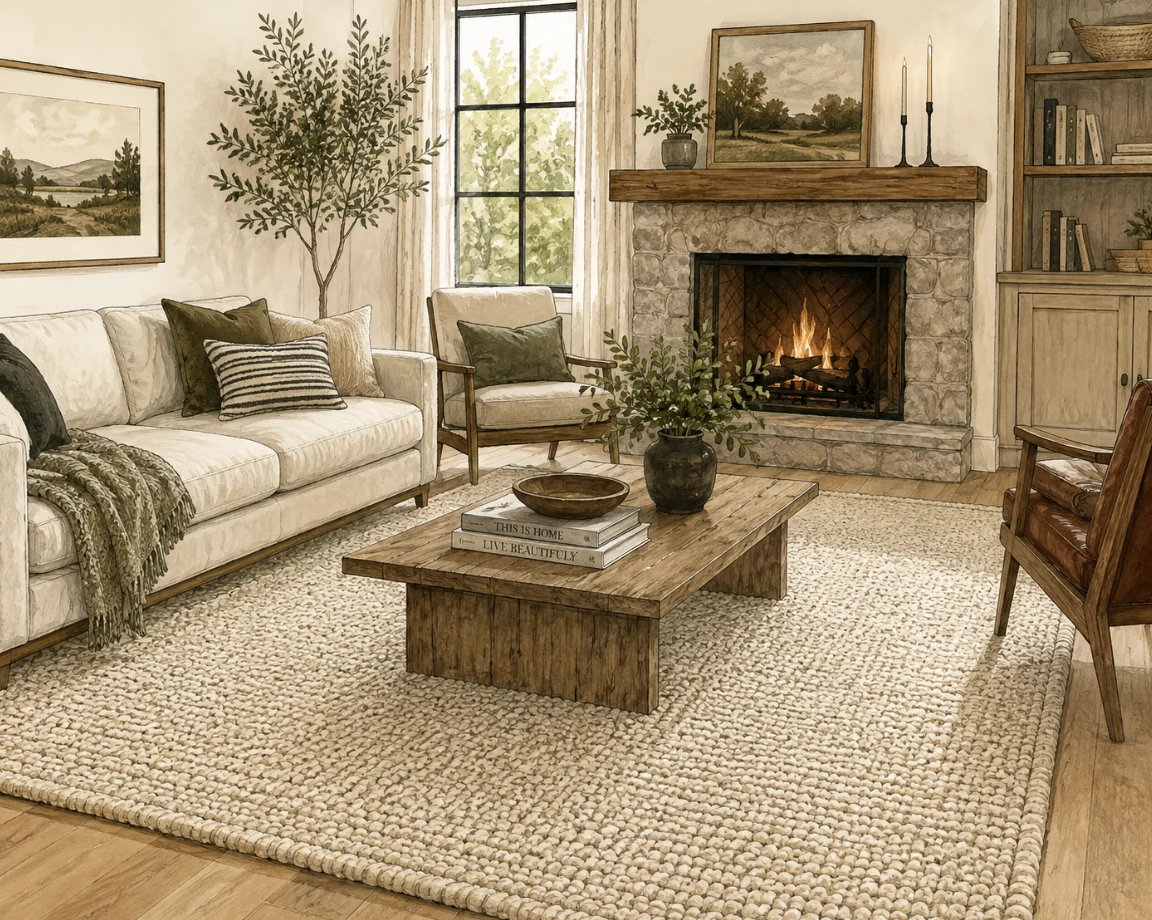
A hard floor topped with natural-fiber rugs is the best healthy home setup. You still get softness and warmth underfoot, can still have your design touch in a room, and it is easier to wash and keep clean.
What natural fibers do you recommend? There are three good options.
- Wool is the one I’d put in a bedroom. It’s soft and warm underfoot and durable enough to last decades. It also has real health advantages baked into the fiber. The natural lanolin coating makes spills bead up instead of soaking in, wool resists dust mites and microbial growth in a way synthetics don’t, and it’s naturally flame-resistant. Real wool is the most expensive option, and new wool rugs shed at first.
- Jute is a fast-growing plant fiber and is a budget-friendly option with an earthy look that pairs beautifully with wood floors. It’s also naturally anti-static. It does, however, feel coarse underfoot, and it hates moisture, a spill that soaks in can leave a permanent mark, so keep it out of bathrooms, kitchens, and damp basements.
- Cotton is softer than jute, far cheaper than wool, and often machine-washable. That washability makes it ideal exactly where messes happen: entryways, kids’ rooms, kitchens. The tradeoff is lifespan; cotton wears and fades faster than wool and won’t spring back under heavy furniture.
“Natural fiber” on its own isn’t a guarantee. Even a wool or cotton rug can be dyed, treated, or finished with harsh chemistry. So it’s important to look for certain quality marks.
OEKO-TEX Standard 100. It tests the finished product, every component- fiber, thread, dye, backing- for a long list of substances known to harm human health: formaldehyde, heavy metals, azo dyes, certain pesticides, and more. If a rug carries this label, an independent lab has confirmed the thing you’re bringing into your house is free of harmful residues above defined limits.
GOTS (Global Organic Textile Standard). It’s a process audit, not just a product test, and it follows the whole supply chain: the fiber has to be certified organic, the processing chemistry is restricted, wastewater is regulated, and fair-labor standards are enforced and audited annually. To wear the full organic label a product has to be at least 95% certified organic fiber.
Neither one is a complete claim by itself, which is why the strongest thing you can find is a rug carrying both: GOTS for how it was grown and made, OEKO-TEX to confirm the finished piece tests clean.
Best,
Hunter
We built a bunch of FREE resources for you!
- Take our home health quiz (~5 min)
- View a recent home assessment report
- Try out our indication guide to lead pipes
- See your radon risk with our Minnesota radon map
- Calculate what the best air purifier is for your home from our database
- Schedule a free 15 minute chat with our founder about any questions you have